
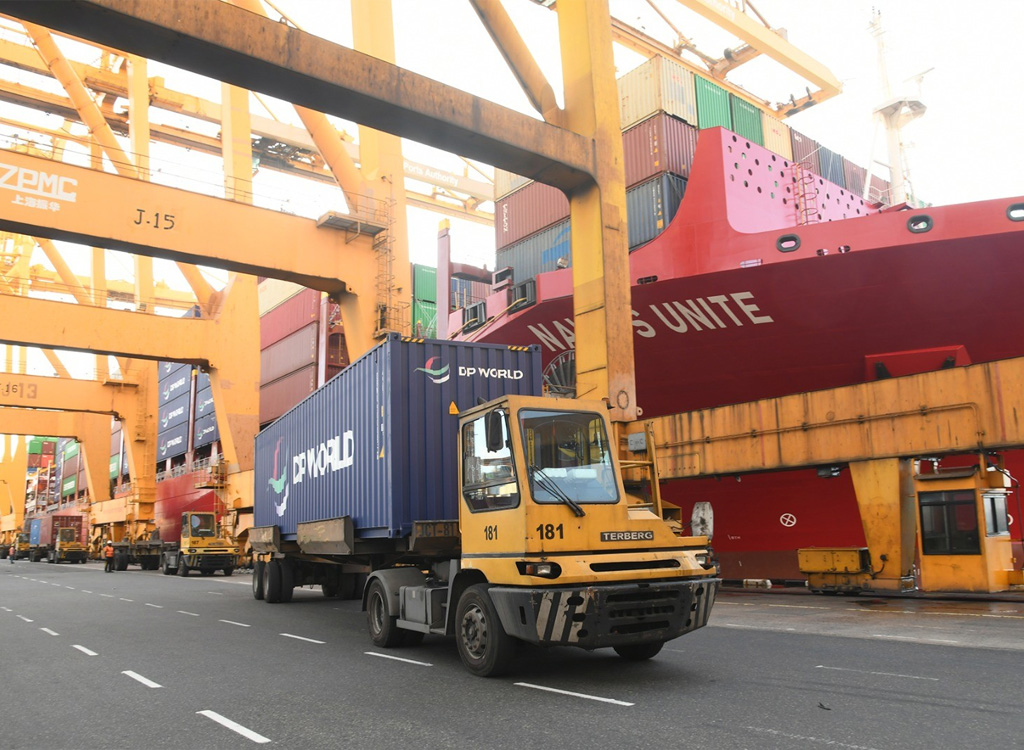
Container congestion at the Port of Colombo remains unresolved despite a high-level meeting involving senior port, customs and government officials, with more than 13,000 import containers awaiting clearance across all terminals, industry representatives said.
According to data cited by the Ceylon Association of Shipping Agents, as of December 23 a total of 13,180 twenty-foot equivalent units, or TEUs, of import containers were stacked at five terminals in the port, underscoring what shipping agents described as persistent operational inefficiencies.
The Colombo International Container Terminals accounted for the largest share, with 8,431 TEUs, or nearly 64% of the total.
The Jaya Container Terminal held 1,880 TEUs, followed by South Asia Gateway Terminals with 1,480 TEUs, Colombo West International Terminal with 780 TEUs and the East Container Terminal with 609 TEUs.
Officials said about 5,430 of the containers at CICT were imports, and nearly two-thirds of those had already been cleared or were exempted from customs scanning.
Despite being eligible to leave the port, the containers are required to exit through the North Container Terminal gate, a process that industry groups say is creating avoidable congestion.
On a typical weekday, about 2,000 import containers exit through the NCT gate, with roughly 80% originating from CICT, CWIT and SAGT.
Of those, an estimated 1,040 containers are already cleared by customs but must still travel nearly 12 kilometers on a round trip within the port to reach the exit gate.
Shipping agents and port operators say the unnecessary inter-terminal movement has clogged internal port roads, disrupted trucking operations and delayed cargo evacuation and yard clearance, worsening congestion even when clearance levels are high.
Industry stakeholders have urged authorities to take immediate steps to ease the bottlenecks.
One proposal calls for the Sri Lanka Ports Authority to fast-track completion of the elevated road access ramp near SAGT, which would allow containers to exit directly and cut pressure on the NCT gate by nearly half.
That could reduce daily gate-out volumes from about 2,000 containers to fewer than 1,000, they said.
Another recommendation calls on Sri Lanka Customs to install container scanning machines near the elevated road access, allowing scan-released containers to leave the port without being routed through the NCT gate.
Transport and logistics associations have been asked to press authorities for urgent action, warning that continued delays could undermine the Port of Colombo’s competitiveness as rival regional ports improve turnaround times.
Analysts said the congestion is not caused by slow customs clearance but by coordination failures and infrastructure bottlenecks that could be resolved quickly with targeted decisions.
In the meantime, customs officials said the Bloemendhal yard has been readied, in coordination with the Sri Lanka Ports Authority, to receive containers as part of ongoing efforts to ease the congestion.













Leave a comment