
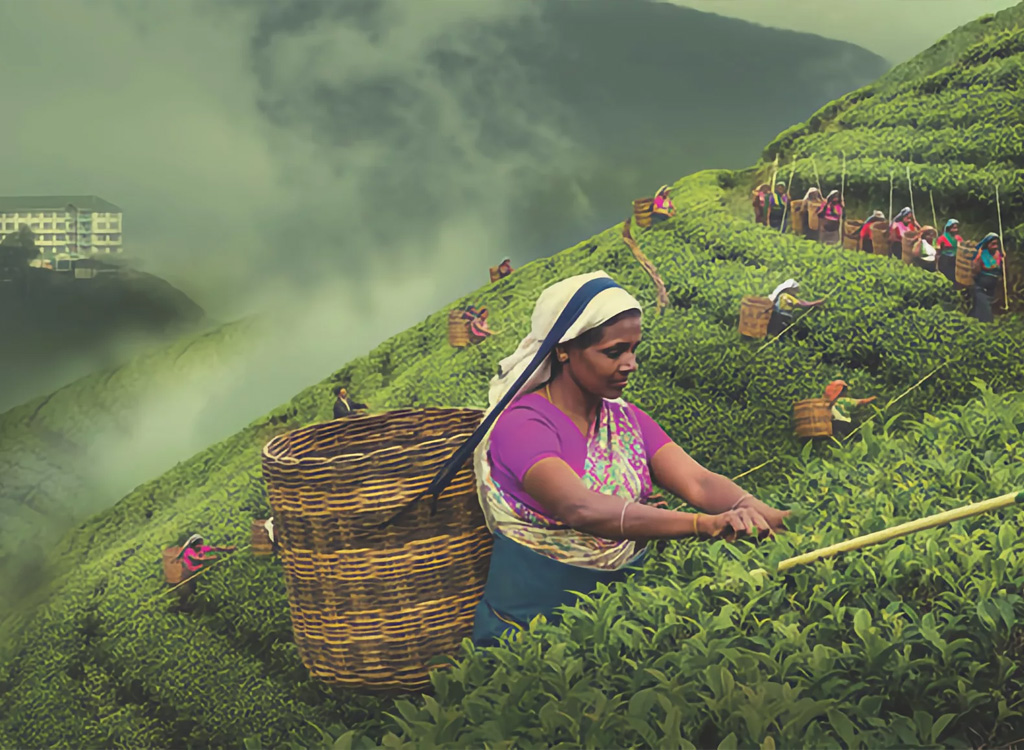
Sri Lanka’s tea industry saw an 8.1% drop in production in the third quarter of 2025, the Department of Census and Statistics reported, citing rising input costs, labour shortages, and long-standing challenges in recultivating plantations.
The ‘Growing of tea’ sector recorded negative growth from July to September, a stark contrast to the 16.9% expansion reported during the same period last year.
“This slump is primarily due to supply-side issues including continuous increases in fertilizer prices, poor plantation maintenance, and persistent labour shortages,” the Department of Census and Statistics’ Gross Domestic Product by Production report for Q3 of 2025 revealed.
The decline affected all categories of tea production, with ‘Made tea’, the largest segment accounting for 62.4% of market share, falling by 7.5%. Prices at the Colombo tea auction also slid by 3.6%, from Rs. 1,207.94 to Rs. 1,164.21 per kilogram.
Despite the contraction, Sri Lanka’s tea exports surged 13.1% during the quarter, climbing from 63.2 million kilos to 71.5 million kilos.
Strong international demand, particularly from Iraq and Turkey, drove export growth, with volumes rising 20% and 54%, respectively, to these countries.
Year-to-date figures from January to October 2025 show cumulative production reaching 220.97 million kilos, a modest increase from 218.15 million kilos during the same period in 2024, according to the Tea Exporters Association.
Sri Lanka exported 245.7 million kilos of tea in 2024, generating approximately $1.4 billion in revenue, marginally higher than the 241.9 million kilos exported in 2023.
Last year also marked an all-time high in export earnings of Rs. 437 billion ($1.435 billion).
The report highlights the paradox of falling production alongside rising exports, suggesting that international demand remains strong even as domestic supply faces structural challenges.
Analysts warn that unless the sector addresses input cost inflation, labour shortages, and plantation recultivation, future growth could be constrained despite high global demand.













Leave a comment