
By Kusal Perera
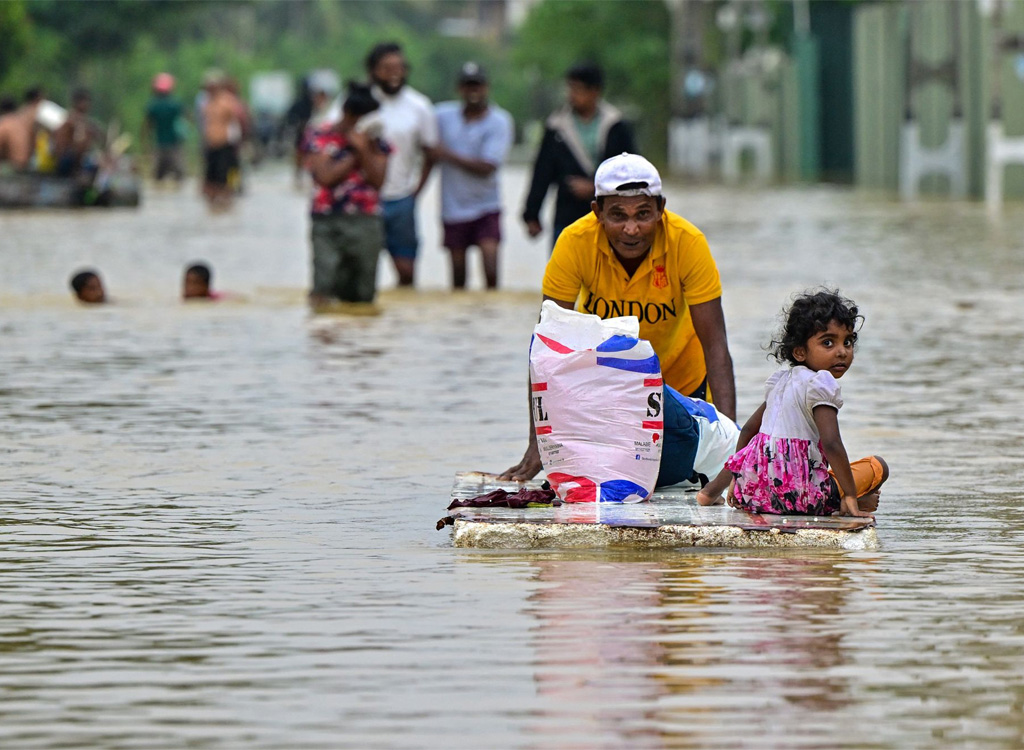
“Women and Child Affairs Minister Saroja Savithri Paulraj yesterday said 275,000 children have been displaced by the landslides and floods unleashed by cyclone Ditwah, many of them separated from their parents or still waiting for news from them, or about them, and their relatives.” – Sunday Observer (SO) /07 December, 2025
This is no different to the guess work of Opposition MP Kabir Hashim, who told parliament a few days before, “about a thousand that may have died in Gampola”, due to the sudden opening of the Kotmale sluice gates.
Getting into more explanations, Minister Paulraj tells SO, “We need accurate numbers — how many are schoolchildren, how many are under-five or under-ten, and how many of them are girls and how many are boys”. What then did she total up to 275,000 affected children? She had also told SO, officials would be able to confirm the full breakdown “only by tomorrow, Monday” 08th December. That would not be, for sure. “Officials” in State departments right down to the “Grama Seva” officers are themselves “affected people” in most places and are baffled by the extent of the damage that had left the whole society virtually in rubbles. Information sharing even at community level has been disrupted in some areas, not only preventing cross-checking but even collecting information.
Bland statements made by Minister Paulraj to the SO, needed further probing. Especially on child protection in “safety centres”. She is quoted as having said, “We have deployed Child Protection Officers (CPO) to safety centres, where displaced children and their families are staying, to ensure their protection.” It is common sense, “safety centres” sheltering displaced families and individuals including children, should have a male and a female CPO, for safety of both girls and boys. In most upcountry centres, to relate to and console little children, they have to be spoken to, in their mother tongue. That demands bi-lingual CPOs too.
I do say, we cannot expect a “perfect safety and protection network” right now, in the middle of a still unfolding tragedy. Yet, with her very “confident” sounding and firm response on which she wants the world to accept everything is under perfect control of the government, I would have asked her, “Do you have enough CPOs to man 950 plus “safety centres” the Disaster Management Centre (DMC) says they are presently managing across the country? How many qualified and competent women CPOs do you have? How many of them are bi-lingual? Fortunately for the Minister, our media personnel are not that professional in their job.
Ditwah tragedy is still unfolding. Numbers of the “affected” still keep increasing. What was apparent during the past week was that, reduction of the number of “missing persons” if any, kept being added to numbers of the “dead”. Thus the number of children the Minister said is waiting with bated breath for the return of their parents, would also increase. The issue of orphaned children is a very sensitive major issue the society and the governing authorities are left to take care of after any tragedy in any part of the world. It was a major issue in post-Korean war, in post Vietnamese war, in Kampuchea after Pol Pot’s savage insurgency, right now in Gaza and in our own land, after the civil war was concluded in May 2009.
In our North-East, it was not just orphaned children, but “war widows” with children who needed special protection and financial support to keep their lives ticking. On 29 September 2010, then Deputy Minister of Child Development and Women’s Affairs, M.A.M Hizbullah told media at a media briefing held at the Information Department Colombo, the war had produced 89,000 widows in N-E. Of them 49,000 were from the East and the balance 40,000 from Vanni and North. In Batticoloa district, the Deputy Minister said, there are 8,000 widows with 03 children each. Before the Norwegian facilitated ceasefire agreement in 2002 February, a UNICEF Report, on “A Special Program for Assistance for Children and Women Affected by Armed Conflict in Sri Lanka 2000-2001” reported 900,000 war affected children in North-East.
Most unfortunately, while numbers are not clearly reported, most reports including UNICEF indicate wholly inadequate provisions and care for war affected children in the North-East. Most children in rehabilitation camps were reported as having been physically and sexually abused by personnel in rehabilitation camps. War widows with children below 05 years were also left as marginalised and vulnerable within State welfare schemes focused on the poor and often coordinated via military supervision. State functions, no doubt often shaped by the majority Sinhala-Buddhist mentality, played a part in North-East relief work.
This context of providing childcare to Cyclone Ditwah affected children, especially in Sinhala South would not be damned by ideological supremacy and would certainly be different and also more challenging. Yet the quality and regularity of childcare available at present is definitely poor and far below par to match the challenge at hand. We have not been paying any serious attention in developing qualified and competent “Psychosocial Counsellors” anytime before, despite an alarming increase in demand during the past decade or two, among urban and semi-rural middleclass school children. A very serious survey report by the “National Institute of Social Development” (NISD) in 2013 for the Department of Probation and Child Care Services, that was sponsored by UNICEF, says, there were 14,179 children in 414 “Child Care Institutions” (CCI) located in all nine provinces in Sri Lanka with 2,979 “Counsellors”. Most CCIs are run by NGOs and private personnel, “registered under the Department of Probation and Child Care Services”. The report observes, “lack of staff with counselling skills was reported as a problem by about 60 per cent of the Probation Commissioners”. The report gives reasons for such incompetent staff recruitment as “low salary scales”. It says, “low salary scales fail to attract well trained personnel to work in such institutions. This has reportedly resulted in the recruitment of untrained personnel.” (page 08)
All this is about CCIs that cater to child victims in “underage and unregistered marriages, insecurity due to conflict, displacement, homelessness, street children, family disputes and broken families” in an under developed, crisis ridden society. That whole inefficient institutional setup would remain frozen outside the tragedy, Cyclone Ditwah would leave with a heavy load of orphaned children of a different category.
Children who were left orphaned overnight. Some were brought out from under rubble, or saved from sweeping floods. Without parents, some without even a single sibling, without neighbours and even without a school and school friends. They need professional psychosocial counselling. They need an atmosphere of affection and safe caring. They need schooling and also some recreation. Providing such an amiable ambience for orphaned children will not be possible for relatives and neighbours who themselves may be victims of Cyclone Ditwah, or affected from it.
Organising and funding a decently safe and affectionate Child Care Programme (CCP) thus becomes the total and immediate responsibility of the government. A programme that would have “skilled Counsellors” who understand the plight of the orphaned child. A programme that would carefully decide the guardianship of the child, the child would feel at ease. A programme with an efficient and regular monitoring system that would also allow the affected child to confess his or her issues confidentially. A programme that would provide qualified and competent Counsellors to schools and all teachers, given a serious collective consultation on post “Cyclone Ditwah” issues, they would have to deal with in school.
This childcare programme for orphaned children I believe, is what Women and Child Affairs Minister Paulraj should immediately publish for public scrutiny, while organising a rapid training programme in all provinces on Psychosocial Counselling, with medical doctors given preference on a salary scale that would count their experience as well, and good enough for any professional in the private sector too. While Cyclone Ditwah demands serious planning for infrastructure development at high cost, developing a healthy new generation is no exception for Sri Lanka to move out of this tragedy.







Leave a comment