
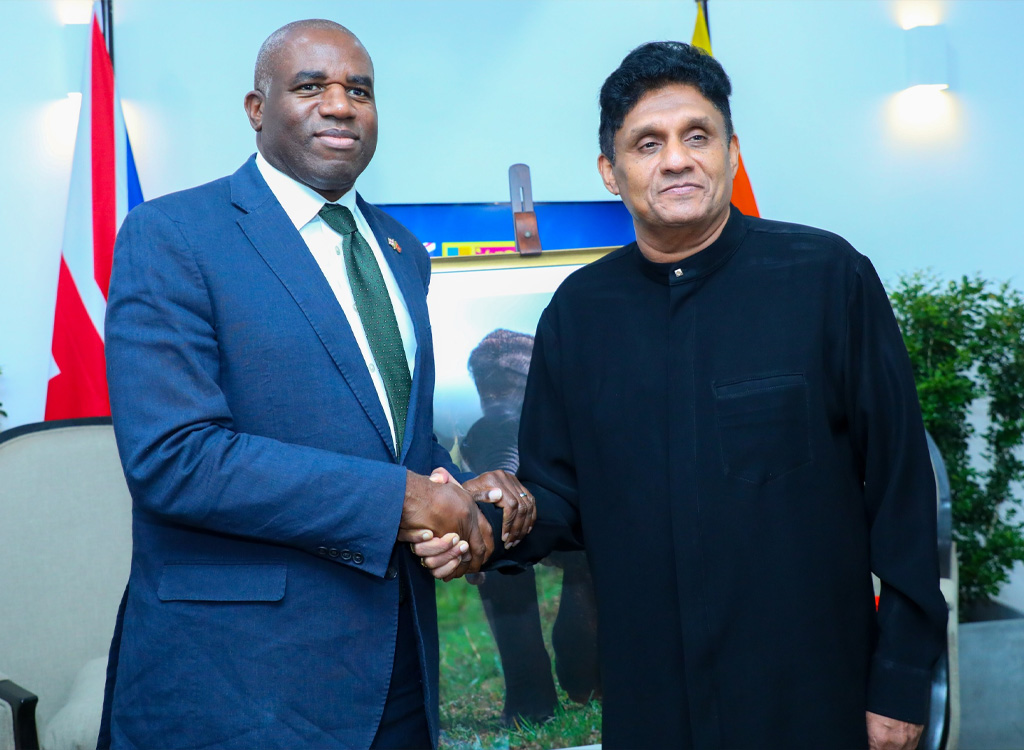
Leader of the Opposition, Sajith Premadasa, met with the Deputy Prime Minister of the United Kingdom, David Lammy at the Office of the Leader of the Opposition in Colombo for wide-ranging discussions on democratic governance, trade expansion, and bilateral humanitarian cooperation.
Premadasa acknowledged reformulation of the Official Development Assistance (ODA), particularly in the areas of governance, the rule of law, climate justice, human rights, and poverty alleviation. He emphasised the importance of “progressive realism” in governance balancing principled democratic values with practical, people-centred economic solutions.
The Opposition Leader welcomed the United Kingdom’s leadership as the President of the Group of States against Corruption (GRECO) and its global Anti-Kleptocracy Campaign. He highlighted the critical need for transparent institutions, noting that strengthening accountability mechanisms is central to rebuilding public trust and ensuring sustainable economic recovery in Sri Lanka.
A key focus of the meeting was the robust trajectory of Sri Lanka–UK trade. Premadasa highlighted that the UK remains Sri Lanka’s second-largest export destination. As of early 2026, the trade partnership has seen significant upswings:
* Trade Volume: Total trade in goods and services reached approximately £1.7 billion for the four quarters ending Q3 2025, reflecting a year-on-year increase of 10.2%.
* Export Dominance: Sri Lankan exports to the UK are valued at £1.2 billion, with the apparel sector contributing 73% of these earnings.
* Future Growth: The leaders discussed strategic growth initiatives, such as the Sri Lanka Expo 2026, which focuses on diversifying exports beyond traditional garments into rubber, ethical fashion, and premium niche goods.
Premadasa also welcomed the transformative phase of the UK’s Developing Countries Trading Scheme (DCTS), which implemented liberalised Rules of Origin effective 1 January 2026. He noted the specific benefits for Sri Lankan industries:
* Tariff-Free Access: Over 92% of Sri Lankan product lines now qualify for duty-free access to the UK market.
* Global Sourcing: Apparel manufacturers can now source 100% of their raw materials (fabrics and yarn) from anywhere in the world while still enjoying zero-tariff entry.
* Simplified Compliance: The removal of the “double transformation” rule has significantly lowered costs for MSMEs and startups by streamlining manufacturing requirements.
* Regional Cumulation: Manufacturers can now utilize inputs from the Asia Regional Cumulation Group (18 countries) while maintaining “originating” status.
On legislative matters, the discussion turned to the proposed Protection of the State from Terrorism Act (PSTA) and the Online Safety Act. Premadasa cautioned against “draconian” applications of the law, specifically warning against broad definitions of terrorism that could criminalize political dissent and trade union activities. He reiterated that the judiciary, not the executive, must drive legal interpretations. Regarding online safety, while acknowledging the need to protect children, he stressed that regulations must align with UK standards and international norms without infringing on civil liberties.
Premadasa conveyed sincere appreciation for the UK’s “Sovereign Solidarity” following the devastation caused by Cyclone Ditwah in late 2025. He thanked the UK government for increasing its humanitarian aid package to £1 million (approx. $1.32 million) in December 2025. This funding, channelled through the Red Cross, UNOPS, and local partners, has provided:
* Emergency shelter and repairs for damaged homes;
* Clean water and sanitation facilities to prevent disease; and
* Essential medicines and food supplies for the 1.8 million people affected.
He also expressed gratitude for the personal message of condolence sent by King Charles III, which reinforced the deep historical ties between the two nations.
Deputy Prime Minister Lammy was accompanied by Andrew Patrick, High Commissioner; Sukhvinder Sodhi, Private Secretary; David Meyer, Head of the Deputy Prime Minister’s International Unit; Fiona Meagher, Special Advisor; and Tom Soper, First Secretary (Political).
Concluding the engagement, Premadasa congratulated Deputy Prime Minister Lammy on his intellectual contributions, praising his books Out of the Ashes: Britain After the Riots (2011) and Tribes: How Our Need to Belong Can Make or Break Society (2020), noting that their exploration of social cohesion and identity holds vital lessons for reconciliation.
In conclusion, Premadasa also proposed enhanced cooperation in protecting Sri Lanka’s wild elephant population and addressing the growing human–elephant conflict. He emphasised the need for sustainable conservation strategies, scientific land-use planning, community protection measures, and international technical support to safeguard biodiversity while ensuring the safety and livelihoods of rural communities affected by human–elephant interactions.









Leave a comment