
By The Pulseline News Desk
The arrest and remand of a young Tamil musician under the controversial Prevention of Terrorism Act (PTA) has reignited debate over the balance between national security concerns and freedom of expression, while also prompting questions about the consistency with which anti-terrorism laws are enforced.
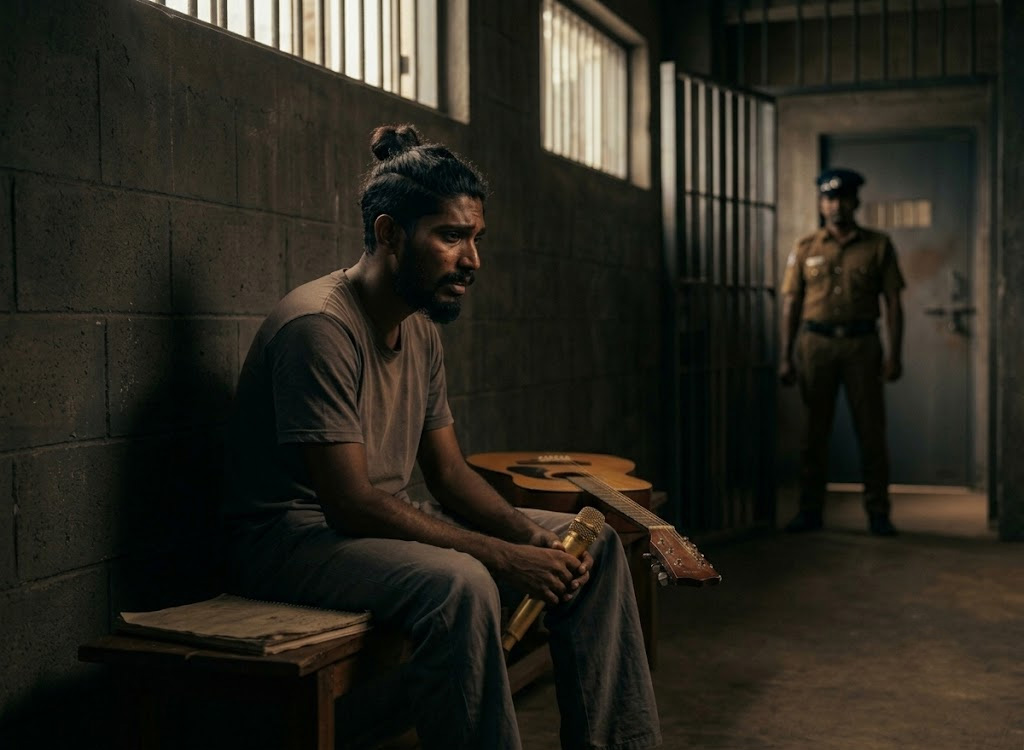
Twenty-four-year-old Ganesh Kumar Sangeethan, a resident of Udayanagar West in Kilinochchi, was remanded until June 17 by the Chavakachcheri Magistrate’s Court after police had alleged that a song he had shared on social media amounted to an attempt to revive the Liberation Tigers of Tamil Eelam (LTTE), the separatist organisation that was militarily defeated in 2009.
The case centres on a musical performance recorded during a temple chariot festival at a Hindu temple in Navatkuli. According to police, the song, which was later circulated on social media with revolutionary-themed lyrics, contained references that could be interpreted as promoting the concept of Tamil Eelam. Authorities had subsequently arrested the musician under provisions of the PTA.
Mounting criticism
The arrest has drawn criticism from legal representatives and rights advocates who argue that the allegations extend beyond the actual content of the song.
Appearing on behalf of Sangeethan, attorney Kesavan Sayandan has challenged the basis of the police accusations, arguing that neither the LTTE nor its leaders, symbols, or banned organisations were mentioned in the lyrics. According to the lawyer, the song did not glorify the LTTE, display its insignia, or refer to its former leader Velupillai Prabhakaran.
Sayandan had further questioned how the use of the term “Tamil Eelam” alone could be interpreted as an attempt to revive the banned organisation. He has pointed out that political entities containing similar terminology have existed within Sri Lanka’s democratic framework, including parties that have been legally registered and contested elections.
The controversy has since expanded beyond the courtroom and entered the political arena.
Namal weighs in
Sri Lanka Podujana Peramuna (SLPP) National Organiser and Parliamentarian Namal Rajapaksa has raised concerns over what he described as the “selective use” of the PTA, questioning whether authorities are applying the law equally across the political spectrum.
In a public statement, Rajapaksa has argued that artistic and musical expression was now being treated as a terrorism-related offence while, according to him, similar content had allegedly been used during the recent Local Government election campaign without attracting legal scrutiny.
He has claimed that certain politicians affiliated with the ruling National People’s Power (NPP) had shared LTTE-themed songs on social media during the campaign period and alleged that a Jaffna District NPP parliamentarian had publicly circulated such material online. Rajapaksa has questioned why law enforcement authorities had not acted in those instances, asking, “Where was the Police then? Where was the PTA then?”
His remarks have added a new dimension to the debate, shifting attention from the legality of the artist’s actions to broader questions about equal enforcement, political neutrality, and public confidence in the application of security laws.
Spotlight on PTA
The case has once again brought the PTA into the spotlight. The legislation, one of Sri Lanka’s most debated security laws, has long faced criticism from human rights organisations, civil society groups, and international observers who argue that its provisions can be interpreted too broadly and may be vulnerable to misuse. Governments, however, have consistently maintained that the law remains necessary to address threats to national security and prevent the resurgence of terrorism.
For many observers, the controversy reflects the continuing sensitivities surrounding the legacy of Sri Lanka’s three-decade civil conflict. More than 15 years after the end of the war, issues relating to memory, identity, political expression, and security continue to generate intense debate, particularly in the Northern and Eastern provinces.
The arrest has also raised broader questions about how artistic and cultural expression should be treated in a society still navigating the challenges of post-war reconciliation. While authorities remain vigilant against any activity perceived as promoting separatism or extremist ideologies, critics argue that distinguishing between political expression, artistic creativity, and genuine security threats remains a complex and delicate task.
As the case proceeds through the courts, it is likely to attract continued legal, political, and public scrutiny. The outcome may not only determine the future of the young musician but could also shape the wider debate on freedom of expression, the scope of anti-terrorism legislation, and whether such laws are being applied consistently regardless of political affiliation or circumstance.







Leave a comment