
By Kushan Kanishka Kumarasinghe
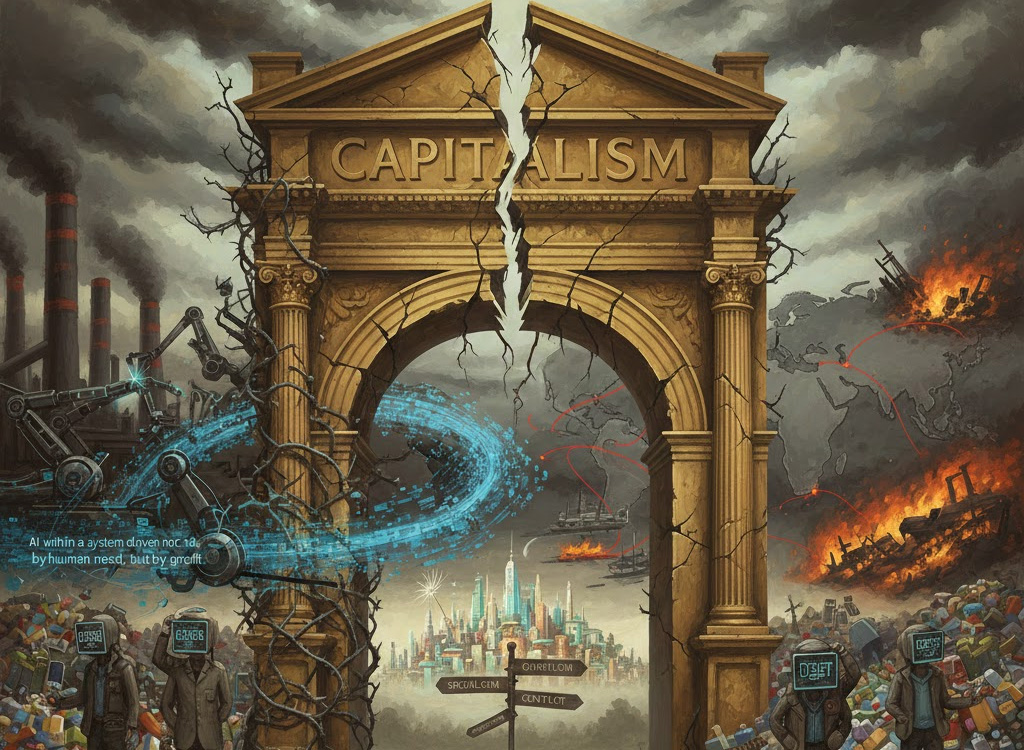
The contemporary world stands at the intersection of two historic crises. The first arises from the internal contradictions of capital accumulation. The second emerges from the rapid expansion of artificial intelligence (AI) within a system driven not by human need, but by profit.
Together, these forces are reshaping the global order — and intensifying its instability.
The crisis of accumulation
Following the Second World War, global capitalism entered a period of unprecedented expansion. The US emerged as the dominant imperial power, the Bretton Woods institutions were established, and reconstruction in Europe and Japan created vast new markets. For several decades, the system appeared resilient.
Yet, Karl Marx had long warned that the very engine of capitalist growth contains its own destructive tendency. The accumulation of capital depends upon extracting surplus value from labour. As capital intensifies production through technological advancement, it simultaneously reduces the relative role of labour — the only source of surplus value. Marx described this contradiction as the tendency for capital to undermine its own foundation.
In Capital, Volume III, he famously explained: “The real barrier of capitalist production is capital itself.”
As productivity rises, fewer workers are required to produce more goods. If real wages stagnate or decline — as they have across much of the world in recent decades — the purchasing power of the masses contracts. The result is overproduction: goods flood the market, but, the very workers who produced them cannot afford to buy them.
Friedrich Engels illustrated this recurring pattern in Socialism: Utopian and Scientific: “The expansive force of the means of production bursts the bonds that the capitalist mode of production had imposed upon them.”
The post-War order managed to temporarily stabilise this contradiction. The US absorbed global surpluses, running trade deficits while financing consumption through debt expansion. Profits accumulated in export-driven economies such as China were reinvested into US financial markets, and the cycle continued. But, such arrangements merely postponed the crisis; they did not resolve it.
Vladimir Ilyich Ulyanov Lenin, analysing imperialism in 1916 in Imperialism: The Highest Stage of Capitalism, described how capitalism survives by expanding into new territories: “Imperialism is capitalism at that stage of development at which the dominance of monopolies and finance capital is established.”
The shift of manufacturing from the US to China, and more recently toward India and other regions, reflects this search for new arenas of exploitation. Yet, in a world increasingly saturated by capital and dominated by global monopolies, expansion becomes more difficult. The geographical frontiers available to absorb surplus capital are narrowing.
AI and the deepening contradiction
The second crisis confronting the world is the rapid development of AI.
AI represents a monumental leap in the productive capacity. It has the potential to reduce repetitive labour, enhance creativity, and transform scientific research, medicine, education and culture. In a socialist social system, such technological advancement could liberate humanity from exhausting and monotonous work.
Marx foresaw this possibility in the Grundrisse: “The development of fixed capital indicates to what degree general social knowledge has become a direct force of production.”
Knowledge itself — what Marx called the “general intellect” — becomes central to production. In theory, this could shorten the working day and expand human freedom.
But, within capitalism, technology is not introduced to reduce human toil for its own sake. It is introduced to reduce labour costs and increase the surplus value. As Marx observed in Capital, Volume I: “Like every other increase in the productiveness of labour, machinery is intended to cheapen commodities, and, by shortening that portion of the working-day, in which the labourer works for himself, to lengthen the other portion that he gives, without an equivalent, to the capitalist.”
Thus, AI under capitalism intensifies unemployment, job precarity, and work intensification for those retained. Workers are displaced, while those who remain face greater productivity demands. The contradiction deepens: as employment declines and wages stagnate, the purchasing power that sustains markets erodes further.
Leon/Lev Davidovich Trotsky, writing during the Great Depression, in The Death Agony of Capitalism and the Tasks of the Fourth International, warned of precisely this historical moment: “Conjunctural crises under the conditions of the social crisis of the whole capitalist system inflict ever heavier deprivations and sufferings upon the masses. Growing unemployment, in its turn, deepens the financial crisis of the state and undermines the unstable monetary systems. Democratic regimes, as well as fascist, stagger on from one bankruptcy to another.”
While technology advances, its benefits are distorted by the social relations governing it. The problem is not technological progress — it is the social system within which that progress unfolds.
War and systemic breakdown
History shows that when capitalism reaches a profound crisis, it often resolves its contradictions violently. The First and Second World Wars were not accidents, but expressions of imperialist rivalry over markets, resources and spheres of influence.
Lenin warned in Imperialism that imperialist competition inevitably produces war: “As long as capitalism remains what it is, surplus capital will be utilised not for the purpose of raising the standard of living of the masses in a given country, for this would mean a decline in profits for the capitalists, but for the purpose of increasing profits by exporting capital abroad to the backward countries.”
When peaceful expansion becomes impossible, conflict follows.
Today, geopolitical tensions, trade wars, militarisation and economic fragmentation indicate that global capitalism is entering another dangerous phase. The combination of stagnation, technological disruption, and inter-imperialist rivalry creates conditions of profound instability.
A system at its limits
The fundamental contradiction remains what it was in Marx’s time: production is social, but appropriation is private. Millions collectively produce the wealth of society, yet, a narrow elite controls and accumulates it.
AI could free humanity from drudgery, open vast fields of artistic and scientific creativity, and shorten the working day. It could allow millions to write, compose, design and invent, expanding culture beyond historical limits. But, within capitalism, it becomes another instrument of profit maximisation and labour displacement.
Trotsky insisted in The Transitional Programme that resolving such crises requires conscious political leadership: “The historical crisis of mankind is reduced to the crisis of the revolutionary leadership.”
Whether one agrees fully with this revolutionary conclusion or not, the questions posed by the current crisis are unavoidable. Can a system based on endless accumulation survive in a finite world? Can AI coexist with a social order dependent on wage labour for mass consumption? And if not, what alternative social arrangement can harness technology for collective human advancement?
These are not theoretical debates confined to academic circles. They are urgent political questions that will shape the future of humanity.
The world is again approaching a decisive turning point.
(The writer is a law student)
Source: The Daily Morning
Disclaimer: The views and opinions expressed in this column are those of the author, and do not necessarily reflect those of this publication.











Leave a comment