
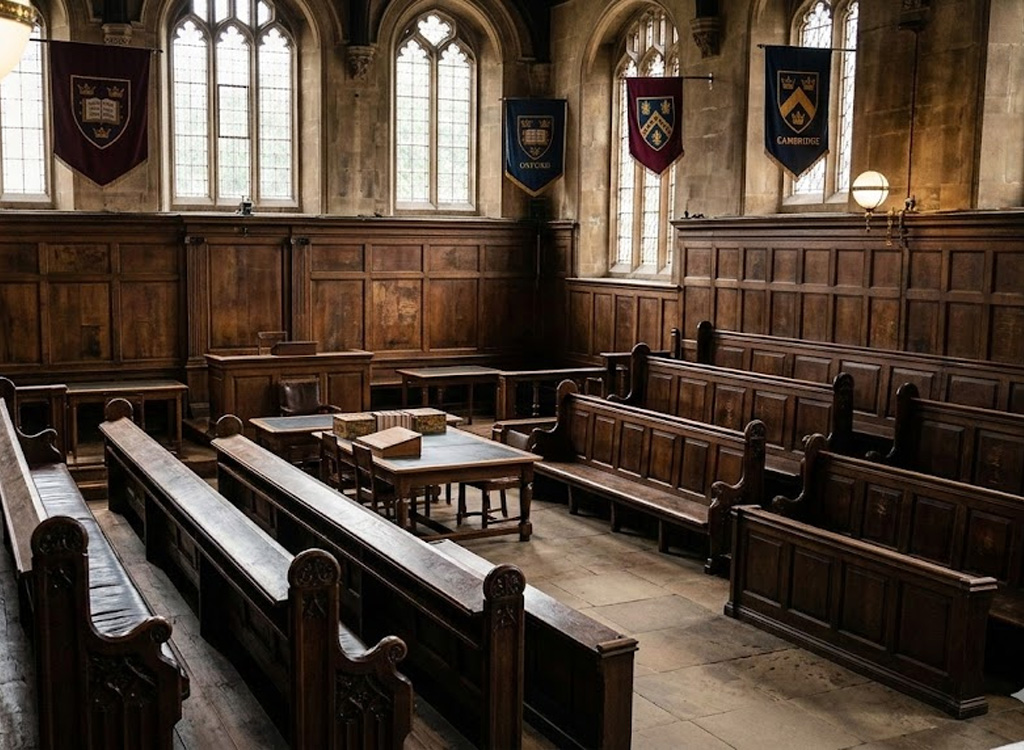
The curious case of Namal Rajapaksa and the Cambridge Union
By Kusum Wijetilleke
Cancel culture is so passé, very 2010, but the de-platforming of Namal Rajapaksa by the student unions of the UK’s two premier universities: Oxford and Cambridge, demonstrates that even in putative bastions of liberalism, it is still power, hierarchy, and pressure that prevail over principle and process.
Oxford Union President Katherine Yang was quoted in the student newspaper, Cherwell, as stating that a “significant number of the students most closely connected to the subject matter” did not feel safe engaging openly, and that an event in which “key stakeholders cannot engage on equal footing” would not produce the kind of debate the Union seeks to facilitate.
Newswire further reported that diaspora advocacy group Tamil Solidarity had called on both Unions to cancel Rajapaksa’s scheduled appearances, arguing that providing him a platform amounted to political rehabilitation, and warning of protests should the events proceed.
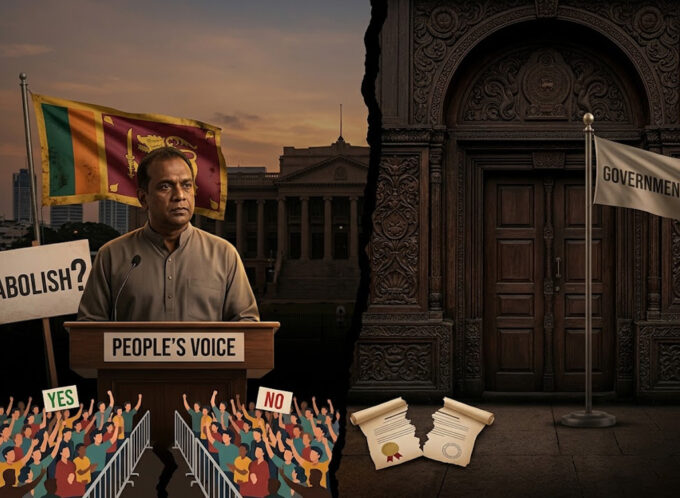
This is perhaps the most instructive point: the overt threat of protest appears to have been decisive. If the mere prospect of disruption is sufficient to rescind invitations, many future events will be vulnerable to similar pressure.
There is, of course, no absolute obligation to provide any individual with a platform as prestigious as a debate or discussion forum at a major British university. Nonetheless, once an invitation is issued, its rescission requires a far stronger justification than has been offered here. This is not merely a question of courtesy, but of process. Formalities have been breached in a manner that sits uneasily with the traditions of the Union, the universities with which it is associated, and the status of the invitee. Whatever one’s personal views of Namal Rajapaksa, he is a Member of the Parliament of Sri Lanka, a fact that is not dispositive, but it is relevant. Liberal institutions are supposed to distinguish between personal distaste and procedural principle.
International standing
The subdued response to this episode cannot be understood in isolation. It reflects an increasingly explicit hierarchy within the international system, a tier system of countries, based on economic and military might but also on their shared alliances. Now, political actors are differentiated not only by their conduct, but by the international standing of the states they represent. What was once tacit has become overt: some states and by extension its citizens, are treated as possessing full agency and legitimacy, others as conditionally legitimate, and many more as marginally so. This ordeal suggests that Sri Lanka exists in a tier nearer the bottom of this emerging hierarchy of States.
The hierarchy extends beyond diplomacy and trade, into the informal norms governing speech, respectability, and institutional risk within elite settings. The exclusion of a controversial figure representing some Western states would immediately trigger debates about academic freedom, precedent, and reputational cost. When the same decision concerns a politician from a peripheral state, those questions scarcely arise. The distinction at work is not one of principle or procedure, but of status.
This pattern of selective exclusion is visible elsewhere. The United Kingdom government has taken severe measures against the pro-Palestinian activist group Palestine Action, including proscription and arrests for wearing clothing bearing its name. Yet on Sri Lanka’s Independence Day, members of the Tamil diaspora were permitted to march through central London, flying the flag of another proscribed terrorist organisation, the LTTE, without comparable intervention. The discrepancy is difficult to explain by law alone and is better understood as a function of political convenience and relative salience.
Seen in this light, the rescinding of Namal Rajapaksa’s invitation is not merely a parochial student-politics controversy. It is a small but revealing illustration of how global hierarchies of legitimacy now operate openly, determining whose exclusion is treated as a matter of grave principle, and whose is barely noticed.
Universities and debating societies necessarily exercise judgment in deciding whom to invite. Platforming is a curated act, not an entitlement, precisely why process matters.
Once an institution such as the Cambridge Union issues an invitation, a presumption is created that the decision was deliberated and justified. To rescind that invitation absent new evidence of wrongdoing or credible security concerns indicates capitulation to pressure, something effectively acknowledged in Yang’s remarks.
Managing optics
In the contemporary environment, free speech is less threatened by the state than by asymmetries of influence. Well-organised pressure groups, reputational campaigns, and online mobilisation increasingly function as informal vetoes. When institutions yield selectively to such pressure, they replace judgment with power-sensitivity.
That is not neutrality. It is discrimination by influence. The problem in the Namal Rajapaksa case is not that objections were raised; objection is intrinsic to democratic culture, but that only some objections counted. A speaker’s lack of a powerful transnational lobby does not render his invitation illegitimate; it merely exposes whose voices carry weight in elite spaces. It also raises questions about the original decision to invite Rajapaksa: was resistance anticipated, and if so, why did the rationale collapse in the face of pressure?
This is how platforming norms erode: not through principle, but through precedent. When invitations become reversible based on who can mobilise the loudest backlash, institutions cease to stand for inquiry and begin to be about managing optics.
Free speech does not require infinite tolerance, but intellectual integrity requires procedural fairness. If a speaker clears the threshold to be invited, the response to disagreement should be interrogation, not cancellation. Otherwise, “free debate” becomes a function of lobbying strength, contrary to the most basic liberal principles.
The cancellation of Namal Rajapaksa at the Cambridge Union represents a further erosion of these principles, largely ignored because it is Namal Rajapaksa. Liberalism does not operate on personal taste. Once invited, he should have been allowed to take the stage and face questioning. That is how discourse functions: ideas are tested through interrogation, not suppressed through cancellation.
The Cambridge Union Society and the Oxford Union have long justified hosting controversial figures on the principle that debate does not imply endorsement, and that engagement with contested power is central to free inquiry. On this basis, both Unions have hosted figures whose records have provoked sustained protest, including Henry Kissinger and Benjamin Netanyahu. In each case, controversy did not displace the principle of engagement.
Applying standards
The point is not to equate individuals or their status, but to ask whether a consistent standard is being applied. If association with controversial state power is sufficient to rescind invitations, the Union’s own logic collapses. Applied rigorously, such a standard would leave little room for debate at all.
The selective outrage of Colombo’s liberal class reflects a broader tendency to equate discomfort with harm and denial of platforms with moral progress. What is being punished here is not speech, but symbolism. Namal Rajapaksa is excluded not for what he has said, which is largely banal and managerial, but for who his family is and the era they represent. Guilt by lineage is the antithesis of liberalism, which rests on individual responsibility.
It is telling that institutions willing to host figures like Charlie Kirk, whose brand is provocation and polarisation, suddenly discover heightened sensitivity when confronted with a non-Western political surname. In this moral economy, who is permitted to speak? Those aligned with Western power, those fluent in elite cultural norms, or those whose violence is framed as tragic necessity rather than oppression?
This is an era of curated legitimacy, in which access, respectability, and credibility are increasingly mediated by advocacy networks and special-interest lobbies. For countries like Sri Lanka, this matters far beyond the case of one politician or one student-union decision.
Global media narratives around states such as Venezuela and Iran illustrate how governments are routinely framed as pariahs, labelled “regimes,” and subjected to heightened suspicion. Such framing is not merely rhetorical, it shapes institutional behaviour: the tone of UN debates, the persistence of investigative mandates, the readiness to presume guilt, and the normalisation of exceptional scrutiny.
Sri Lanka risks drifting into a similar position. Successive governments have failed tests of reconciliation, justice, and accountability. Domestic investigations have stalled while international narratives have hardened. As a result, terms such as “genocide” have become increasingly inseparable from Sri Lanka’s defeat of the LTTE, circulating across activist discourse, popular culture, and elite commentary. Once such framing embeds itself, it reshapes how institutions engage with a country, what assumptions are made, what standards are applied, and how readily extraordinary measures are justified.
This is why narrative matters. When a particular story takes hold, it alters the institutional environment in which a country operates. Mandates expand, scrutiny intensifies, and procedural safeguards quietly weaken. What begins as media framing ends as structured bias within international forums.
No less than legendary Indian author and political dissident Arundathi Roy, recently remarked that before Gaza the “standard” for a genocide was Sri Lanka. This is pervading popular culture and once this narrative sticks, it will be almost impossible to wash off.
(The writer is a political commentator, media presenter, and foreign affairs analyst. He serves as Advisor on Political Economy to the Leader of the Opposition of Sri Lanka, and is a member of the Working Committee of the Samagi Jana Balawegaya (SJB). A former banker, he spent 11 years in the industry in Colombo and Dubai, including nine years in corporate finance, working with some of Sri Lanka’s largest corporates on project finance, trade facilities, and working capital. He holds a Master’s in International Relations from the University of Colombo and a Bachelor’s in Accounting and Finance from the University of Kent (UK). The writer can be contacted via email: [email protected] or Twitter: @kusumw)
Disclaimer: The views and opinions expressed in this article are those of the writer and do not necessarily reflect the official position of this publication.







Leave a comment