
By Nilantha Ilangamuwa
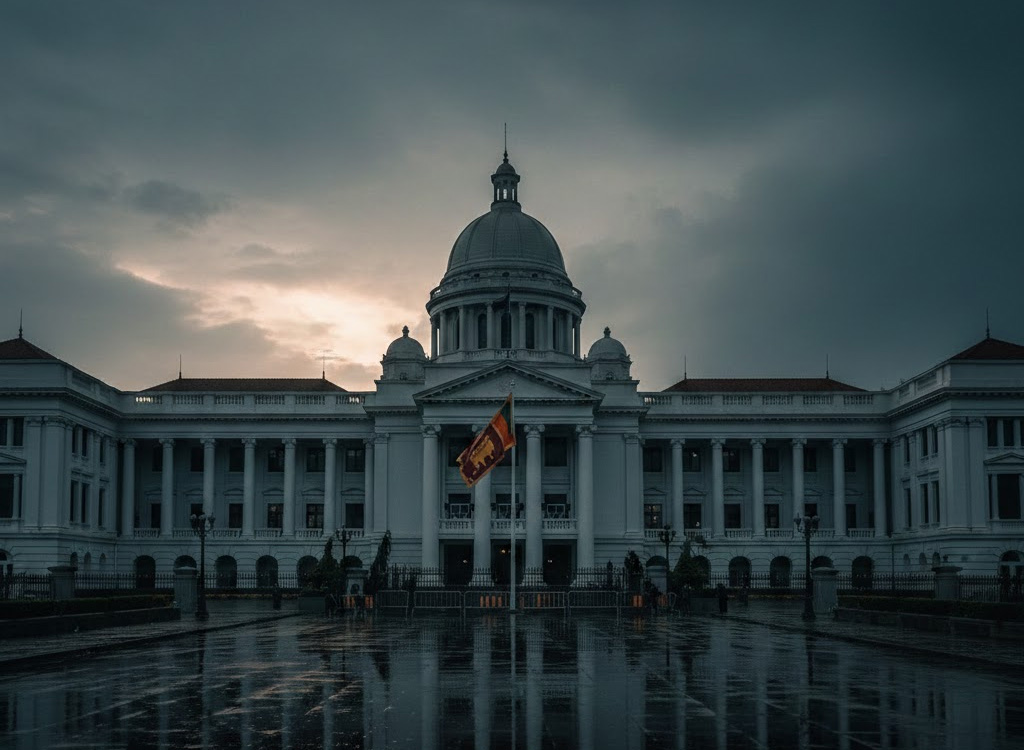
Yet another Independence Day tamasha is looming. Have we confused piety with power? Can institutions that tolerate betrayal ever command respect? Who, in the end, is accountable when moral authority becomes currency for ambition?
What once appeared as internal dissent over discipline, ethics, and authority has hardened into public rejection. Buddhist temples, historically custodians of restraint and moral arbitration, are now widely perceived as sites of patronage, caste consolidation, and commercial enterprise.
This erosion will not remain confined to religious space. When institutions that once moderated power lose legitimacy, power itself becomes unrestrained. In Sri Lanka, this collapse of moral authority is not an isolated religious failure; it is a symptom of deeper institutional exhaustion that cuts across the State.
Recurring historical patterns
Independence in Sri Lanka has long functioned as ceremony rather than reckoning. Flags are raised, anthems rehearsed, and speeches recycle the grammar of liberation, yet governance tells a more disquieting story.
The question is not whether colonial rule formally ended in 1948, but whether freedom – as responsibility, restraint, and institutional autonomy – ever truly began. What emerged was not a republic anchored in civic maturity, but a system that performed sovereignty while hollowing out its substance. Freedom was affirmed rhetorically while practised as managed dependence.
This failure did not begin with the British, nor can it be explained as colonial residue alone. Sri Lanka’s political history reveals a repeated pattern: systems collapse, but institutions are never rebuilt.
The destruction of the Rajarata polity following Kalinga Magha’s invasion in the 13th century did not merely displace a capital; it dismantled a governing ecology – irrigation administration, land tenure, monastic record-keeping, regional accountability. The shift southwards preserved kingship but abandoned institutional coherence. Governance became adaptive rather than reconstructive, a pattern repeated across centuries.
South Indian interventions, particularly under the Cholas, introduced centralised administration and revenue systems, but these were instruments of extraction, not consent. They produced administrative form without political ownership.
Even earlier, Ming China’s intervention under Admiral Zheng He made sovereignty conditional. The trilingual Galle inscription explicitly situates Sri Lanka within an external moral and political hierarchy. Long before European colonialism, the island had learnt to operate within borrowed authority.
By the time the Portuguese arrived, political fragmentation was entrenched. Queyroz’s chronicles of the Kandyan Kingdom reveal incessant court intrigue, transactional loyalty, and factional violence. European powers did not invent division; they professionalised it. The Dutch refined contractual rule, while the British perfected centralisation. Their most enduring legacy was not exploitation alone, but a State that governed efficiently while remaining structurally indifferent to social well-being.
Colonial rule was not only extractive but violent. Massacres were carried out to enforce submission, leaving entire communities erased or terrorised. This does not make their actions justifiable. Yet, as locals, we failed to deliver justice to those sacrificed at the sword of power. Generations suffered, and the mechanisms to acknowledge, compensate, or resist this violence were never built. The memory of these massacres is part of the unfinished reckoning that independence failed to address.
British administrators were not blind to this danger. Leonard Woolf, writing of Hambantota, observed villagers living in constant fear of hunger, constrained by a bureaucracy that regulated life without providing security. Administration functioned as an end in itself, not as a means of justice.
Sir James Emerson Tennent acknowledged that colonial economic policy privileged stability over equity, producing dependency rather than development. British parliamentary debates repeatedly questioned whether Ceylon’s governance produced obedience rather than responsibility. These critiques were documented, archived, and ignored.
The Colebrooke-Cameron reforms exemplified this contradiction. They dismantled indigenous systems of accountability while centralising authority in Colombo. English education produced an elite fluent in administration but detached from local legitimacy.
A theatre of survival
When independence arrived, this architecture remained intact. Power was transferred, not transformed.
As Hannah Arendt warned, liberation without institutional reconstruction merely replaces one ruling class with another. Sri Lanka’s independence lacked the moral struggle necessary to anchor freedom in responsibility.
Post-independence politics quickly became a theatre of survival. Political office was not treated as stewardship but as a resource to be captured, defended, and inherited. Dynastic rivalries replaced policy; vendettas displaced governance. The judiciary, bureaucracy, and Police were subordinated to political expediency. Law became ritualistic, selectively enforced, increasingly performative. As A.J. Wilson observed, constitutional experimentation masked the absence of constitutional culture.
Buddhist institutions, rather than moderating this descent, were absorbed into it. Stanley Tambiah documented how monastic authority became entangled with nationalist politics, transforming ethical restraint into ideological mobilisation.
Temples became instruments of legitimacy rather than conscience. Caste hierarchies, long muted, reasserted themselves through temple administration and patronage networks. Commercialisation followed, and moral authority was quietly liquidated. When revolt emerged, it was directed outward – against the institution itself.
Minority politics mirrored this dysfunction. Elites pursued maximalist agendas instead of building cross-ethnic institutional solidarity. The Tamil diaspora, insulated from domestic consequence, frequently amplified polarisation while marginalising moderates.
Ranajit Guha’s critique is instructive: liberation movements led by elites tend to reproduce domination in new forms. In Sri Lanka, minority and majority elites alike learnt to weaponise instability for leverage.
Economic governance reflects this hollowing. The state survives on borrowed capital, not productive capacity. Debt finances consumption, spectacle, and administrative continuity, while structural reform is perpetually deferred.
Independence transferred fiscal vulnerability along with political authority. The republic performs sovereignty through loans, foreign goodwill, and managed insolvency. What appears as state survival is, in practice, prolonged dependence.
Historical parallels are instructive. Cicero lamented that Rome retained form while losing substance. Thucydides described post-Peloponnesian Athens as a society where language justified power. Post-Ashokan Maurya preserved bureaucracy without moral authority. Late Han China maintained Confucian orthodoxy while power fragmented among eunuchs and warlords.
In each case, institutions endured ceremonially while functionally decayed. Sri Lanka follows this lineage.
The persistence of historical amnesia compounds the problem. Political personalities are glorified, failures reframed as betrayal, institutions absolved of responsibility. As Francis Fukuyama notes, state capacity without accountability produces stagnation, not order. Sri Lanka’s electorate, habituated to performance over competence, perpetuates the cycle. Reform is neutralised before it begins.
A question of conscience
Sri Lankan society has gradually learnt to mistake endurance for freedom. What began as accommodation to constraint hardened into a cultural norm where limited choice, managed scarcity, and selective justice are accepted as ‘good enough.’ This is not ignorance; it is habituation.
Dysfunction persists without consequence and is no longer experienced as abnormal. Political unfreedom is reframed as stability, institutional weakness as pragmatism, moral compromise as realism. Citizens learn not to ask whether institutions work, only whether they function sufficiently to avoid collapse. Freedom becomes survival within imposed limits. The state does not need to coerce compliance; society supplies it voluntarily, having internalised unfreedom as natural.
Sri Lanka’s republic endures as a façade sustained by ritual, debt, and adaptation. Independence is commemorated annually, but institutional integrity remains unexamined. Political power operates as inheritance, not trust. Freedom is proclaimed while dependency deepens. Governance survives by borrowing credibility, deferring reform, and normalising dysfunction.
The question confronting every person in this land is no longer about hollow pride in a curated past, but about conscience: after decades of independence, have we reduced ourselves to nothing more than a republic of debt?
(The writer is an author based in Colombo)
Disclaimer: The views and opinions expressed in this article are those of the writer and do not necessarily reflect the official position of this publication.










Leave a comment