
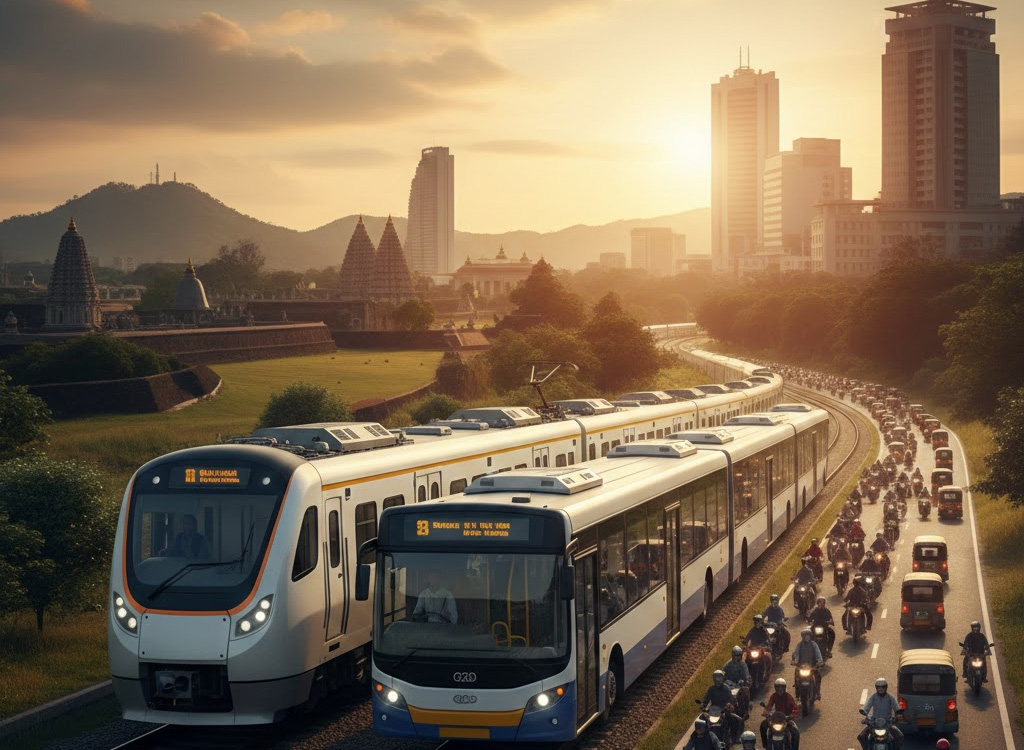
Sri Lanka’s transport policy has settled into a contradiction that is both economically inefficient and socially regressive. Private vehicle ownership is treated as a fiscal lever, heavily taxed and periodically restricted, while public transport capacity expands sporadically and often inadequately.
The aggregate vehicle numbers are frequently cited as proof that the country has too many vehicles on its roads. Total vehicle population rose from 5.6 million in 2014 to 8.8 million in 2025. That increase of more than three million vehicles is real, but the composition of that growth deserves closer scrutiny. Motorcycles account for over 5.17 million of the total, and tricycles account for more than 1.2 million, while motor cars stand at 973,376.
Recent registration data illustrates where the system is expanding and where it is not. In 2025, Sri Lanka registered 254,817 motorcycles and 17,332 tricycles, compared with 2,096 new buses. When bus fleet additions remain modest and uneven, and the demand for daily commuting continues to grow, households seek alternatives.
It would be simplistic to describe motorcycles and tricycles as cheap substitutes. They are subject to taxation, fuel costs, maintenance expenses, and financing burdens that are significant for middle- and lower-income families. Yet, they offer one attribute that public transport has struggled to guarantee: certainty. Certainty of departure. Certainty of arrival. Certainty that a missed connection will not translate into lost wages or missed opportunities.
The argument that Sri Lanka must discourage private vehicle growth to manage congestion is not without merit. Road space is finite, and fuel imports carry macroeconomic implications. However, discouragement without substitution is constraint. If four-wheelers are priced beyond reach through taxation, and two-wheelers become the fallback option, the underlying congestion dynamic does not disappear. It merely changes form.
The condition of public transport capacity must therefore be central to the discussion. The rail network continues to carry hundreds of millions of passengers annually. Ticketed passenger travel, which approached 750 million journeys in 2017, fell sharply during the pandemic and recovered to approximately 530 million in 2022. Season ticket travel rebounded to about 360 million in the same year, indicating the heavy reliance of commuters on rail corridors into Colombo and other urban centres.
The bus system presents a similar pattern of dependence combined with constraint. While the total bus population has gradually increased over time, operational capacity has not always matched timetable requirements. The Sri Lanka Transport Board fleet in operation declined in recent years, and the number of buses operated per day fell from over 5,200 in 2017 to roughly 4,266 in 2022, even as timetable requirements exceeded 7,300 services. That shortfall is experienced directly by passengers in the form of longer waiting times, uneven route coverage, and reduced late-evening availability, particularly outside major urban centres.
Rural and peri-urban Sri Lanka is where this imbalance becomes most visible. In districts where bus frequency is limited and services may cease early, mobility is a practical necessity. Access to employment, healthcare, education, and markets depends on predictable transport links. When those links are fragile, households rationally invest in private mobility, even at significant cost.
Policy sequencing is therefore crucial. If the objective is to moderate private vehicle growth, then public transport must first be made sufficiently reliable, frequent, and geographically comprehensive to absorb displaced demand. Fleet expansion cannot be episodic.
Maintenance backlogs cannot be allowed to sideline large segments of available buses. Rail frequency on commuter corridors must correspond to peak-hour demand rather than historical schedules. These are not cosmetic upgrades but structural requirements.
The cancellation of major transport initiatives in recent years has also narrowed the pathway to capacity expansion. Large-scale projects such as the Light Rail Transit system and external grant-funded programmes represented opportunities to modernise urban mobility infrastructure. Regardless of political interpretation, their absence leaves a gap that must be filled either through domestic financing or alternative partnerships. Without such investment, incremental adjustments to vehicle taxes will not produce systemic change.
Transport is a productivity issue before it is an environmental or fiscal issue. Delayed arrivals, unreliable connections, and overcrowded services translate into lost working hours and reduced economic efficiency. An economy seeking to enhance competitiveness cannot treat mobility as a residual category of public expenditure. It must be recognised as foundational infrastructure.
Sri Lanka’s transport debate should therefore move beyond the rhetoric of “too many vehicles” and confront the structural imbalance between private and public capacity. The data shows sustained growth in private mobility alongside uneven expansion of buses and rail services. Households respond to the options available to them, not to abstract policy preferences.
A credible reform agenda would establish clear multi-year targets for bus fleet augmentation, enforce maintenance standards that reduce non-operational stock, and prioritise rail corridor upgrades that address peak-hour congestion. Only after public transport demonstrates reliability and scale should restrictions on private vehicle growth be tightened in the name of congestion management or environmental objectives.
A state that taxes private mobility heavily while underinvesting in public alternatives risks entrenching inequality and inefficiency simultaneously. A state that first builds a dependable public system creates the conditions for rational behavioral change. Sri Lanka must decide which path it intends to follow.
Source: The Morning Money
Disclaimer: The views and opinions expressed in this article are those of the writer and do not necessarily reflect the official position of this publication.












Leave a comment