
By Keishara Perera
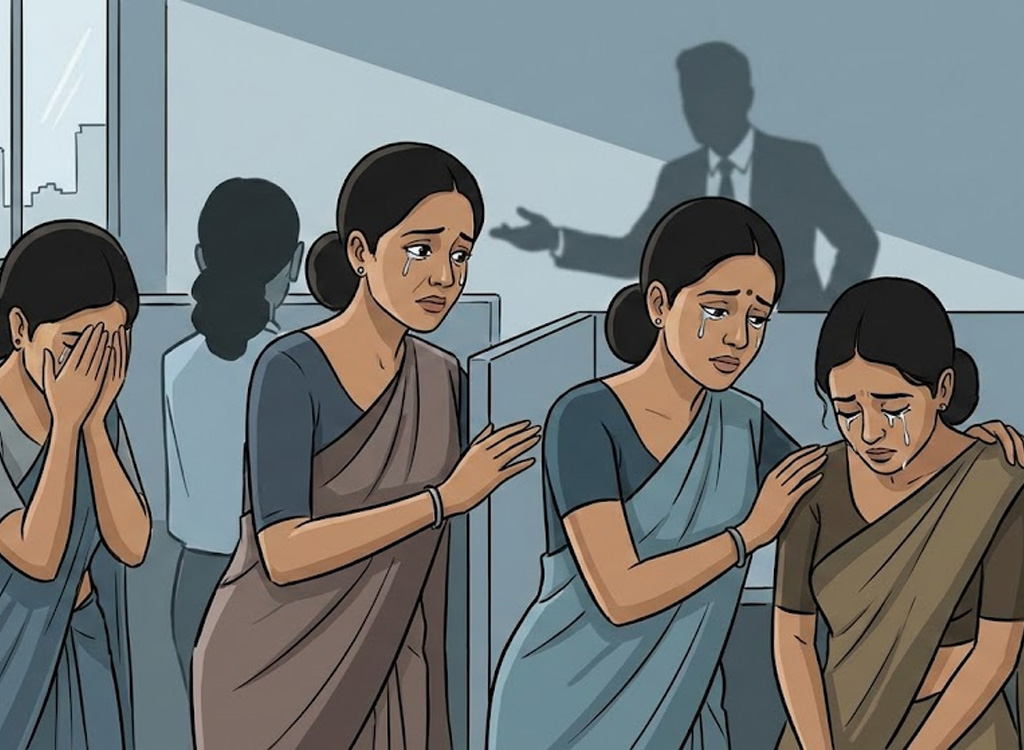
Women workers constitute a substantial portion of Sri Lanka’s work force but they face various forms of sexual harassment in the workplace on a day-to-day basis. The lack of a specific labour legislation in Sri Lanka which deals with sexual harassment in the workplace has contributed towards the violation of the rights of women workers over the years.
Although Sri Lanka is a party to key conventions of the International Labour Organization (ILO) which guarantee gender equality in the workplace and the existence of domestic labour legislation aimed at protecting women workers, there is no specific labour legislation for women workers to seek relief against sexual harassment in the workplace.
Although this subject is a matter which is discussed at various forums in Sri Lanka, sexual harassment in the workplace still remains one of the reasons which restrict the participation of women workers in the country’s workforce.
Justice Anil Gooneratne in the famous case of Manohari Pelaketiya vs. Ministry of Education Secretary H.M. Gunasekera and others (SC[F/R] 76/2012, SCM 28.09.2016) has observed the serious consequences sexual harassment can have on women workers as follows: “I observe that continuous abuse and sexual harassment over a period of time would cause physical and mental damage to any human being. It is not possible for a female to resist such abuses unless she is a strong personality who could react and retort to such abuses and harassment and make the abuser to shamelessly withdraw, being exposed to the public at large of his indecency. Continuous threats and abuses could also make a person unwell both physically and mentally.”
Therefore, it is essential to clearly identify the parameters of what exactly would amount to sexual harassment in the workplace in Sri Lanka in order to clearly identify instances of sexual harassment and to take action in order to deal with those cases, and, most importantly, to prevent sexual harassment in the workplace. This is because all socio-sexual behaviour that occurs in a workplace would not amount to sexual harassment and every kind of harassment which takes place in the workplace would not be sexual harassment that can be prosecuted in a court of law.
Sadly, however, in Sri Lanka, many women workers are not aware of what constitutes sexual harassment in the workplace and their right to an environment free from sexual harassment.
Current legal framework
One of the main forms of sexual harassment is quid pro quo sexual harassment, which means ‘this for that’ or ‘something for something,’ and in the context of the workplace, it would mean ‘superiors seeking sexual favours from subordinates in exchange for employment benefits’ (Sarveswaran, ‘Sexual Harassment at Workplace: An Evaluation of the Effectiveness of Legal Responses Available in Sri Lanka’).
The Penal Code of Sri Lanka makes it a criminal offence to assault, sexually harasses, or cause sexual annoyance to another person either by use of words or actions, and it further states that unwelcome sexual advances by words or actions used by a person in authority at a working place constitutes the offence of sexual harassment. Therefore, a victim of sexual harassment has a right to lodge a complaint with the Police and pursue criminal action against the harasser.
On the other hand, Sri Lanka has signed and ratified the Convention on the Elimination of All Forms of Discrimination Against Women (CEDAW) and Article 11(1) requires states parties to take all appropriate measures to eliminate discrimination against women in the field of employment in order to ensure, on basis of equality of men and women, the same rights including the right to protection of health and to safety in working conditions, including the safeguarding of the function of reproduction.
Further, CEDAW General Recommendation No. 19: Violence against Women, in its recommendation on Article 11, states that equality in employment can be seriously impaired when women are subjected to gender-specific violence, such as sexual harassment in the workplace.
In light of these international obligations, Justice Janak De Silva in the case of SriLankan Airlines Ltd. vs. P.R.S.E. Corea (SC Appeal No.91/2017 decided on 2 February 2024) observed that sexual harassment included such unwelcome sexually determined behaviour as physical contact and advances, sexually coloured remarks, showing pornography, and sexual demands, whether by words or actions.
Such conduct can be humiliating and may constitute a health and safety problem; it is discriminatory when the woman has reasonable grounds to believe that her objection would disadvantage her in connection with her employment, including recruitment or promotion, or when it creates a hostile working environment.
Article 14(1)(g) of the Constitution recognises that a citizen has the freedom to engage by himself or in association with others in any lawful occupation, profession, trade, business, or enterprise. The Fundamental Right to engage in a lawful occupation, profession, trade, business, or enterprise is dependent on the creation of an environment free from sexual harassment.
Limitations of legal framework
In Sri Lanka, in the absence of domestic labour legislation dealing specifically with workplace harassment and violence, women workers, especially in private sector employment, have to resort to the criminal justice system for recourse.
Although sexual harassment can cost companies millions of dollars in lawsuits in most Western countries, very few victims of sexual harassment in Sri Lanka seek justice through legal action for various reasons such as embarrassment, difficulties in obtaining evidence to corroborate the testimony of the victim, and cumbersome and lengthy legal procedures.
Dealing with sexual harassment under the Penal Code is not a satisfactory remedy for women workers, and especially as a remedy in labour law, since there is a higher burden of proof in a criminal case, and also due to their fears concerning job security. Therefore, people rarely take action under the Penal Code for sexual harassment.
The reluctance to pursue a criminal case and the cost the complainant has to incur are some other reasons for women workers’ reluctance to take action under the Penal Code for instances of sexual harassment (Arosha S. Adikaram, ‘Dealing with Sexual Harassment in the Workplace: A guide to Employers and Employees,’ Stamford Lake Publication, 2017).
On the other hand, the Penal Code does not cover the forms of psychological harm that can be commonly seen at the workplace which could also amount to sexual harassment and can cause similar trauma to people, such as suggestive stories, offensive jokes, offensive comments and remarks, unwanted discussion of personal matters, and subjective objectification (rumours and/or comments). Thus it is absolutely necessary that a specific labour legislation which deals with sexual harassment in the workplace is introduced in Sri Lanka.
In light of this lacuna in the law and recent incidents of violence and harassment of women workers, a recent Cabinet decision to approve a resolution to introduce legal provisions enabling Sri Lanka to ratify and implement ILO Convention 190 concerning the elimination of violence and harassment in the world of work is a step in the correct direction.
The way forward for SL
The ILO adopted the first international treaty on the aspect of violence and harassment in the workplace in June 2019 known as Convention 190 concerning the elimination of violence and harassment in the world of work.
This convention filled a regulatory gap and introduced uniform terminology to enable member states to formalise concepts within their jurisdictions as there was a dearth of guidelines to legislators in establishing national standards. It also established the right of every employee to be free from violence and harassment in the workplace (Shyamali Ranaraja, ‘ILO Convention on Violence and Harassment, 2019 and its Implications for Sri Lanka’s Labour Law,’ 2021/22 Vol. XXVI, The Bar Association Law Journal).
The convention recognises the right of everyone to a world of work free from violence and harassment, including gender-based violence and harassment. It further recognises that violence and harassment in the world of work can constitute a human rights violation and that it is a threat to equal opportunities while also being unacceptable and incompatible with decent work.
It reminds ILO members that they have an important responsibility to promote an environment of zero tolerance to violence and harassment in order to facilitate the prevention of such behaviours and practices.
It defines ‘violence and harassment’ in the world of work as a range of isolated or repeated unacceptable behaviours and practices, or threats thereof, which result in, or are likely to result in, physical, psychological, sexual, or economic harm, and includes gender-based violence and harassment.
Meanwhile ‘gender-based violence and harassment’ has been referred to as violence and harassment directed at persons because of their sex or gender, or affecting persons of a particular sex or gender disproportionately, and sexual harassment has been included here.
The convention protects not only workers and other persons in the world of work but also persons in training, including interns and apprentices, workers whose employment has been terminated, volunteers, jobseekers and job applicants, and even employers, and it applies to violence and harassment which occurs in the course of, linked with, or arising out of work.
Accordingly, the convention requires member states to endorse domestic laws for the prevention and elimination of violence and harassment in the workplace, in consultation with all stakeholders i.e. employers, employees, and government bodies. The following key attributes have been identified as what should be adopted by member states in order to prevent harassment and violence in the workplace in the domestication process:
- The prohibition of violence and harassment by law
- Adoption of policy framework which helps to prevent violence and harassment
- Adopting procedures for the enforcement of gender-based violence laws
- Providing solutions and help for people affected by any form of harassment or violence
- Introducing forms of punishment for offenders
- Creating awareness and a safe environment for people to discuss any issues relating to harassment or violence in the workplace
- Introducing proper methods of investigation and continuous monitoring of workplaces through regulatory bodies
The Indian approach
In the process of adopting reforms to the law, Sri Lanka could draw from the salient aspects of India’s Sexual Harassment of Women at Workplace (Prevention, Prohibition, and Redressal) Act, which was enacted on 22 April 2013 with the aim of providing protection for women workers against sexual harassment and in order to prevent and address the complaints of sexual harassment at the workplace.
The intention of the Indian legislature in enacting this statute is on the basis that “sexual harassment results in violation of the Fundamental Rights of a woman to equality under Articles 14 and 15 of the Constitution of India and her right to life and to live with dignity under Article 21 of the Constitution”. The act further recognises the constitutional guarantee relating to the right to practise any profession or to carry on any occupation, trade, or business which includes a right to a safe environment free from sexual harassment.
The definition given to an ‘aggrieved woman’ in relation to a workplace is considerably broad and it involves “a woman, of any age whether employed or not, who alleges to have been subjected to any act of sexual harassment”.
The meaning of the term ‘employee’ has been given a very broad definition as well, and it includes any person “employed at a workplace for any work on regular, temporary, ad hoc, or daily wage basis… including a contractor… and includes a co-worker, a contract worker, probationer, trainee, apprentice…”.
‘Sexual harassment’ has been defined broadly to include all unwelcome physical, verbal, or non-verbal conduct of sexual nature such as a demand or request for sexual favours, making sexually coloured remarks, and showing pornography. This definition is also in line with the Indian Supreme Court’s definition given to ‘sexual harassment’ in the case of Vishaka vs. State of Rajasthan and others (AIR 1997 Supreme Court 3011).
Implied or explicit promise of preferential treatment or a threat of detrimental treatment in the present or future employment of a female employee or “interference with her work or creating an intimidating or offensive or hostile work environment for her or humiliating treatment likely to affect her health or safety” would amount to acts of sexual harassment and an aggrieved woman can make a written complaint regarding an act of sexual harassment at her workplace within three months of the incident.
The act requires every employer to constitute an ‘internal complaints committee’ which would first attempt to settle the matter through conciliation between the parties, and if no conciliation is possible, the matter will proceed to inquiry.
In the determination of the compensation, if any, to be paid to the aggrieved woman, the act states that factors such as the “mental trauma, pain, suffering, and emotional distress caused to the aggrieved woman” should be taken into consideration, along with the loss of her career opportunities as a result of the incident of sexual harassment and “any medical expenses incurred by the victim for physical or psychiatric treatment” should also be considered by the relevant committee in determining the compensation payable by the respondent.
Recommendations for immediate consideration
Until ILO Convention 190 is ratified and the provisions thereof are adopted into the proposed domestic legislation for the prevention of violence and harassment in the workplace, the legislature could consider including the necessary inquiry procedure into the Industrial Disputes Act No.43 of 1950 in order to deal with complaints relating to sexual harassment in the workplace, giving the labour tribunal presidents jurisdiction to inquire into these matters and to make an appropriate order with regard to compensation.
The proposed new legislation could also contain provisions which set out in detail the duties and responsibilities of employers in relation to the prevention of sexual harassment in the workplace.
Sri Lanka can also consider incorporating appropriate provisions in the Shop and Office Employees’ Act No.19 of 1954 and Factories Ordinance No.45 of 1942, issuing a mandate to all employers to take the necessary preventive and disciplinary measures in order to prevent sexual harassment at their workplaces.
Further, employers should take note that they themselves have a responsibility to ensure a zero-tolerance policy towards sexual harassment in the workplace.
As Justice Janak De Silva has very accurately pointed out in the case of Brandix Apparel Solutions Ltd. vs. Fernando (SC Appeal 60/2018, SCM 05.05.2022), “It is the duty of an employer to provide a safe and supportive work environment for its employees. The productivity of the employee and the company will not increase unless such an environment exists. Sexual harassment in any form should be dealt with severely because it will otherwise pollute the working environment and affect employee morale.”
(The writer is an Attorney-at-Law)
Disclaimer: The views and opinions expressed in this article are those of the writer and do not necessarily reflect the official position of this publication.












Leave a comment