
By Dr. Nadee Dissanayake
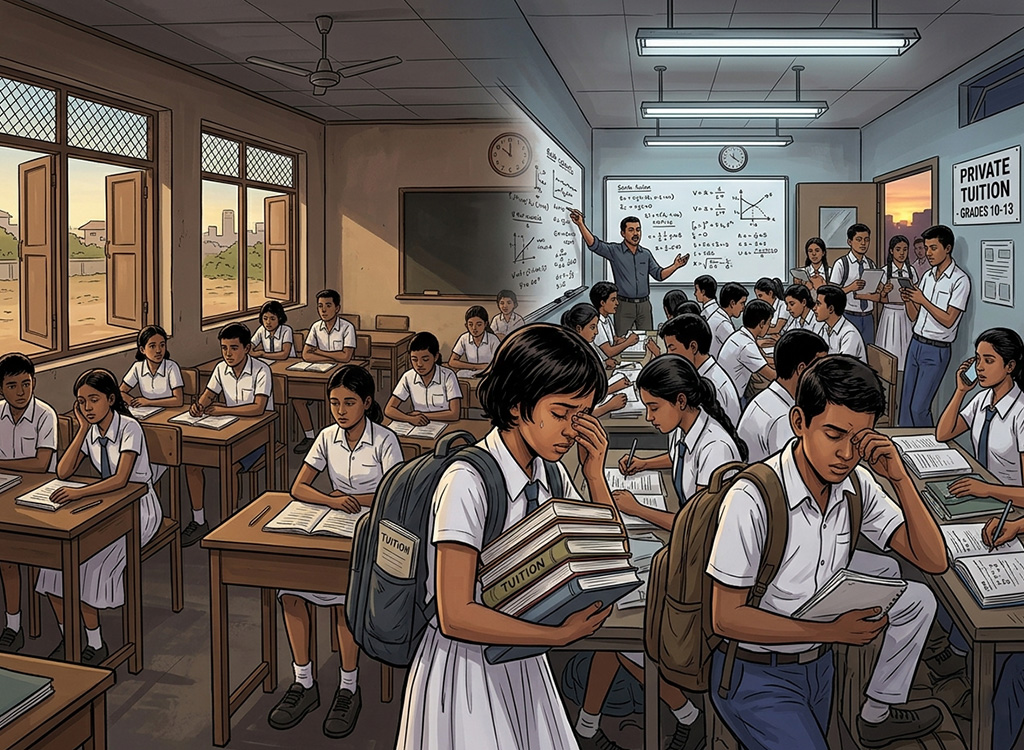
In Sri Lanka today, the school day rarely ends with the final bell. For countless students, learning stretches far beyond classroom walls, into tuition halls, online platforms, recorded lessons, and messaging groups overflowing with notes and instructions.
What began as optional support has quietly evolved into a parallel education system, a shadow economy shaping student outcomes. Tuition is no longer extra; it has become a perceived necessity.
Parents fear that formal school hours are insufficient, competition is relentless, and national exams leave little room for error. What was once a supplement to learning has now become a survival strategy.
The quiet privatisation of free education
Sri Lanka has long prided itself on free education, a cornerstone of social progress and equality. However, for many families, the reality tells a different story.
Preparing children for high-stakes exams often comes at the cost of private tuition, paid from savings, leisure, or even basic necessities. Schools may be ‘free’ on paper, but in practice, households bear growing financial and emotional burdens. For many parents, opting out of tuition feels like jeopardising a child’s future.
This quiet shift has consequences beyond household budgets. By outsourcing critical learning to the private sector, the State loses influence over a large part of students’ education. Tuition operates largely unchecked, with minimal public debate, regulation, or research. Its long-term social and developmental impacts remain largely invisible.
The childhood gap
The impact of private tuition manifests long before exam day. Students from wealthier families gain extra coaching, targeted strategies, and practice opportunities. Those without resources fall behind, not from lack of effort or talent but because the system rewards the ability to pay.
These disparities compound over time, affecting university access and future career opportunities. The implications extend to society. When success hinges on financial capacity, social mobility erodes.
Talented students from lower-income households face structural disadvantages, while trust in the fairness of education diminishes. What was intended as a public good increasingly feels like a private commodity. The social cost is high: frustration, diminished confidence in institutions, and weaker social cohesion threaten the fabric of society.
Burnout: The hidden cost
Sri Lankan students are celebrated for their dedication, but this commitment comes at a steep personal cost. Long school hours, evening tuition, and packed weekends leave little room for rest, play, or independent exploration. Academic pressure has become constant, and exhaustion is often mistaken for discipline.
The human toll is profound. Chronic burnout stifles motivation, creativity, and emotional resilience. Many students emerge with strong grades but fragile personal coping skills, unprepared for the uncertainties of life beyond exams. In essence, relentless intensity produces high achievers on paper but vulnerable individuals in practice.
Learning driven by fear
The tuition boom is fuelled not just by ambition but by fear. Limited university places, tight job markets, and fierce competition create anxiety for both students and parents. Tuition offers a sense of control, a reassurance in an unpredictable system. But this has shifted education’s purpose.
Learning is increasingly a tool to manage fear rather than cultivate curiosity, critical thinking, or holistic growth. Despite high academic engagement, many students question the relevance of what they study. Endless exam preparation leaves little room for reflection, skill development, or personal growth.
Students often feel well trained for tests but underprepared for life. This misalignment fosters frustration, disengagement, and diminished self-confidence, highlighting a growing gap between schooling and real-world readiness.
Structural gaps fuel shadow economy
The shadow education system thrives because formal schooling struggles to meet demand. Syllabus overload, exam-focused evaluation, overcrowded classrooms, and uneven teacher quality make tuition appear essential. However, despite its scale, tuition rarely features in policy discussions. Limited regulation, scarce data, and minimal research hinder accountability and reform.
The consequences ripple far beyond classrooms. When learning prioritises memorisation over problem-solving, workforce adaptability, innovation, and long-term development suffer. The shadow education economy imposes hidden costs – financial, social, and developmental – that quietly shape a generation.
Rethinking the path forward
Eliminating tuition overnight is unrealistic and politically fraught. Instead, the challenge is understanding why tuition has become indispensable and addressing those root causes. Strengthening classroom teaching, streamlining curricula, moderating exam pressures, and recognising diverse forms of learning are critical first steps.
Acknowledging the tuition sector is equally important; transparent discussion, evidence-based research, and inclusive policy reform are essential to restore balance.
When schools function effectively as trusted learning centres, tuition can complement rather than replace formal education. Without reform, dependence on private tuition will continue to grow, entrenching inequities and undermining young people’s developmental potential.
Reclaiming education as a public good
Sri Lanka has reason to be proud of its education legacy. But pride in past achievements must not obscure current realities. When success depends increasingly on private expenditure, exhaustion is mistaken for excellence, and fear drives learning, the system signals an urgent need for renewal.
The central issue is not tuition itself but the declining sufficiency of formal schooling. Restoring schools as effective, equitable, and trusted institutions ensures that all students, regardless of background, can thrive.
Without thoughtful reform, the shadow education economy will continue to expand, shaping futures in ways that are largely unseen but deeply consequential, affecting social cohesion, productivity, and national development.
Reform needed
Change requires deliberate action.
Policymakers and school administrators must prioritise strengthening classroom teaching and teacher capacity, balancing curricula with holistic development and moderating exam pressures. Integrating the tuition sector into education planning can improve transparency and equity. Investments in teacher training, digital infrastructure, and under-resourced schools can reduce reliance on private tuition.
By restoring trust and quality in public schooling, education can once again serve as a shared social good, accessible, equitable, and empowering for every student.
Sri Lanka’s education system faces a pivotal choice: continue leaning on private tuition to boost results, or revamp formal schooling to genuinely prepare young people for life, fostering resilience, creativity, and confidence alongside academic achievement.
(The writer is an independent researcher)
Disclaimer: The views and opinions expressed in this article are those of the writer and do not necessarily reflect the official position of this publication.











Leave a comment