
By Veeragathy Thanabalasingham
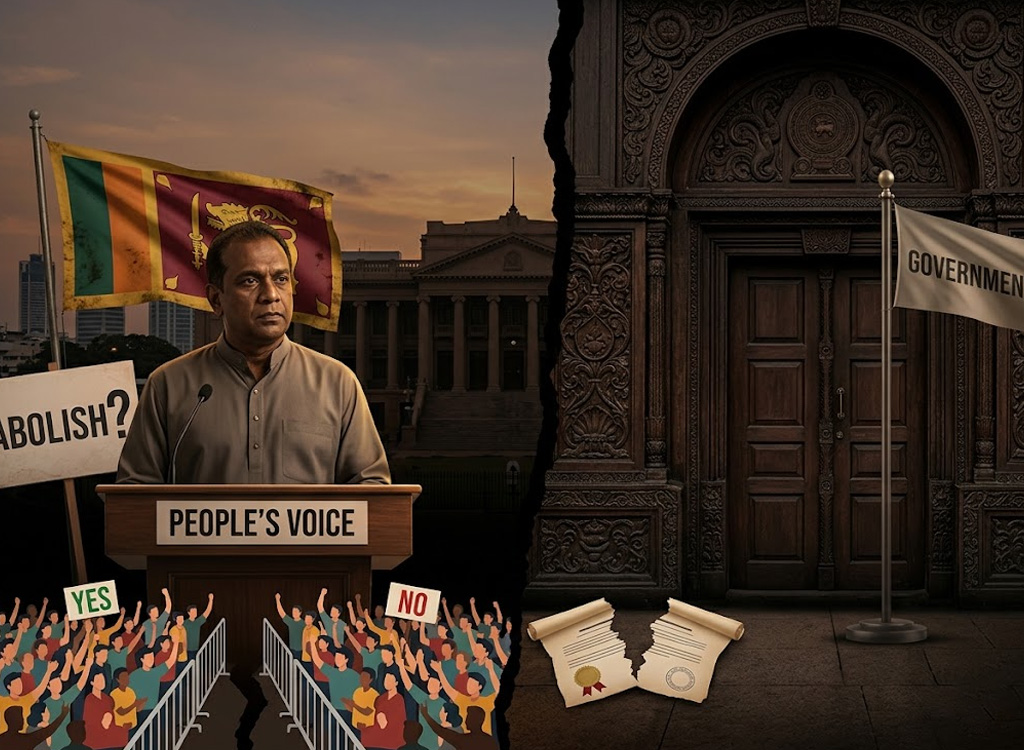
A study conducted by a think tank called Research Lanka reveals that the Sri Lankan population is sharply divided over the abolition of the executive presidential system.
The study indicates that 50% of the population desires the abolition of the presidential system, while the other 50% wishes for it to continue. At the same time, it has come to light that 80% of the people believe the National People’s Power (NPP) Government will not bring in a new constitution, with only 20% maintaining belief that a new constitution will be introduced.
The research further suggests that the majority of the people believe that if the incumbent Government fails to bring in a new constitution, Sri Lanka may never see another one in the future.
A pledge never fulfilled
Governments usually tend to introduce new constitutions during the early stages of their term. Sri Lanka’s two Republican Constitutions were introduced early in the tenures of Sirimavo Bandaranaike’s United Front Government and J.R. Jayewardene’s United National Party (UNP) Government, respectively.
When questions regarding a new constitution arose during the initial months of the NPP Government, its leaders stated that the constitutional drafting process would be initiated after three years. Now, a year and a half has passed. Given the internal challenges the Government faces and the issues likely to intensify due to current international crises, it is difficult to expect the country’s situation to be conducive to introducing a new constitution in the coming years.
Regarding the abolition of the executive presidency, no president who came to power promising its removal has ever fulfilled that pledge. The NPP made the same promise as well.
However, the people have never defeated a president in a subsequent election specifically for failing to fulfil the promise of abolishing the presidency. Among those who broke this promise, two Presidents – Chandrika Kumaratunga and Mahinda Rajapaksa – served two terms each in power. When Rajapaksa contested for a third term, several other factors contributed to his defeat.
Therefore, while the abolition of the executive presidency has been a key promise put forward by opposition candidates contesting against incumbent presidents, there remains a doubt as to how far this has truly been a popular demand. The results of the aforementioned study strengthen that doubt.
One cannot claim that the people brought the UNP to power with a massive majority in the July 1977 General Elections specifically because Jayewardene promised to introduce the executive presidency. Similarly, it cannot be said that in elections where those promising to abolish the system won, the people chose them solely for that particular promise.
The executive presidency and the debates surrounding its abolition will likely continue, but it appears that change is not on the horizon.
A way to pressure the Govt.
It is an open secret that the Government lacks interest in conducting Provincial Council Elections. The NPP Government, led by the Janatha Vimukthi Peramuna (JVP) – which holds a fundamental stance against the devolution of power – is proposing a new constitution. No one can foretell what the nature of power devolution will look like in that framework.
In this context, it becomes essential to protect the Provincial Council system despite its inherent flaws. Foreign Minister Vijitha Herath, who is also the Chairman of the Parliamentary Select Committee appointed to determine the electoral system for Provincial Councils, stated during the committee’s first meeting that it would submit its initial report within three months.
Handing over provincial administration to elected representatives quickly is only possible if elections are held under the Proportional Representation (PR) system, rather than the mixed electoral system used for Local Government Elections. M.A. Sumanthiran in the previous Parliament and Shanakiyan Rasamanickam in the current Parliament submitted bills in the form of private member’s motions regarding this matter.
If the Government had no desire to pass Rasamanickam’s bill and conduct the elections, it could have introduced such a bill itself. Had that been the intention, the Government would not have appointed a select committee. So what is the way to pressure the Government to hold elections soon?
Representatives of Tamil and Muslim parties in the select committee must collectively insist on holding elections under the PR system to avoid further delays. If a favourable response is not received, they should openly declare that the Government’s true intention is to delay the elections and walk out of the committee. This could serve as a viable way to exert pressure on the Government.
Tamil politicians’ frequent meeting with diplomats
Meeting foreign diplomats has become a primary political activity for Tamil politicians. Whether or not they approach the Government to find solutions to their people’s problems, they never fail to meet with diplomats to lodge their complaints.
Photos of Tamil politicians meeting diplomats are seen in the media almost every day. These meetings take place not only in Colombo but also in the north, east, and hill country. Diplomats now frequently visit the north and east, sometimes staying for several days to witness the people’s issues firsthand, while also gathering information from politicians and civil society representatives.
In the post-war period, the political strategies of Tamil parties have largely remained dependent on the international community. The Tamil political leadership primarily relies on international assistance to hold the Sri Lankan Government accountable for rights violations committed during the war and to pressure Colombo into finding a solution to the ethnic issue.
However, it is doubtful whether Tamil parties have ever conducted a formal assessment of the actual benefits gained from this trust. The main reason they rely so heavily on the international community is their inability to carry forward the struggle for political rights of the Tamil people with the necessary political wisdom suited to current realities.
The ‘international community’ is nothing more than a collective of powerful global nations. It is not Somalia or Sudan. It is no secret to Tamil politicians that these powerful nations approach the problems of other countries only in ways that serve their own geopolitical interests. This situation arose because Tamil parties failed to unite themselves into a formidable political movement in the post-war political landscape.
The current reality is that no foreign country is prepared to bring Sri Lanka before any court for war crimes, nor are they ready to apply pressure to find a solution that satisfies the legitimate political aspirations of the minority communities.
Tamil politicians consistently tell foreign diplomats that a solution based on a federal system is necessary for the ethnic problem. There is nothing wrong with that. However, no country is going to pressure the Sri Lankan Government to implement a federal solution.
At most, one can expect foreign nations to urge the Government to hold Provincial Council Elections and fully implement the 13th Amendment to the Constitution.
In the current situation, it would be wise for Tamil politicians to understand that it is not the demand for a federal solution but the demand for Provincial Council Elections that will exert at least some level of immediate pressure on the NPP Government.
(The writer is a senior journalist based in Colombo)
Source: The Morning
Disclaimer: The views and opinions expressed in this article are those of the writer and do not necessarily reflect the official position of this publication.








Leave a comment