
By Vox Civis
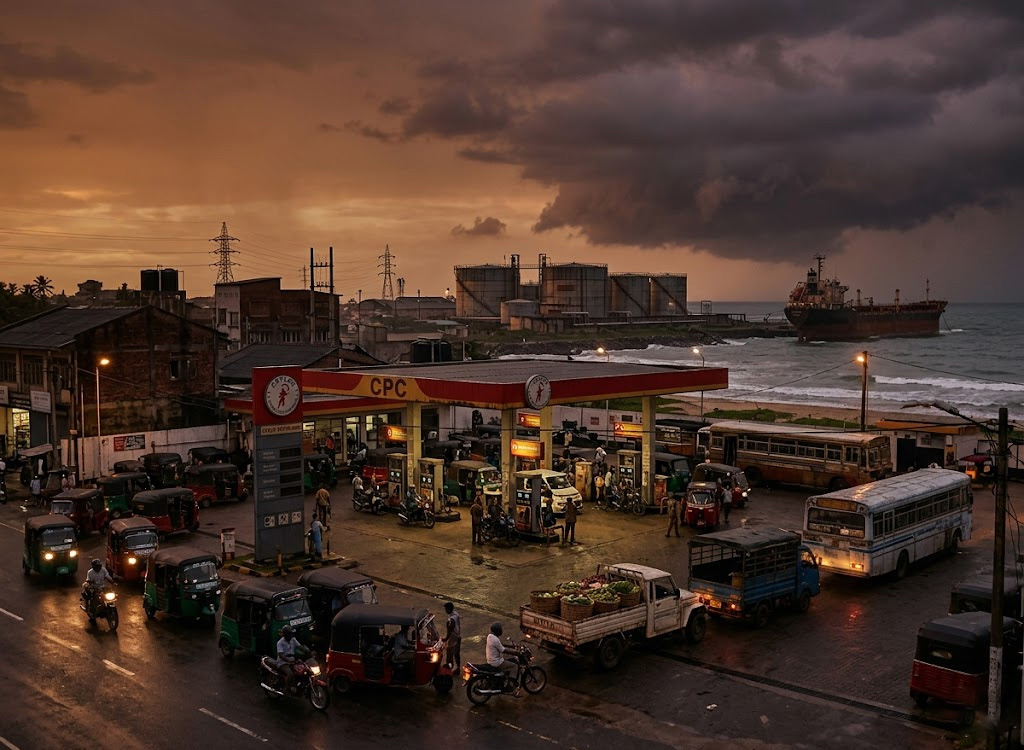
If one thought that the recent fuel shocks led Sri Lanka to the economic crossroads once again, then it’s time to think again, because the nation’s next economic stress test may already have begun. Few statistics illustrate the economic transformation of Sri Lanka over the past decade more starkly than the price of fuel.
In November 2015, a liter of Petrol 92 cost Rs.117. Today it costs Rs.434, representing an increase of 271 percent. Auto diesel has risen from Rs.95 in 2015 to Rs.407 per liter, a staggering increase of 328 percent. Kerosene, the fuel most closely associated with lower-income households and traditional livelihoods, has experienced perhaps the most dramatic rise of all, climbing from Rs.44 to Rs.285 per liter, an increase of 548 percent.
These stats can in no way be dismissed as mere numbers because they represent the profound shift in the cost of living, the cost of production, and the cost of doing business in Sri Lanka. Every increase in fuel prices ripples through the economy, raising transportation costs, increasing food prices, pushing up manufacturing expenses and reducing the disposable income of ordinary citizens.
Alarming disparity
What makes this situation particularly alarming is that while fuel prices have risen by several hundred percent over the last decade, wages and incomes have barely kept pace. For many Sri Lankan families, domestic economic recovery remains an abstract concept discussed in policy circles rather than a reality experienced at the household level.
The challenge facing Sri Lanka today is that as high as they might be, fuel prices may not have yet reached their peak. Indeed, they could be preparing for another significant upward adjustment just as the economy is attempting to regain its footing.
This is because the temporary subsidy introduced by the Government earlier this year to cushion consumers from the effects of global energy shocks is rapidly approaching its expiry date. The Rs.60 billion buffer was designed as a short-term relief measure following disruptions to global energy markets caused by escalating tensions in the Middle East. It absorbed approximately Rs.100 per liter of diesel costs and around Rs.20 per liter of petrol costs. That fund is now effectively exhausted.
The consequences are already visible in the high prices at the pump. Yet even these increases do not fully reflect the prevailing costs. Officials have acknowledged that fuel continues to be sold below the actual cost recovery level. This means that unless international oil prices decline significantly and remain stable, consumers will inevitably bear a larger share of the burden in the months ahead.
The difficulty for policymakers is that their room for manoeuvre is extremely limited. Sri Lanka’s economic recovery programme is built around the International Monetary Fund (IMF) bailout package, and one of its fundamental pillars is the maintenance of cost-reflective energy pricing. Simply put, fuel prices must reflect actual costs rather than political considerations.
IMF tolerance limit
During the recent oil shock triggered by the conflict in the Middle East, the Government temporarily absorbed part of the cost. The IMF tolerated this as an exceptional and transparent measure. However, it has also made clear that permanent subsidies are incompatible with the programme’s fiscal objectives. As a result, the Government has already committed to phasing out broad-based fuel subsidies entirely by September 2026. Beyond that point, domestic fuel prices will be expected to move in line with international market conditions through regular revisions.
The political appeal of subsidised fuel is obvious. The economic consequences are equally obvious. Sri Lanka’s recent history demonstrates what happens when energy prices are artificially suppressed while losses accumulate in state-owned enterprises. The bill eventually arrives in the form of debt, inflation, currency depreciation and economic instability.
Yet the removal of subsidies carries its own dangers. Higher fuel prices feed directly into inflation. Transportation becomes more expensive while agricultural production costs rise, manufacturing margins shrink and consumer spending weakens. The consequence of all this is slower economic growth.
The challenge confronting the government is therefore not whether prices should reflect costs but how to manage the social consequences of those costs. Thus far the National Peoples Power (NPP) government’s response has been to shift away from blanket subsidies towards targeted assistance. Rather than subsidising fuel for every vehicle owner, including wealthier households, support is increasingly being channelled through welfare programmes such as Aswesuma.
Additional assistance is also being directed towards sectors considered strategically important, particularly agriculture and fisheries. Fuel allowances for fishermen and measures to contain fertiliser costs are supposedly intended to protect food production and prevent a wider inflationary spiral. Whether these interventions prove sufficient remains to be seen.
Extended vulnerability
The broader concern however is that Sri Lanka’s vulnerability extends far beyond fuel pricing. At its core, the current crisis is a reminder of the country’s continued dependence on imported energy. Every spike in global oil prices immediately translates into pressure on foreign reserves, pressure on the exchange rate and pressure on economic growth.
When the monthly fuel import bill exceeds half a billion dollars, the implications are naturally, profound. Every additional dollar spent on fuel is a dollar unavailable for debt servicing, reserve accumulation or productive investment. This reality helps explain the Central Bank’s increasingly aggressive efforts to defend the rupee. However, one of its most controversial measures has been the recent decision to shorten the period within which exporters must convert residual foreign currency earnings into rupees.
The logic behind the policy is straightforward. As the rupee weakened, some exporters delayed converting foreign exchange earnings, anticipating further depreciation and larger gains. While entirely rational from an individual business perspective, such behaviour reduces the supply of foreign currency available to the market and can accelerate downward pressure on the exchange rate.
The Central Bank’s new directive effectively forces exporters to bring dollars back into the domestic banking system much faster than before. The immediate impact was dramatic. The rupee recovered sharply, gaining roughly two percent within days of the announcement but slipped back by the end of last week. But, from a purely tactical perspective, the policy worked.
The strategic question, however, is whether such measures can be sustained without undermining confidence. This concern was raised by Opposition MP, Dr. Harsha de Silva, who argues that mandatory conversion requirements resemble emergency measures used during the height of Sri Lanka’s foreign exchange crisis back in 2022.
Blow to investor confidence
His criticism deserves serious consideration. Investor confidence depends heavily on predictability, transparency and economic freedom. Businesses prefer operating in environments where commercial decisions are determined by market forces rather than administrative directives. Sudden interventions, even when well-intentioned, tend to create uncertainty regarding future policy direction. Dr. de Silva’s central question is therefore an important one. If these regulations are crisis measures, how long will they remain in place? If they are temporary, what conditions will trigger their removal?
These are not just technical questions as they go to the heart of how Sri Lanka intends to balance economic stability with market confidence. The Central Bank would argue that extraordinary circumstances require extraordinary responses. Alongside currency conversion rules, it has also tightened monetary policy through a significant increase in interest rates. By raising borrowing costs, policymakers hope to reduce import demand, contain inflation and discourage speculative behaviour.
Such measures are painful but understandable. No Central Bank can indefinitely spend foreign reserves defending a currency. Sri Lanka learned this lesson the hard way during its economic collapse. Yet there is also a danger in overcorrecting.
Fuel prices are already acting as a brake on economic activity. Higher interest rates add another layer of restraint. Stricter foreign exchange regulations are creating additional burdens for exporters. Taken together, these measures risk slowing the very sectors capable of generating the foreign exchange needed to stabilise the economy. This tension between stability and growth is likely to define economic policymaking over the next year.
Global headwinds and local impact
Meanwhile, developments beyond Sri Lanka’s shores are creating additional uncertainty. Fitch Ratings recently revised its global sovereign outlook from neutral to deteriorating, citing the economic consequences of the escalating conflict involving Iran and the United States. According to the agency, the conflict is expected to weaken global growth, increase inflationary pressures and heighten geopolitical risks. For a country like Sri Lanka, which remains heavily dependent on imported energy and external financing, such developments are deeply concerning.
While global oil markets remain highly sensitive to events in the Middle East, even rumours of disruptions to supply routes can trigger significant price movements. Sri Lanka has little influence over these events yet bears their consequences immediately. This reality underscores the larger truth that energy security is no longer simply an environmental objective or a development aspiration; it is a national economic imperative.
No country can consider itself economically secure when its prosperity depends on uninterrupted oil flows through geopolitical flashpoints thousands of kilometers away. Sri Lanka’s long-term answer lies in reducing that dependence. The Government’s ambition of generating 70 percent of electricity from renewable sources by 2030 represents a step in the right direction. The country possesses abundant solar and wind resources, particularly in regions such as Mannar and the Northern Province. The challenge is implementation.
The greatest obstacle today is not the availability of renewable resources but the limitations of the national grid. Without substantial investment in transmission infrastructure and grid modernisation, the country cannot fully utilise renewable energy even when generation capacity exists. Battery Energy Storage Systems offer another important part of the solution. By storing surplus renewable energy and releasing it during peak demand periods, such systems can reduce reliance on expensive diesel-powered generation.
Economic cost of delays
Liquefied Natural Gas was also intended to serve as a transitional fuel, providing cleaner and cheaper power generation while renewable capacity expanded. Yet delays in developing the necessary infrastructure have prevented Sri Lanka from realising those benefits. The result is that modern power plants designed for LNG continue operating inefficiently on more expensive fuels. These delays carry real economic costs measured not only in dollars but in lost opportunities.
Ultimately, energy security will require a combination of renewable energy expansion, modern grid infrastructure, energy storage capacity, LNG development and institutional reform within the electricity sector while the alternative is continued vulnerability to every geopolitical shock and every disruption in global energy markets. The worrying reality is that Sri Lanka may be confronting these multiple risks simultaneously.
And looming over all these concerns is the possibility of a severe El Niño event. Should significant weather disruptions affect agricultural production, hydroelectric generation or food supplies, the economy could face another wave of inflationary pressure when it is already struggling to absorb higher energy costs. The danger therefore, is not any single challenge in isolation; it is the cumulative impact of several adverse developments occurring at the same time.
Sri Lanka’s economic recovery has undoubtedly made progress since the dark days of 2022. Foreign reserves have improved. Inflation has moderated. Confidence has partially returned. Yet recovery remains fragile and the next phase will be far more difficult than the first. Stabilising a collapsing economy is one challenge but building a resilient and self-sustaining one is another entirely.
The NPP administration therefore faces a formidable test. It must navigate rising fuel costs without triggering social unrest, defend the currency without strangling growth, maintain IMF credibility without undermining investor confidence and accelerate energy reform before the next global shock arrives. The stakes could hardly be higher.
For the average Sri Lankan, the price displayed at the fuel station is no longer merely a number on a screen. It has become a barometer of the nation’s economic health, its exposure to global events and its progress towards genuine resilience. The question facing the country is whether the next fuel shock will become another chapter in Sri Lanka’s long history of recurring crises or the catalyst that finally forces the structural changes needed to break the cycle.
The answer will determine far more than the price of fuel. It will determine the direction of the country’s economic future.
Disclaimer: The views expressed in this article are those of the author (Vox Civis) and do not necessarily reflect the official stance of Pulseline. Economic data is for informational purposes only.











Leave a comment