
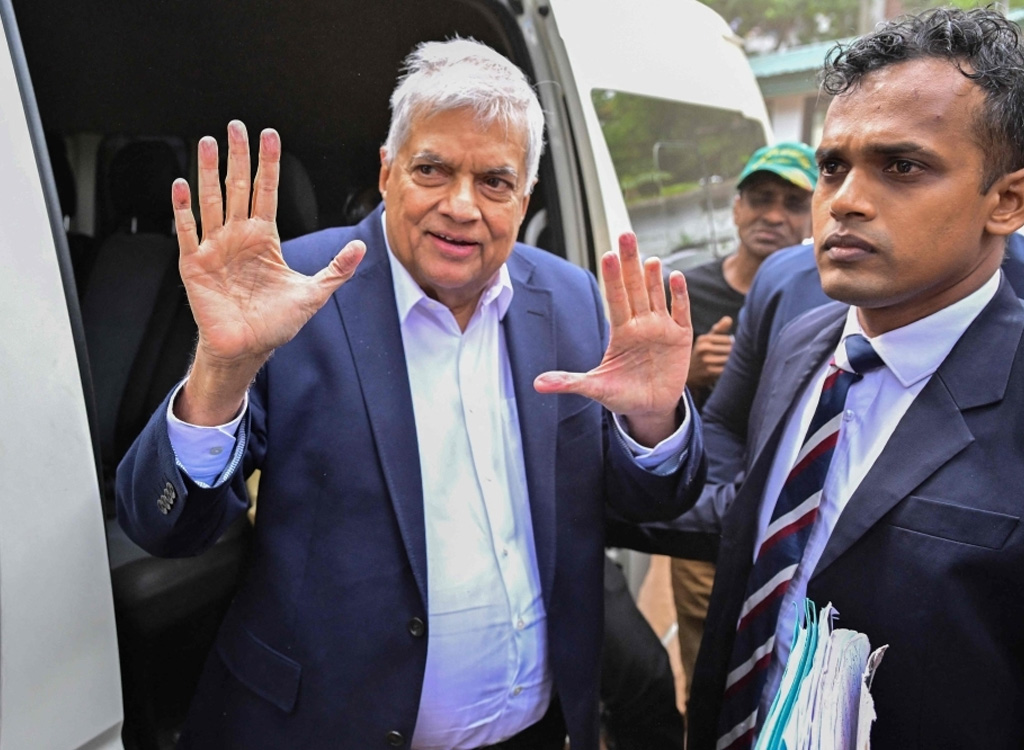
The Ranil Wickremesinghe case
By Vox Civis
The unfolding legal saga surrounding former President Ranil Wickremesinghe has crystallized into one of the most consequential political flashpoints in post-independence Sri Lanka, precisely because it straddles the fault line between accountability and retribution.
At the heart of the case lies Wickremesinghe’s disputed London trip of September 2023, with investigators alleging the misuse of approximately LKR 16.6 million in public funds for what they describe as a private visit to attend his wife’s honorary academic ceremony, while Wickremesinghe insists the stopover formed part of his official return from a United Nations engagement. His unprecedented arrest and brief remand in August 2025, the first such action against a former Head of State, followed by the remanding of his former Presidential Secretary, Saman Ekanayake last week, have elevated what might otherwise have been a routine financial inquiry into a full-blown test case for Sri Lanka’s justice system.
The National People’s Power (NPP) government seems to be presenting the prosecution as proof that ‘elite impunity’ has ended – one of its primary election promises. Yet, the sharp backlash from across the political spectrum, including long-standing rivals, underscores a growing belief that the case is disproportionate in scale and selectively pursued, particularly when measured against far larger unresolved scandals, more of which are being added on a regular basis with fingers being pointed at the NPP.
While investigations are supposedly nearing completion and an indictment is expected next month, Wickremesinghe’s continued freedom on bail, amid increasingly tense court proceedings and hints of broader probes into historic cases, ensures that this controversy will not merely determine his personal legal fate, but will also shape public judgment on whether the rule of law in Sri Lanka is being strengthened or being dangerously politicised.
Supreme irony
The government in general and the Attorney General’s Department in particular, may be committing themselves to what can only be described as a supreme irony. In its relentless pursuit of what increasingly resembles a witch hunt, the determination to incarcerate Wickremesinghe may yet boomerang upon the very institutions prosecuting the case, on the basis of the identical allegation they claim to be investigating.
This is because the police investigation into the alleged misuse of state resources by the former President, primarily relating to his attendance at his wife’s academic convocation in the United Kingdom while in office, is now mirrored by the investigators’ own recent trip to London, ostensibly for further investigations. Interestingly, none of the investigating officers had thought it fit to visit the university in question and seek confirmation of the event, as directed by court.
That trip, undertaken at public expense by an undisclosed group of police officers, appears to have yielded no substantive results, while simultaneously stirring diplomatic unease. To make matters worse, an application by a citizen to the Right to Information Commission requesting details of the trip and costs incurred have been disallowed on the flimsy pretext of invasion of privacy of the officers concerned and the possibility of compromising both the ongoing investigation as well as the litigation process.
The unavoidable irony is that, it is the court itself that sought confirmation of the original invitation letter. Having failed to do that, at least on the face of it, the London visit by these investigators itself appears to squarely falls within the definition of ‘misuse of public funds,’ the very offence they purport to be probing.
This case, therefore, it can be argued, is no longer merely about one former President, one overseas visit, or one set of vouchers. It has become a test of whether Sri Lanka’s long arm of the law is capable of distinguishing between lawful accountability and politically motivated prosecution, or put another way, between investigation and theatre; between the rule of law and the selective weaponisation of legality. Therefore, at its core lies the deeper and more unsettling question of when the State itself violates legal process in the name of enforcing it, who then stands accused?
The theatre of prosecution
There is no question that the allegations against Wickremesinghe concerning the alleged misuse of public funds deserve scrutiny, as do all allegations involving public office. At the end of the day, no one is above the law. But neither is the law above itself. Procedure, jurisdiction, proportionality, and constitutional limits are not technical inconveniences to be brushed aside in the pursuit of political goals of the ruling party.
Yet, what the country has witnessed in the recent past is the transformation of a criminal investigation into a public spectacle. Each court appearance is preceded and followed by a media circus. A section of the public, intoxicated by the idea of retribution, appears to derive visceral pleasure from the possibility of incarceration, savoring even the most trivial courtroom exchanges. At the same time, social media dissects every word uttered in court, often even before accredited court reporters could file their notes.
The courtroom, once a space of sobriety and restraint, has been reduced to an extension of political theatre, especially by the theatrics of the prosecuting entity, whose presentation of facts has already come under intense scrutiny. It now appears that the lead prosecutor may have been economical with facts providing the defence more muscle at the next hearing date in April.
The conduct of the investigation itself reinforces this perception. The extraordinary publicity accorded to routine procedural steps, the manner in which the CID leadership has publicly framed the inquiry, and the language used by state counsel all point to a process driven as much by optics as by evidence. That, in itself, should alarm anyone who values the integrity of Sri Lanka’s legal system.
Political investigations and institutional damage
There is no doubt that this investigation bears a political character. That, however, does not mean the allegations are false; it means the manner in which they are pursued reflects political objectives rather than neutral legal standards. Such politicisation invariably has consequences; some beneficial, others deeply damaging.
On the positive side, the public is being exposed to legal reasoning, financial procedures, and judicial scrutiny in real time. Citizens are beginning to question the transparency of investigations, the limits of police power, and the accountability of prosecutors. In a democracy, such engagement is healthy. But the damage far outweighs the benefits.
First, politically driven investigations erode public confidence in the police and prosecutorial services. When the public perceives that the law is being applied selectively, faith in impartial justice inevitably takes a hit.
Second, the judiciary itself is drawn into unnecessary hullabaloo. Courts are forced to adjudicate cases that appear inflated beyond their legal substance, consuming scarce judicial time that should be devoted to serious crime, corruption, and unresolved cases of national importance.
Third and most damaging of all, the crude exposure of Sri Lanka’s investigative limitations to the international community reinforces a narrative of institutional incompetence and legal immaturity. This is not a theoretical concern. It affects foreign relations, investor confidence, and Sri Lanka’s standing in international legal forums.
Question of jurisdiction
However, the most glaring illustration of this problem is the much-publicised claim that CID officers travelled to England to “conduct investigations.” This claim, repeated in media reports and left inadequately clarified by the authorities, betrays either a profound misunderstanding of international law or a deliberate attempt to mislead the public.
Under international law, territorial sovereignty is absolute in criminal jurisdiction. Every state exercises exclusive authority over law enforcement within its borders. Foreign police officers have no inherent right to investigate crimes, collect evidence, interview witnesses, or access records in another sovereign state on their own. Given this status quo, Sri Lanka’s Criminal Investigation Department has no legal authority to independently conduct investigations in the United Kingdom.
If Sri Lankan authorities require evidence from the UK, only one lawful pathway exists, that being Mutual Legal Assistance (MLA), a process that is rigid, formal, and judicially supervised.
First, it requires, authorisation from a Sri Lankan court or the Attorney General. Second, a formal request must be transmitted through diplomatic and legal channels to the UK government. Third, there must be scrutiny by UK courts to determine legality and proportionality. Fourth, investigations must necessarily be conducted exclusively by UK authorities under UK law. Finally, the transmission of findings back to Sri Lanka.
At no stage does this process permit Sri Lankan police officers to roam British institutions, inspect universities, interview individuals, or collect documents. The Magistrate’s remarks in open court make it abundantly clear that this process was not followed. Any information obtained outside this framework is legally worthless. It cannot be admitted as evidence. Worse, it constitutes a violation of UK law, international law, and Sri Lanka’s own criminal procedure.
It is in this backdrop that the London trip of the CID team undertaken at public expense, without demonstrable legal authority, and producing no tangible outcome, fits squarely within the definition of misusing public funds. The investigators have, in effect, replicated the very offence they are tasked with investigating.
Enormous cost
This case has already consumed enormous public resources. Taxpayer money has been spent on overseas travel, prolonged court proceedings, and media management. Judicial time, arguably one of the scarcest resources in Sri Lanka, is being drained by a case whose legal foundations appear to be growing weaker with every passing hearing. Notwithstanding all that, the leading prosecutor has promised that Wickremesinghe will be served indictment by next month.
One need only compare this investigation with the glacial pace or complete stagnation of inquiries into the Easter Sunday attacks, the assassination of Lasantha Wickrematunge, the killing of Wasim Thajudeen, and the disappearance of Prageeth Eknaligoda to observe the unmistakable signs of politicisation. In those cases, the State pleads complexity, lack of evidence, or jurisdictional difficulty. Here, it demonstrates boundless enthusiasm and the contrast is damning.
Given this backdrop, the hounding of former Presidential Secretary, Saman Ekanayake marks a dangerous escalation. Under Article 41(1) of the Constitution, the Presidential Secretary is appointed to assist the Executive President in the exercise of constitutional powers. The role is not that of a personal auditor or private investigator. It is administrative, functional, and subordinate to presidential authority.
Therefore, it is not the Secretary’s function to question where a President travels, where he stays, or what his other personal arrangements are. Those matters are handled by diplomatic missions and protocol services. In other words, the Head of State is not accountable to his Secretary for personal logistics.
Moreover, presidential immunity – despite political rhetoric to the contrary – has not been entirely removed from the Constitution. Orders issued by a President during his term retain constitutional protection. Crucially, it is now a matter of record that Ekanayake did not personally benefit from any funds, did not engage in procurement, and did not sign the vouchers in question. He approved estimates, nothing more. The ultimate outcome of his incarceration is that it has sent shivers down the spine of the public sector hierarchy, who going forward will think thrice before approving or placing their signature on any document.
The perils of collateral damage
This case demonstrates how even a former Presidential Secretary can be subjected to humiliation, remand custody, and reputational destruction without signing a single voucher or misappropriating a single rupee.
Therefore, the broader implications for the public service are chilling. General 35 vouchers – routine instruments of state finance – have now been transformed into legal tripwires. A single signature, even without personal benefit or procurement authority, can potentially result in criminal prosecution, remand custody, and years of litigation. The danger lies in the structure of B-reports, which rely almost exclusively on vouchers while ignoring the contextual approval framework contained in files that are often unavailable to accused officers.
This creates a perverse incentive where civil servants are exposed to maximum risk with minimal protection. The likely result from this episode rather than being cleaner governance will inevitably be further administrative paralysis.
Losing the moral high ground
Besides, the damage extends beyond domestic law. In court, it was claimed that the University of Wolverhampton is a “private university” with no state affiliation. This is factually incorrect. The University of Wolverhampton is a public university, founded in 1827 and granted university status under UK law in 1992. Its degrees are conferred under government-regulated standards. In 2023, it awarded Professor Maithree Wickremesinghe an Honorary Professorship, one of the rarest academic distinctions globally. Such honours are conferred on a minuscule fraction of scholars worldwide.
To mischaracterise such an institution and to indirectly demean such an honour, in pursuit of political ends is not only inaccurate but also reckless. Needless to say, misleading a court, intentionally or otherwise, is a grave matter. Misleading the community is worse.
It appears that the prosecution is attempting to sustain its case almost entirely on the basis of a statement purportedly obtained from the then Sri Lankan High Commissioner to the United Kingdom. If that indeed is the case, then it is only natural that fundamental questions of fairness and due process would arise.
Firstly, elementary principles of justice demand that the defence of Wickremesinghe be granted a full and unfettered opportunity to question and cross-examine the former High Commissioner. Any attempt to rely on her statement while denying the defence that right would strike at the very heart of natural justice.
Clear judicial instruction
Secondly, the presiding judge at the previous hearing was unambiguous in directing the complainant to obtain and present confirmation from the University of Wolverhampton regarding the alleged invitation letter, stating clearly that such verification was essential to proving the charge. In light of that explicit judicial instruction, is it either reasonable or proper to allow the case to meander around secondary claims such as the High Commissioner’s statement or assertions about who was allegedly present on a balcony, while the central evidentiary requirement remains unfulfilled?
In the backdrop of the judicial instruction being neglected and if the complainant is unable to secure confirmation from the university itself regarding the invitation letter, the inevitable conclusion is not merely that the case is weakened, but that it is also rendered legally untenable. Courts cannot be asked to substitute conjecture, inference, or peripheral testimony for primary documentary proof. To permit otherwise would be to dilute the evidentiary standards of the justice system itself, an outcome far more damaging than the fate of any single defendant.
Many assume this case affects only Ranil Wickremesinghe’s reputation. That is a profound miscalculation. What is being damaged is Sri Lanka’s institutional credibility: the seriousness of its prosecutions, the competence of its investigators, and the reliability of its legal representations. A state that cannot distinguish between investigation and spectacle, between jurisdiction and adventurism, between accountability and vendetta, ultimately places itself in the dock. This case will be studied not for its outcome, but for what it reveals about the long arm of the law in Sri Lanka under the NPP.
Disclaimer: The views and opinions expressed in this column are those of the author, and do not necessarily reflect those of this publication.









Leave a comment