
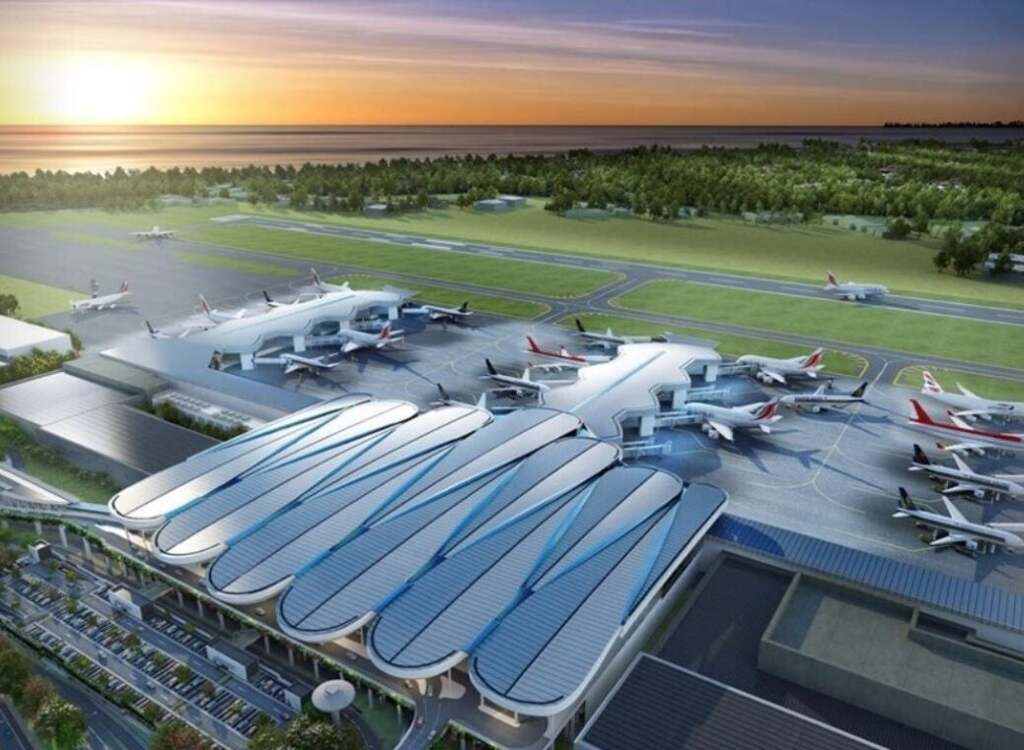
Astrology says any fault in a house’s main doorframe affects its main occupant adversely.
Taken similarly, the key entry point to a country is its international airport, which is Bandaranaike Airport at Katunayake (KIA) in the case of Sri Lanka.
Comparatively, it is smaller in size and is devoid of largeness and glamour than other international airports in the world.
It may have taken a few steps forward, but KIA and the international tag do not go hand in hand.
Therefore, successive governments made plans for its development, in stages. The first stage has been completed and the airport is now in a position to provide flight services only.
Second stage for a 15 million capacity
The second stage was to prepare it for tourism and investment attraction and toward the achievement of future targets. The terminal built under the first stage is capable of serving six million passengers annually. That is enough in the present context, but congestion will surely appear in a few years’ time.
As a solution, a second terminal was to be constructed to cater to nine million passengers, to give KIA the capacity to serve a total of 15 million passengers.
In global infrastructure, airport constructions are very complex, costly and nationally important. Since it happens under the procedure of the state, corruption and bribery is unavoidable. The World Bank and Transparency International have been stressing the greater likelihood of corruption in billion-dollar projects of this magnitude.
‘Bigger the construction – bigger the bribery’ theory
Senior World Bank economist Charles Kenny’s book ‘Construction, Corruption and Developing Countries’ (2007) highlights that massive corruption occurs in state-given contracts of such scale.
World Bank analyses that between five and 20 percent of construction costs that run into billions of dollars are lost to bribery or corruption (World Bank, WPS4099). The enormity of the sum easily provides opportunities for the artificially raising of capital or money changing hands as commission.
With national significance, construction of airports needs the direct intervention of highly-placed state officials for planning, procurement and approval. The World Bank observes that their intervention paves the way for influencing selection and awarding the contract to the chosen constructor.
Given the technical complexity of the construction, public and regulatory institutions find it difficult to know the true nature of capital expenditure etc. that go towards the construction of an airport. Therefore, only a person with an extensive subject knowledge is able to understand what actually is happening. Furthermore, keeping a constant watch on such constructions is a must. Fulfilling both is difficult and the result is airport construction is massive both in cost and corruption.
Citing what happened in Brazil, World Bank blog (As countries sit on shaky foundations…) points out a renegotiation of contracts give rise to corruption. It notes the importance of transparency.
Taisei arrives under JICA aid
The construction of the KIA’s second passenger terminal began on 15 December 2020 under a concessionary loan from JICA, with Japan’s Taisei Corporation as the main contractor.
The first consideration in selection is previous experience of the contractor. Taisei has fulfilled that requirement and there was no opposition to it getting the tender.
As a leading global construction and civil engineering company, it has made itself a name for having successfully constructed major infrastructure projects, including the construction of modern airports. From planning to construction of terminals, tarmacs etc. it has vast experience in airport construction in Japan and elsewhere in the world.
Global experience
Taisei was the main contractor in the construction of the passenger terminal complex of Hamad airport in Qatar, acclaimed a best airport in 2024, and its expansion work as well.
Taisei completed the second passenger terminal of Noi Bai airport in Vietnam in 2015.
Kuala Lumpur airport in Malaysia, Japan’s Haneda, fourth best in the world, as well as Chubu, Kansai airports are the other international airports whose constructions were successfully undertaken by Taisei, unarguably giving it a name as an expert in the field.
Country goes bankrupt; JICA halts funding
As the KIA’s second stage work was ongoing, the country was declared bankrupt. The government decided to halt foreign debt payments and the lenders followed suit. JICA suspended the funding in July 2022.
With that, Taisei was forced to terminate the contract in December of that year, with the work reaching around six percent completion by that time.
Minister accused
Next came an accusation against the then aviation minister Nimal Siripala de Silva of having solicited bribes from the Japanese company. That forced him to resign from the ministry, but he made a return after the Bribery Commission cleared him for an absence of proof of wrongdoing.
Election time that followed saw the NPP riding to power on a promise of eliminating bribery and corruption. Having won both national elections, president Anura Kumara Dissanayake promised a developed country free of fraud. His attention was drawn to the KIA when he inquired into halted key development projects.
He intended to get JICA resume the funding and talks were held with Japan in that regard. However, citing past corruption and irregularities, it agreed to grant 30 pc only of the total project cost. Vowing a full transparency in governance, Dissanayake persisted with his efforts for a full funding.
Trust in new president
During his official visit to Japan, he continued discussions and that government agreed to extend the full sum in a show of faith in him. The fifth biggest economic superpower’s relenting in that manner painted a positive picture in Sri Lanka’s economic image.
The government then decided to call for fresh tenders.
The central expressway construction faced a similar obstacle, with Metallurgical Corporation of China Ltd. halting work in the stretch between Kadawatha and Mirigama in view of the country’s economic bankruptcy. When China’s EXIM bank stopped the funding, work had achieved a 36.38 pc physical progress.
Different story in remainder of KIA’s work
Five biggest local construction companies requested the president to cancel the 2015-16 contract given to MCC and call for new competitive and open bidding. In May, the Transport Ministry appointed a seven-member committee to recommend how the remainder of the tender should be carried out.
After studying the MCC’s proposal, the committee decided against calling for fresh tenders. It recommended an analysis of the capital assets presented by MCC, pay its dues running into billions and negotiate completion of the remainder of the work by the same company. Accordingly, the work was given to MCC after having paid interest for the relevant period.
However, the path to the construction of the KIA’s second passenger terminal was totally different to that.
Deadline extended three times
The Aviation Ministry called for a new tender which was mired in controversy from the outset. Bids were to be called between 04 September and 24 December of 2024. Taisei met the deadline. The Ministry extended it twice, until 18 March and 25 March.
By the time Sojitz – Larsen & Toubro (L&T) Consortium applied, the time limit had passed. The reason for the extension came to be known to all.
The first irregularity in this tender is the extension of the deadline in favour of a particular bidder.
HLPC’s objections to Sojitz L&T
The high-level procurement committee (HLPC), the highest state mechanism in procurement, objected to the bid by Sojitz L&T. The attorney license in its bid was not approved by a local registrar as per requirement and it did not come under the company’s possession either.
However, the technical evaluation committee went ahead and allowed that bid to be considered in a clear violation of procurement guidelines.
No one knew the reason for the disregard of the cabinet-approved HLPC’s recommendation to cancel Sojitz L&T’s bid.
Trading company and ally
It is clear that Sojitz L&T, being a trading company, is not qualified to undertake a construction of this nature. Egypt rejected its bid for an airport construction, citing no previous experience. To coverup its disqualification, Sojitz L&T got together with India’s L&T. The experienced Taisei submitted its bid while Sojitz L&T did it together with an Indian company in a sordid coverup.
The tender was to be closed within 180 days from its opening in August 2024. But, it has now been dragging on for more than a year with excuses of attorney license registration by a local registrar and various others given. L&T has shown complete failures in Sri Lanka’s state and private sector projects in the past.
L&T and inabilities
One case in point is the Greater Colombo Wastewater Management Project. It was delayed by 1,840 days, or more than five years.
That Japanese trading company has no experience whatsoever in airport construction. JICA projects need a Japanese company involved, which is its sole qualification. Sojitz came to take up the role of the “mute helping the blind to beg.” Such is the sorry situation in the tender for the expansion of the country’s main entry point.
L&T has created a number of problems in its contracts to state institutions, such as the Public Administration Ministry and the CEB. which have resorted to arbitration as a way out. That should definitely have ruled it out and blacklisted. But, its underhand mechanism is so strong that it has been able to remain as a bidder for the KIA’s second passenger terminal construction project.
President’s objective dashed?
It has violated procurement guidelines of both the Sri Lankan state and JICA. However, it is clear someone big is in love with the company. That is a blatant betrayal of the nation and NPP regime’s declared intention mandated by the people to fight corruption.
President Dissanayake said in his budget speech the halted work on the KIA’s second stage development will resume early next year with JICA already agreeing to extend financial support.
However, going by the state of affairs, it seems unlikely the project will happen anytime soon. The president has been able to get JICA’s concessionary loan, but instead of transparency, the process is blemished by commissions changing hands. The attempt is to get the unqualified Sojitz to overcome the technical evaluation committee obstacle. Then comes the tender price. Low bids being the order of the day, a bidder without having any idea about work quality and timeframe can place any low price.
The country’s main entry point should be a symbol of quality and dignity. Our regional competitors are Singapore, India, Malaysia, Dubai, Abu Dhabi and others. Therefore, the KIA should be in top quality condition. Towards its construction, the qualifier should be experienced and capable, not a beggar-like union bent on daylight robbery. If given the contract, it will teach us the lesson next to its five-year delay in the drainage project.
Next come legal proceedings and bad name. With the array of corruption involved known now, the qualified will, as his right, go to courts for redress. The rest of the world will know the nature of rulers who use the country’s main airport as a mine of corruption. Lenders will surely turn elsewhere, affecting targets in tourism and investments. There would be no demand by tourists at the visa counter. The country stands to lose in all fronts.
On the other hand, the government that vowed to crown the nation in a kingdom of transparency, will be exposed in its true nature. It is apparent the minister, deputy minister, ministry secretary, chairmen and other authorities are allowing the irregularities to continue. Only the president seems to have any concern. He did his level best to get the project to resume. His pains and country’s future are lost to a game of bribery and commission.
We call upon the president not to allow it to happen. As highlighted in the beginning, any fault in the house’s main doorframe adversely affects its main occupant. Therefore, he should do his utmost to rectify it.
(The Leader)







Leave a comment