
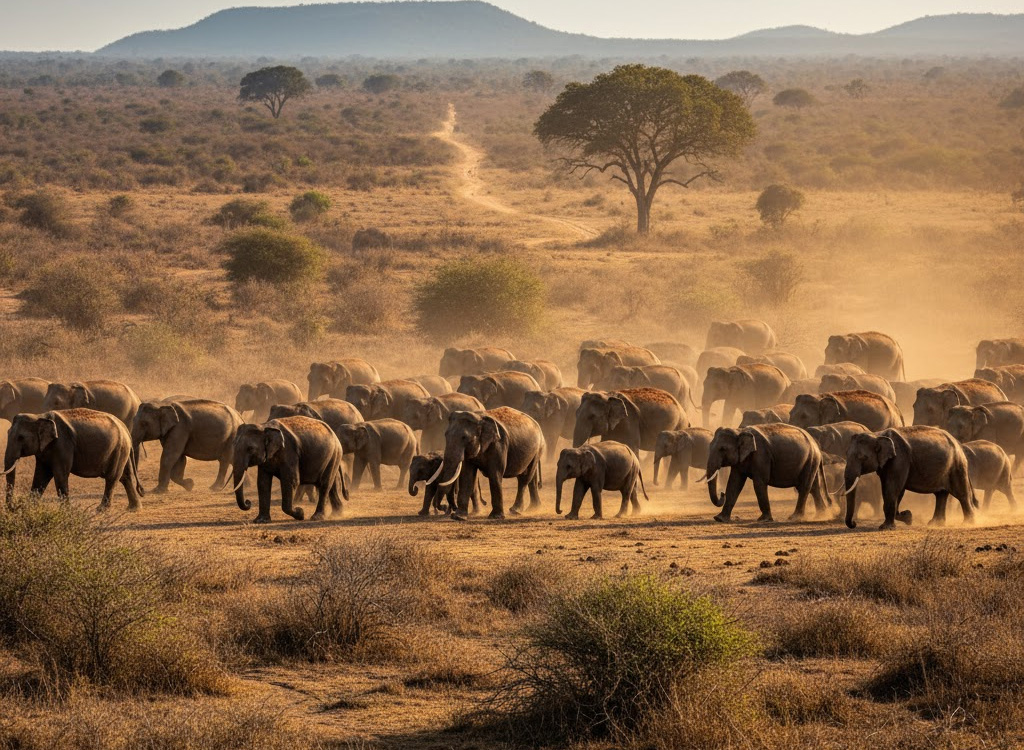
The Ministry of Environment has ordered the immediate suspension of an unapproved operation to drive wild elephants from villages into forest reserves in Hambantota and Anuradhapura, after learning of the campaign through media reports, a senior Ministry spokesperson said.
According to the official, the Ministry had not granted prior approval for the operation, which was reportedly carried out by teams comprising Wildlife Conservation officers, Air Force personnel, police, and members of the Civil Defence Force.
The large-scale drive, launched on 2 November, involved nearly 2,000 personnel and aimed to push elephant herds back into protected areas.
The Ministry emphasised that the operation contradicts the ongoing National Plan for the Management of the Human-Elephant Conflict (HEC), which focuses on scientifically backed, sustainable solutions to mitigate clashes between rural communities and Sri Lanka’s wild elephant population.
“The current national plan is being implemented to create long-term, ecological balance. Driving large numbers of elephants into forest reserves is not a scientifically viable solution and cannot be approved,” the spokesperson said.
Under the National HEC Management Plan, several initiatives are underway — including the establishment of feeding zones in the Thabbowa and Kala Wewa reserves, removal of invasive plant species affecting over 70 acres of grasslands in areas such as Puttalam, and the strengthening of elephant fences across key zones.
The Cabinet of Ministers has also approved recruiting 600 new Wildlife Conservation officers, along with the procurement of 100 cabs and 180 motorcycles for the Department of Wildlife Conservation (DWC) to enhance on-ground monitoring and rapid response capabilities.
It is estimated that around 60% of Sri Lanka’s wild elephants live outside designated reserves, largely due to the availability of food sources in rural and agricultural areas.
The national plan seeks to reduce elephant incursions by improving food availability within reserves and establishing safe corridors for elephant movement.












Leave a comment