
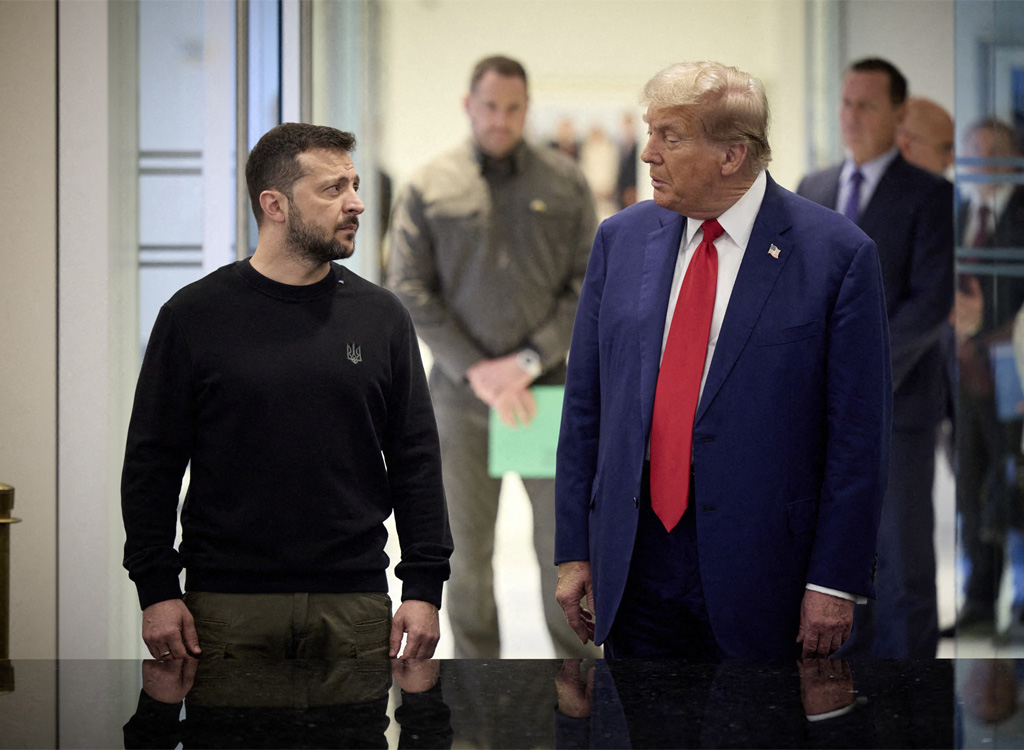
Donald Trump has hinted he could walk away from supporting Ukraine as he doubled down on his administration’s recent criticism of Europe, describing it as “weak” and “decaying” and claiming it was “destroying itself” through immigration.
In a rambling and sometimes incoherent interview with Politico, a transcript of which was released on Tuesday, the US president struggled to name any other Ukrainian cities except for Kyiv, misrepresented elements of the trajectory of the conflict, and recycled far-right tropes about European immigration that echoed the “great replacement” conspiracy theory.
Trump called for Ukraine’s president, Volodymyr Zelenskyy, to accept his proposal to cede territory to Russia, arguing that Moscow retained the “upper hand” and that Zelenskyy’s government must “play ball”.
His envoys have given Zelenskyy days to respond to a proposed peace deal under which Ukraine would be forced to accept territorial losses in return for unspecified US security guarantees, according to the Financial Times, which reported on Tuesday that the US leader was hoping for a deal “by Christmas”.
In his often halting remarks, Trump swerved from subject to subject while rehearsing familiar grudges and conspiracies. He also declined repeatedly to rule out sending American troops into Venezuela as part of his effort to bring down the president, Nicolás Maduro.
“I don’t want to rule in or out. I don’t talk about it,” Trump said, adding he did not want to talk about military strategy.
The US president repeatedly described what he said were Europe’s problems in entirely racial terms, calling some unnamed European leaders “real stupid”.
“If it keeps going the way it’s going, Europe will not be … in my opinion … many of those countries will not be viable countries any longer. Their immigration policy is a disaster. What they’re doing with immigration is a disaster. We had a disaster coming, but I was able to stop it.”
The interview followed the release last week of a new US national security strategy that claimed Europe faced “civilisational erasure” because of mass migration and offered tacit support for far-right parties.
The recent interventions by Trump and his administration on Europe have been greeted with mounting dismay among European leaders, after similarly disparaging remarks by the US vice-president, JD Vance, at the Munich Security Conference in February.
The German chancellor, Friedrich Merz, rejected the notion that European democracy needed saving and described some elements of the new national security strategy as unacceptable.
Merz said on Tuesday that the policy document underscored the need for a European security policy more independent of Washington.
“Some of it is unacceptable for us from the European point of view,” he told reporters during a visit to the city of Mainz. “That the Americans want to save democracy in Europe now, I don’t see any need for that … If it needed to be saved, we would manage that alone.”
Merz was speaking after the EU’s foreign policy chief, Kaja Kallas, had earlier described the White House document as a provocation.
The president of the European Council, António Costa, said on Monday that Washington signalling it would back Europe’s nationalist parties was unacceptable. “What we cannot accept is the threat to interfere in European politics,” he said.
“Now it’s clear, Vance’s speech in Munich and the many tweets of President Trump have become official doctrine of the United States, and we must act accordingly.”
Commenting on changes he said were occurring in big European cities such as London and Paris, Trump made clear that the problem as he viewed it was that they were becoming less white.
“[In] Europe, they’re coming in from all parts of the world. Not just the Middle East, they’re coming in from the Congo, tremendous numbers of people coming from the Congo. And even worse, they’re coming from prisons of the Congo and many other countries.”
He again singled out London’s first Muslim mayor, Sadiq Khan, for criticism.
“And Europe is … if you take a look at Paris, it’s a much different place. I loved Paris. It’s a much different place than it was. If you take a look at London, you have a mayor named Khan.
“He’s a horrible mayor. He’s an incompetent mayor, but he’s a horrible, vicious, disgusting mayor. I think he’s done a terrible job. London’s a different place. I love London. I love London. And I hate to see it happen. You know, my roots are in Europe, as you know.”
Khan later said that Trump was “obsessed” with him, adding: “I literally have no idea why President Trump is so obsessed with this mayor of London. I’m not sure what he’s got against a liberal, progressive, diverse, successful city like London.”
Asked if the trajectory of European countries meant they would no longer be US allies, Trump replied: “Or they’ll be … well, it depends. You know, it depends. They’ll change their ideology, obviously, because the people coming in have a totally different ideology. But it’s gonna make them much weaker. They’ll be a much … they’ll be much weaker, and they’ll be much different.”
While he denied he had a specific vision for Europe, Trump agreed he had “endorsed people that a lot of Europeans don’t like”, including Hungary’s Viktor Orbán.
“I have no vision for Europe. All I want to see is a strong Europe. Look, I have a vision for the United States of America first. It’s Make America Great Again,” he said. “I’m supposed to be a very smart person, I can … I have eyes. I have ears. I have knowledge. I have vast knowledge. I see what’s happening. I get reports that you will never see. And I think it’s horrible what’s happening to Europe.”
European leaders received support from Pope Leo XIV on Tuesday, who addressed the new US national security strategy, saying what he had read would “make a huge change in what was for many, many years a true alliance between Europe and the United States.” He added that comments from Trump suggested an effort to try to “break apart what I think needs to be an alliance today and in the future.”
(The Guardian)











Leave a comment