
By The Pulseline News Desk
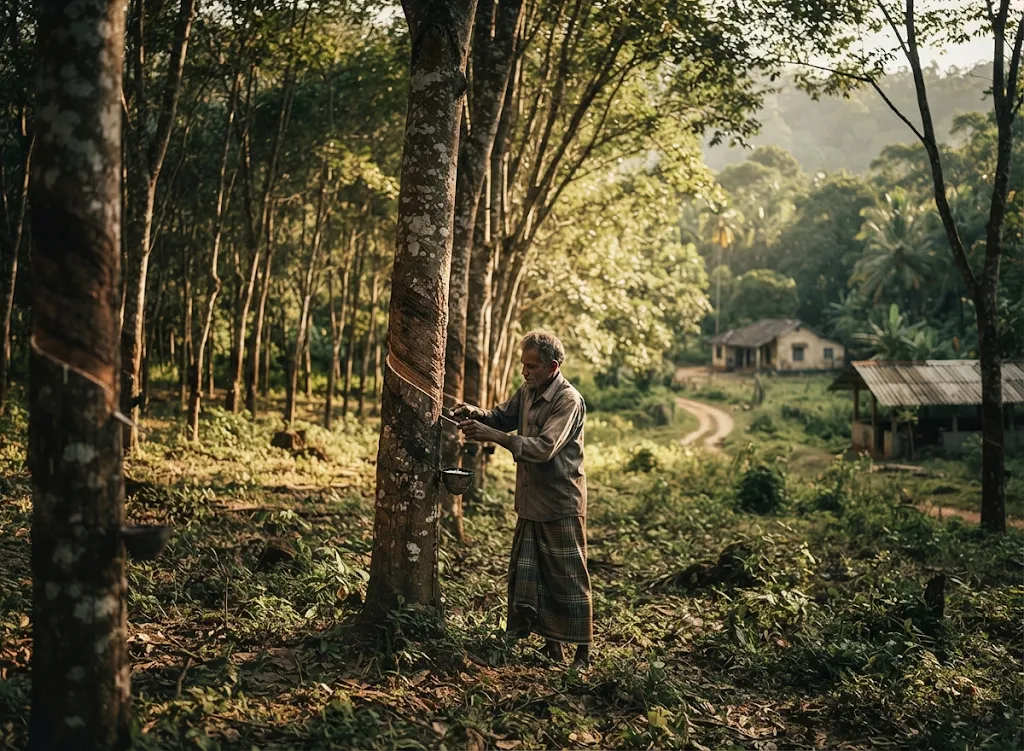
Sri Lanka’s natural rubber industry is marking 150 years of cultivation with renewed calls for government intervention to address declining productivity, investment uncertainty and mounting international compliance requirements that threaten its long-term competitiveness.
The Colombo Rubber Traders’ Association (CRTA) has said the anniversary should be used to revitalise the industry rather than simply celebrate its past, warning that structural weaknesses across cultivation, plantation management and supply chains need urgent attention.
The industry began in 1876, when Hevea brasiliensis seedlings arrived at the Henarathgoda Botanical Gardens in Gampaha, and grew into an important sector supporting rural livelihoods, manufacturing and international trade.
Today, however, it faces ageing trees, stagnant productivity, rising production costs, labour shortages and insufficient replanting.
“Celebrating 150 years of Sri Lanka’s natural rubber industry is an occasion of immense pride for our nation,” CRTA Chairman Harin de Silva has said.
Investment uncertainty
A major concern is the long-term investment outlook for Regional Plantation Companies (RPCs), whose land lease agreements expire in 2045.
The CRTA has called for these agreements to be extended, arguing that greater certainty over land tenure would encourage investment in replanting, productivity, infrastructure and sustainable management. Without this, companies may struggle to commit long-term capital.
Smallholders also need support to keep cultivation viable. The association has identified effective rain-guarding, access to quality planting material, better cultivation practices and stronger replanting programmes as key measures.
It has also urged authorities to explore expanding cultivation into suitable drier and non-traditional areas, subject to research, climate assessments and land-use planning.
Global competition and regulation
Exporters also face price volatility, shifting industrial demand and stricter environmental and supply-chain rules, notably the European Union Deforestation Regulation (EUDR) and its traceability and geolocation requirements.
The CRTA has said the sector needs coordinated technical assistance, clear regulatory guidance and help in collecting and verifying supply-chain data. It has argued that sustainability should be seen not merely as an obligation but as an opportunity to strengthen Sri Lanka’s reputation as a reliable supplier of quality rubber.
Research and manufacturing strengths
Sri Lanka’s standing rests on strong research and expertise in specialised grades. The Rubber Research Institute of Sri Lanka, founded in 1909 and recognised as the world’s oldest, built the country’s technical foundation, while its latex crepe grades earned a reputation for premium quality. The 1952 Rubber-Rice Pact with China underlined the commodity’s role in export earnings.
The CRTA has said the next phase must expand value-added manufacturing, building on Sri Lanka’s position as a major solid tyre manufacturing centre and its production of surgical gloves, latex bedding and specialised industrial products.
It has called for greater investment in technology, innovation, quality and export market development, and closer collaboration across the industry to direct Sri Lankan rubber towards markets that reward quality and technical performance.
Trading sector remains central
The CRTA has said traders remain an essential link between producers, processors, manufacturers and international buyers, with the Weekly Colombo Rubber Auction serving as a central marketplace for more than 116 years.
Beyond buying and selling, traders provide financing, quality assurance, market intelligence, logistics and risk management. A predictable and competitive business environment, the association argues, would allow them to support producers and strengthen access to overseas markets.
It has called for coordinated action by the Government and all industry stakeholders around five priorities: improving productivity and replanting; strengthening the viability of smallholders and plantations; expanding research, innovation and value addition; improving supply-chain transparency and regulatory readiness; and reinforcing international competitiveness. “Our responsibility is to ensure that rubber remains a viable livelihood for our growers, a dependable source of business for our traders, a competitive raw material for our manufacturers and a trusted product for our international customers,” de Silva has said












Leave a comment