
By Dr. Nadee Dissanayake
Physically here, emotionally elsewhere
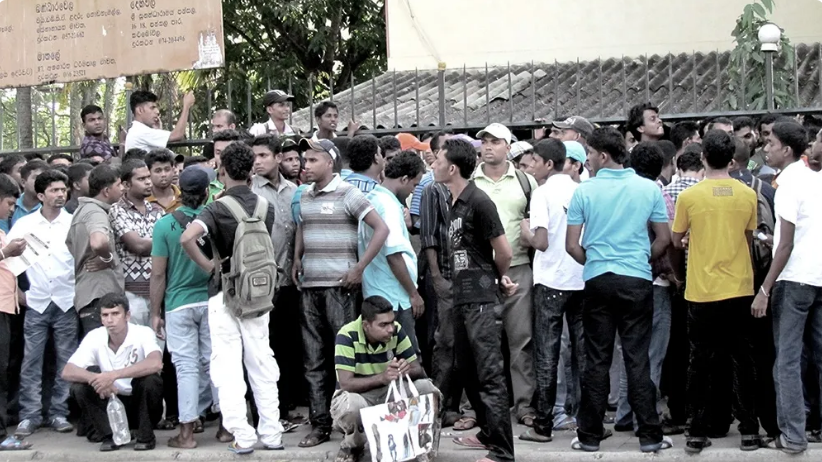
Sri Lanka’s young people are not all queueing at embassies or rushing to catch flights abroad. Many still attend university lectures, report to offices each morning, and scroll job portals late into the night. On the surface, they remain present. But beneath this visibility lies a quieter reality: emotionally, a growing number have already withdrawn.
This is not migration in the conventional sense. It is something subtler and far harder to track – emotional migration. It involves the gradual erosion of trust, hope, and long-term commitment to the country. It does not appear in emigration statistics or foreign employment figures, but its impact may ultimately be more damaging than the visible loss of people.
Conversations with final-year undergraduates, early-career professionals, and first-time job seekers reveal a shared emotional landscape. They are not angry or confrontational. They are weary. Careful. Increasingly reluctant to take risks.
Life is planned in short intervals; six months, a year at most. Major decisions such as marriage, home ownership, entrepreneurship, or postgraduate study are postponed indefinitely. This hesitation is not a sign of diminished ambition. It reflects a deeper perception: ambition now feels unsafe.
The promise that once anchored a generation
For decades, Sri Lanka offered its youth a powerful assurance: education, especially free education, would be the pathway to dignity, stability, and upward mobility. This was not merely a policy choice; it was a social contract. Families made sacrifices, students endured intense competition, and in return, society promised opportunity and belonging.
That promise has weakened. Graduates entering the labour market today face prolonged recruitment processes, temporary contracts instead of permanent positions, and starting salaries eroded by inflation.
While headline inflation has eased since the worst of the economic crisis, the everyday cost of living – food, transport, rent, utilities, and healthcare – remains disproportionately high relative to income.
Even young people who are employed live with constant vulnerability. A single shock – a medical emergency, a rent increase, or the responsibility of supporting ageing parents – can undo years of effort. Savings are minimal. Credit is expensive. Social safety nets are thin.
Faced with this environment, young Sri Lankans adjust their expectations, not by dreaming bigger, but by expecting less. They save instead of spending. They delay instead of building. They observe instead of leading.
This emotional retreat does not register in official data, but its effects are visible: declining innovation, reduced civic engagement, and a culture shaped more by caution than confidence. A society struggles to progress when its youngest members are conditioned to minimise risk rather than imagine possibility.
When risk stops looking brave
Starting a business in Sri Lanka used to be seen as brave and inspiring. Today, for many young people, it feels like stepping into a storm.
They have watched enterprises collapse overnight during economic crises and seen small businesses destroyed by sudden policy shifts, import bans, and power cuts. Hard work and compliance no longer guarantee survival when the system itself is unstable. The lesson they learnt was clear: self-preservation comes first.
That shift in mindset is reshaping the choices of an entire generation. Young Sri Lankans increasingly opt for short-term contracts, remote gigs, or overseas opportunities, not always for higher pay, but for predictability.
When survival becomes the default, risk-taking and innovation take a backseat. Entrepreneurship weakens, leadership pipelines shrink, and national progress slows. What feels like a sensible personal decision today may be a costly roadblock for the country tomorrow.
Degrees without direction
Sri Lanka continues to broaden access to higher education. University enrolment is up, and private education is booming. But graduate dissatisfaction is growing. The problem isn’t education itself; it’s a mismatch.
Many degrees no longer lead smoothly to jobs. Employers lament skills gaps, while graduates face underemployment. Young people are repeatedly told to reskill, retrain, and chase extra qualifications, often at their own cost, just to stay competitive.
Free education increasingly feels incomplete. Parents who once saw it as a guaranteed ladder to stability now watch their children struggle not due to failure, but because the system falls short.
The result is quiet disillusionment rather than protest. Students attend lectures, submit assignments, and graduate, but stop imagining futures. Certificates are earned, yet belief steadily fades, leaving hope and ambition quietly drained.
Love for country, absence of trust
Perhaps the most painful contradiction is that many young Sri Lankans still love their country deeply. They cherish family, culture, language, and community. They want to stay close to their parents, to contribute, to belong.
But love alone cannot sustain commitment when trust is missing. Trust grows when effort is rewarded, rules are predictable, and institutions act reliably. Instead, young people have seen sudden policy shifts, administrative failures, and weak accountability. The lesson is clear: planning can be dangerous.
When trust fades, retreat becomes the default. Youth disengage from civic life, shy away from leadership, lower their expectations, and quietly keep exit options open emotionally, if not physically.
Sri Lanka is not losing all its young people to borders; it is losing many to distance, disconnection, and disillusionment. The real flight is silent, invisible, and far more consequential than any migration statistics can capture.
The silent cost of emotional migration
Emotional migration is particularly dangerous because it creeps in quietly, almost invisibly. It rarely makes headlines, yet it slowly drains a nation of its most critical resource: belief in the future.
A generation that doubts long-term stability will hesitate to invest financially, socially, or emotionally. It avoids risk, refrains from building institutions, and disengages from public systems. Compliance becomes minimal, participation optional, and ambition tempered. No economic recovery, no matter how technically sound, can succeed without restoring this sense of trust and purpose.
Sri Lanka’s recent stabilisation efforts have improved macroeconomic indicators: growth is returning, inflation is moderating, and external balances are strengthening. But for many young people, these figures remain abstract.
Recovery is not measured in GDP points; it is experienced in whether effort actually leads somewhere, whether tomorrow feels safer than today, and whether planning for the future makes sense. Without this lived confidence, economic gains cannot translate into meaningful progress for the next generation.
Rebuilding confidence, not just the economy
Keeping young people engaged is not simply about higher wages, migration restrictions, or policy slogans. It is about restoring confidence in fairness, predictability, and opportunity.
Young Sri Lankans do not expect perfection. They expect honesty. They want systems that reward effort, cushion sudden shocks, and treat them as stakeholders rather than expendable labour. If certainty cannot be offered, credibility must be.
Sri Lanka now faces a defining choice. It can continue stabilising the economy while overlooking the quiet emotional disengagement of its youth, or it can recognise that recovery without belief is fragile and incomplete.
A nation cannot truly rebuild if its young people are present only in body, not in spirit. Emotional migration may be subtle, but its consequences will echo for decades. Reversing it will require more than technical reforms.
It will require rebuilding trust patiently, visibly, and consistently so that young Sri Lankans once again feel that staying is not merely possible, but meaningful and worth the risk. The future of the nation depends not just on policies, but on winning back the hearts and hope of its youth.
(The writer is an independent researcher)
(The views and opinions expressed in this article are those of the writer and do not necessarily reflect the official position of this publication)
Source: The Sunday Morning








Leave a comment