
Going beyond facing emergency situations to build strong mechanisms with State and community participation
By Kaushi Jayawardena
The trembling shock from a disaster does not fade from hearts and minds in a short time given the impact of the shock that spreads throughout people’s lives, placing a burden on individuals far beyond what numbers can measure.
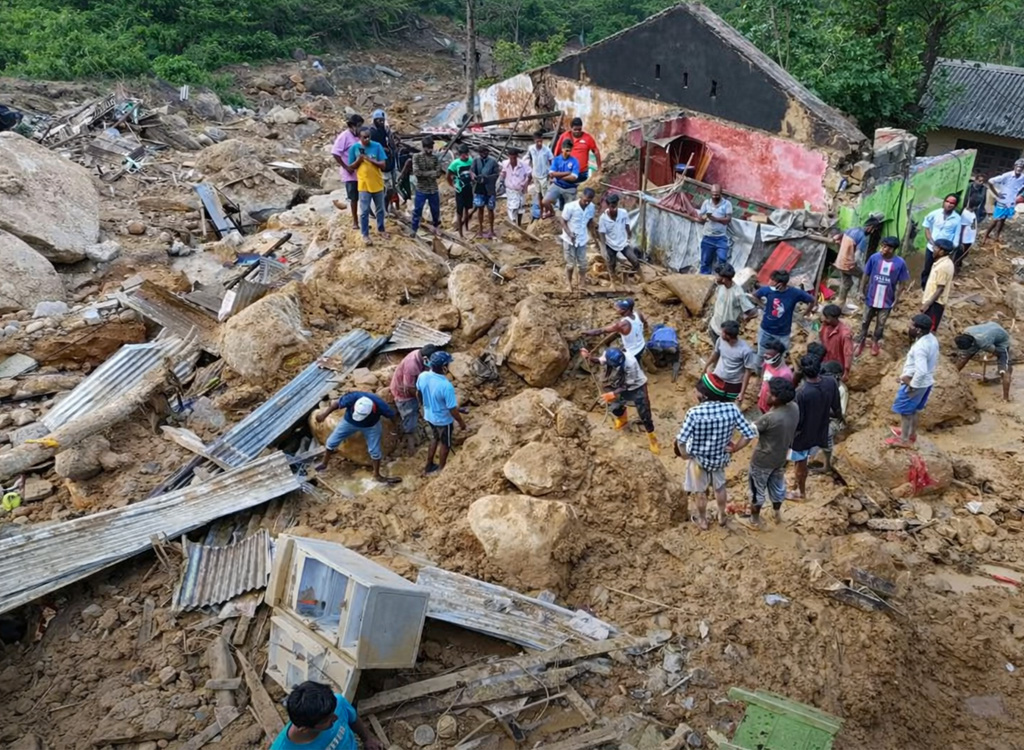
The Ditwah cyclone left behind devastation that caused much physical and mental trauma to those affected.
Even after the Ditwah cyclone has passed, a series of formal discussions was recently initiated by the Rights Now organization to examine whether the country is properly carrying out the necessary post-disaster plans, and the level of prior preparedness for such disasters. This was the second discussion in a series on managing the disaster situation following Cyclone Ditwah. The theme of second discussion of the Samabima Dialogue Forum was: “The Role of Government Disaster Management Institutions in Disaster Response and Recovery” with resource contribution provided by Menaka Wijesinghe, Secretary of the Association of Disaster Risk Management Professionals (ADRIMP).
A disaster is not merely an unfortunate natural event; it is a test of time that measures a society’s organisational strength, the functionality of its governance system, and the sense of responsibility people hold. In such situations, Sri Lanka’s government disaster management institutions play a broad role — from saving lives to long-term recovery.
The 2004 tsunami disaster opened a new chapter in disaster management for Sri Lanka. Following its aftermath, the Disaster Management Centre (DMC) was established in 2005, initiating the identification of disaster risks across the country, organising early warning systems and training programmes, and building a coordinated process at the local level. National and district disaster management centers provide the basic structure for collecting disaster information, issuing warnings, and implementing emergency response plans under the Disaster Management Centre (DMC).
The first step in disaster response is saving lives. During sudden situations caused by floods, landslides, or dry weather conditions, the DMC works in close coordination with the security forces, police, health services, and local government institutions. Providing temporary shelter for the displaced, drinking water, medical facilities, and essential goods are the core functions of this stage. This is not merely an emergency reaction but a planned and coordinated process.
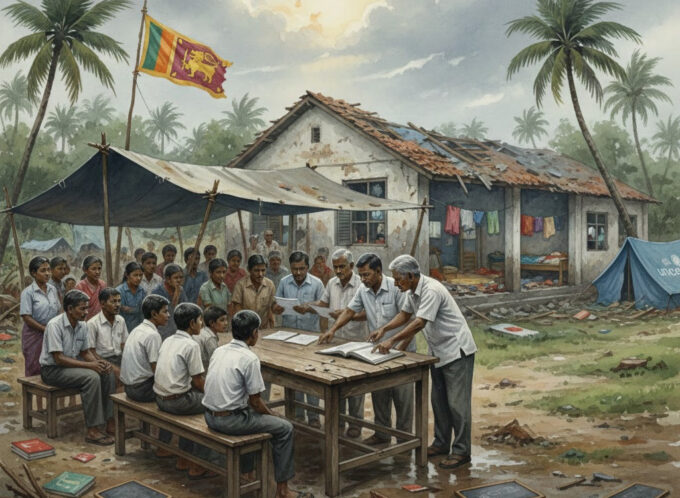
However, disaster management does not end with providing immediate relief. In the recovery phase, rebuilding destroyed houses, schools, roads, and water supply systems, re-establishing livelihoods, and reviving local economies become important. The goal of any government is not merely to return to the previous state, but to build a safer and more sustainable structure – build back better.
Disaster risk education
Similarly, disaster risk reduction is an essential element for long-term safety. Through geological surveys, preparing risk maps, school-level preparedness programmes, and community awareness initiatives, efforts are made to minimise disasters before they occur. In this scenario, coordination is not only among state institutions, but participation from the private sector, non-governmental organizations, and community-level involvement is also essential.
Ultimately, the role of disaster management institutions is not only to act urgently during a calamity but to prepare in advance to create a situation where disasters do not occur. Examining Sri Lanka’s disaster response and recovery process invites a deeper conversation about our responsibility as a nation, coordination, and securing future generations.
In this regard, Wijesinghe, Secretary of ADRIMP, who took a very important approach, emphasized that disaster management is one of the most in-demand topics in the world today. He further stressed that climate change is currently the most discussed topic globally, and that Sri Lanka has also taken steps such as aligning with various agreements and establishing institutions in that regard.
Due to its geographical location, monsoon weather patterns, and spread of settlements, Sri Lanka continuously faces natural disasters such as floods, landslides, atmospheric cyclones, dry periods, and sea-related issues. Especially due to climate change, the intensity and frequency of these disaster situations are steadily increasing.
Structural issues
Since the 2004 tsunami, the country’s disaster management system has been significantly strengthened organizationally. Under the DMC, preparedness, response, and rehabilitation activities are carried out at national, provincial, and local levels. However, there are several clearly visible problematic situations. When asked about them, Wijesinghe expressed, “We have faced various disasters at different times. But the biggest disaster to affect the country after the tsunami was Ditwah. Several problems became visible here. One is whether the community at the ground level was prepared for this. Is the disaster management structure really close to the ground? This is a subject under the central government. At the ground level, there are only a small number of Grama Niladhari officers and disaster management intervention officers. The institution closest to the ground is the National Disaster Relief Services Institute, which operates at the Divisional Secretariat level. There is an institutional question about how much connection there is between these two. Once the Disaster Management Act was enacted, it clearly included provincial and district structures. But there is a problem in operationalising them. This is not an individual problem; it is a structural problem. The difficulty in maintaining this at the ground level arises from maintenance issues.”
He further noted, “For a long time we have maintained a mindset of complete dependence on the military in disaster management. This also contributes to the weakness of these structures and systems. Because people have strong dependency on these structures, they think that even if we do nothing, the military or police will come and save us. There is also a problem with methods of directly involving village people in this.”
Another issue that Wijesinghe pointed out was that the concept of a ‘village’ is not a technical one. “A village is usually defined either by road boundaries or some other minor factor. Normally, a disaster does not affect an entire village in a uniform way. Usually, half of one village, part of the next village, and some from another are affected. There are no specific values assigned to them. Even if a disaster management committee is formed in a village, if it does not directly affect the people themselves, that committee is of no use to them. If I am in trouble and there is no help, that disaster management committee is useless. During the Ditwah cyclone too, whether there were organized teams at the ground level with the capacity to work in a coordinated manner was a problem,” he noted.
Disaster management should not be based solely on state intervention; it must be a process in which the entire society comes together. At its heart are the volunteers. If their active and professional training and coordination are strengthened, Sri Lanka can become a more prepared and resilient society in facing disasters. On this matter, Wijesinghe stated, “In the disaster management plan prepared this time, the word ‘volunteers’ is nowhere to be found. These are created with a centralized mindset. When working voluntarily, ranks and positions are not important. More attention must be given to volunteers. Even though the military and police intervene in such situations, there are several areas that need to be attended to before they intervene. Likewise, they should be called in only when the community can no longer manage the situation themselves. Such situations should be developed from the ground up.
There is still no dedicated fund allocated for disasters in Sri Lanka. When distributing relief, there should be a proper mechanism to distribute aid correctly to those affected, as mentioned in the Act. Who is responsible for this? How many people receive it? How much money has been allocated? There should be a proper method and on-site process based on accurate data. This has not happened. These kinds of measures are not being implemented properly. That is why they contribute to failures.”
Overall, while Sri Lanka has a strong legal and organizational foundation for disaster management, the practical implementation efficiency and community coordination still require further strengthening.
Disaster response and recovery is not merely providing immediate assistance; it is a long-term process of building a stronger society by minimising future disaster risks. National-level plans coordinated by the DMC, early warning systems provided by the Department of Meteorology, and technical advice given by the National Building Research Organisation (NBRO) can be combined to build the structural strength of disaster management.
Another key factor in ensuring a strong disaster mitigation and preparedness system would be to conduct periodic reviews of the disaster management plan to address recurring issues related sustainability and ensure the plan remains futuristic as well as to ensure that the review and evaluation processes should be conducted for all state institutions, which should not be limited to a post-disaster assessment. Accountability regarding any failures in addressing a disaster would also help further strengthen the country’s disaster mitigation and preparedness mechanisms.
However, the fundamental factors of a successful response are inter-institutional cooperation, community coordination, and science-based decision-making. The recovery process should not be limited to physical reconstruction; it must also include restoring livelihoods, education, mental well-being, and more.
The role of disaster management institutions is not only to face an emergency situation. When strong legal backing, technological innovation, and community participation come together, Sri Lanka can move forward not just as a country that faces disasters, but as a nation that becomes stronger through them.
Disclaimer: The views and opinions expressed in this article are those of the writer and do not necessarily reflect the official position of the organization.






Leave a comment