
By Dinouk Colombage
Recent appeals made by President Donald Trump to America’s traditional allies has illustrated that regarding the war in Iran, the US and Israel stand alone. Much has been written about this matter, with several opinions emerging over what the absence of a positive response to the call of arms by the U.S. means. Arguments have been made that this is (1) a clear indicator that President Trump does not command the support of the international community. While (2) others have clung to the possibility that nations are attempting some semblance of adherence to the Rules Based Order. And (3) the refusal has been attributed to the fact that is simply a war that no other nation sees any advantage in involving itself in.
There is, to this writer’s mind at least, the argument to be made that the global community is in fact finding itself caught in an amalgamation of reasons 1 and 2. Mainly the U.S. President has to a great extent lost the support of the U.S’ allies, brought on by the Trump Tariffs and the continuous un-presidential outbursts against countries on social media, and the world choosing to stay on the sideline and observe whether the global pecking order is indeed undergoing a changing of the guard. As the days proceed in the war, it is becoming clearer to those both in Washington and around the world that in fact Israel is dictating the actions taken by America. In a recent post on his social media, Truth Social, President Trump stated that the recent attack by Israel on the South Pars Gas Field in Iran was carried out without US knowledge. A similar admission was made at the beginning of the war when U.S. Secretary of State, Marco Rubio, explained that America believed a pre-planned Israeli attack on Iran would have resulted in Iran striking out in retaliation at U.S. interests in the region, and so they decided to strike Iran first.
Ever since the October 7 attacks by Hamas on Israel, that resulted in Israel’s alleged genocide in Gaza, the world has found itself divided over Israel and their growing influence over the U.S and to a lesser extent Europe. While America has shown itself as a continued ally of Israel, the Global South has attempted to distance themselves from the country, pursuing UN resolutions condemning the war in Gaza, while the citizenry of these nations decries the actions of the Israeli government.
In the case of Iran, the outcry has been noticeably silent – despite mounting evidence emerging from both the U.S. and international bodies that Iran posed no significant threat to America, the justification used to launch the attacks. In fact, last week the U.N. Security Council overwhelmingly adopted a resolution which condemned the attacks launched by Iran against its neighbouring states, while making no mention of the U.S. and Israel’s unprovoked attacks on Iran. While significant support for the resolution emerged from the General Assembly, both Russia and China, who have condemned the attacks in the past, chose not to use their veto. Whether this was due to the large support the resolution held in the General Assembly, or whether it is part of a wider strategy by China to tilt the global order away from the U.S. is a question that needs answering.
As Israel’s war in Gaza raged on, global opposition to the conflict continued to mount as was demonstrated by the increasing number of U.N. resolutions demanding a cessation to hostilities. Despite this opposition America, under President Joe Biden, did not shy away from disregarding global sentiment and chose to veto any such resolutions that made it to the Security Council. It is therefore unlikely that either China or Russia, both known for not taking notice of global opinion when it runs contrary to their agenda, would have simply disregarded their previous condemnation of the U.S/Israel attacks without attempting to include such wording to accompany the rest of the resolution.
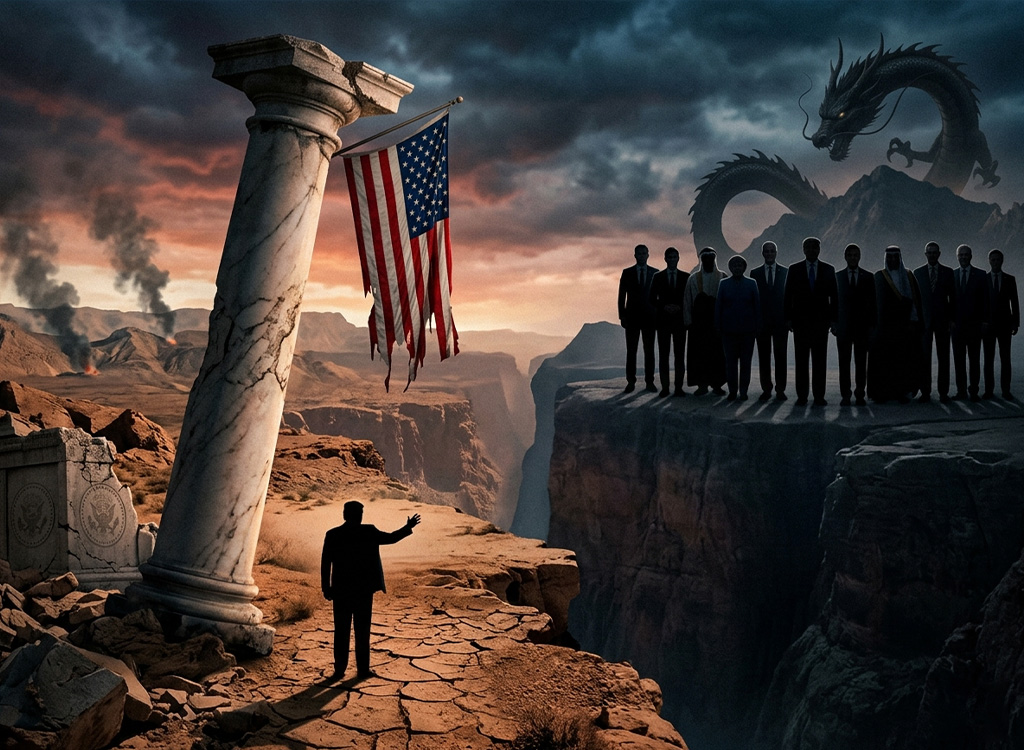
The hypothesis that now emerges is that in fact the absence of any focused opposition to the U.S. and President Trump’s continued war in Iran is a calculated move to hasten the decline of the U.S. on the global stage. The absence of international support for the U.S’ campaign has demonstrated that America no longer commands the seat of power it once did, post World War 2. The responses by nations following the imposition of the Trump Tariffs in early 2025 demonstrated the need for countries to seek out alternatives to the U.S. Europe and the U.K. were among those that explored alternative markets, including in India. China, who for the past several years has been portrayed as a global economic bully, was suddenly being approached with open arms by the Global North.
In turn the U.S. was seen as weaponizing the dollar, forcing countries to fall in line with their latest global agenda sans discussion and compromise among allies. To make matters worse, the U.S. was being seen as openly flouting the globally adhered to Rules Based Order, resorting to “economic coercion” when negotiating with rising economic powers. Under Trump 1.0 the world was unprepared for the ad-hoc decision making style of Donald Trump. His decisions to withdraw America from global organisations such as the UNHRC and the Paris Climate Accords left nations scrambling to adapt. On this occasion the actions of the U.S. President, while certainly more extreme than his last term in office, does not leave the global community truly shocked.
As the world continues to lose confidence in the U.S, the opportunities are fast emerging for competitors to replace America, before a newly defined multipolar world order is established. Absence of direct opposition, by countries such as China, to the U.S. is not indication that they are unwilling, but rather that they are allowing the U.S. to damage itself rather than tackle them head-on.
The U.S’ grip on their status as the “leader of the free world” has slackened greatly. The response by the global community to the war in Iran is in direct contradiction to what was seen in 2022 following Russia’s invasion of Ukraine. On the back of invasion, it was the U.S. that galvanised the “Coalition of the Willing”. The failure to summon a similar military coalition to support the U.S’ actions in Iran, demonstrates that America’s partners have recognised its dwindling power base. In fact, while many nations have not only spurned Donald Trump’s pleas for military support, they have approached the Iranians and sought assurances that their vessels will be allowed to pass through the Strait of Hormuz un-harassed. Not only has the U.S. found itself devoid of allies in the war, but they have also found themselves facing an absence of opposition to their actions. In turn this has allowed the impetuous actions of Donald Trump expedite America’s demission as the global leader.
As Donald Trump drives forward the war in Iran it will not be the drones or missiles emanating from the region that will signal America’s decline, but rather the silence of opposition which might possibly have served as the counsel that America so dearly needs.
(The writer is the Chief Research Officer at the Geopolitical Cartographer and has previously served as the Director of International Affairs to former President Ranil Wickremesinghe)
Disclaimer: The views and opinions expressed in this article are those of the writer and do not necessarily reflect the official position of this publication.









Leave a comment