
By Methmalie Dissanayake
Three months after Cyclone Ditwah triggered devastating floods and landslides across Sri Lanka, thousands of families remain displaced, with many still living in temporary shelters, camps, overcrowded homes, and rented rooms as the State struggles to move from emergency relief to long-term resettlement.
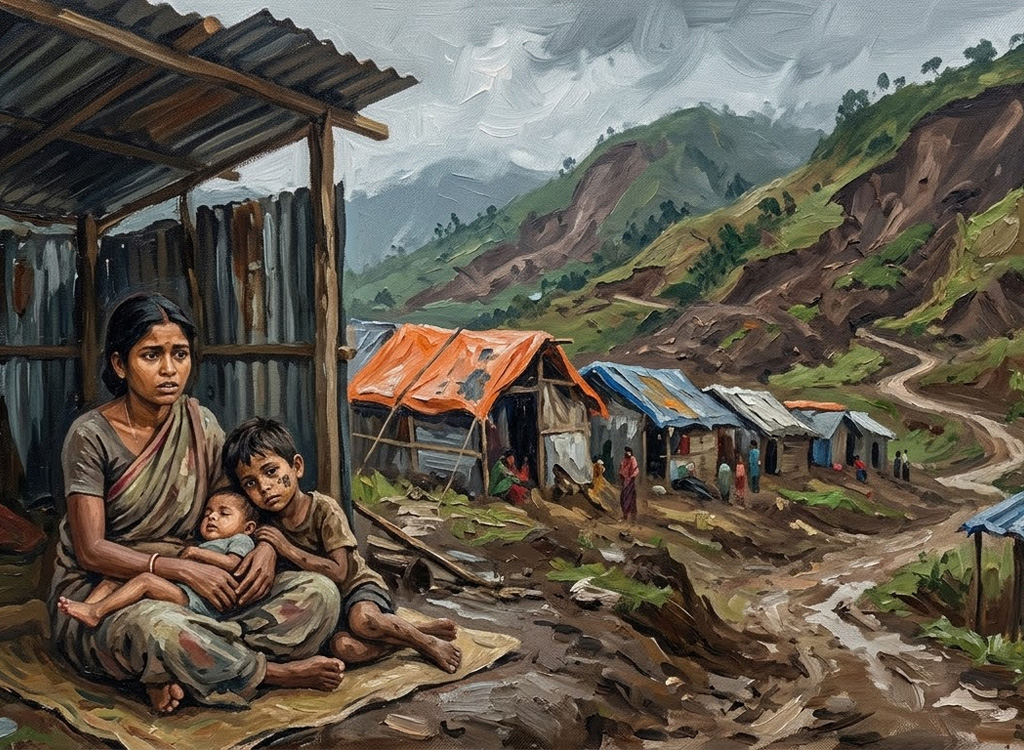
In Haggala and Rendapola in Nuwara Eliya, 23 estate families displaced by landslides are still living in temporary tents provided within the estate. Residents say the conditions are extremely difficult, with no proper drinking water, electricity, or sanitation facilities.
“We have been in these tents for two months now. They gave us a solar light, but it only works for an hour,” one resident said. Another described the difficulty of meeting even the most basic daily needs. “We have to carry drinking water here ourselves. If it rains, we can’t stay at all because everything gets muddy.”
Residents said there were no toilets in the settlement and that the tents offered little protection against the cold nights and heat during the day. Parents also said that the conditions had become particularly difficult for children.
“Our children have no way to go to school; they can’t even manage their uniforms here,” one parent said. “We have to cook and eat our food while it’s cold, using phone torches to see in the dark. The children are suffering in the darkness.”
There is also growing anxiety over the coming windy season, with families fearing that the temporary shelters will not withstand stronger weather conditions in the months ahead. “When the winds start next month, we won’t be able to stay here. The tents will blow away in the wind,” a resident said. A young mother appealed for urgent intervention. “If you could build us a house where we can live freely before the windy season, it would be a great blessing.”
As of 3 March, 3,146 individuals from 1,075 families were still living in 32 active safety centres. However, a far larger number of displaced people – 14,927 persons from 43,831 families – are staying with relatives or friends, or in other alternative locations outside formal shelters.
Among the worst-affected districts, Nuwara Eliya, Badulla, and Kegalle recorded some of the highest numbers of displaced persons staying outside official camps, with Nuwara Eliya alone accounting for more than 60,000 such individuals.
The prolonged displacement has been particularly severe in the plantation sector, where many Malaiyaha Tamil families, who were already facing long-standing social and economic vulnerabilities, continue to struggle for safe shelter, land, and basic services in the aftermath of the disaster.
Latest data on displacement and compensation
The State has mobilised substantial financial assistance for post-disaster recovery. As of mid-February, the Government had distributed around Rs. 24,438.79 million in total relief.
This included Rs. 10,674.08 million in house cleaning allowances of Rs. 25,000 paid to 426,963 families, reaching a completion rate of 98.37%, and Rs. 7,186.45 million in house restoration allowances of Rs. 50,000 paid to 144,377 families, covering 83.63% of targeted recipients. In addition, Rs. 2,389.07 million had been allocated to support 159,271 schoolchildren affected by the disaster.
The same allowance structure has also been used for business recovery, with grants of Rs. 25,000 for pavement and mobile traders and grants of Rs. 50,000 for unregistered businesses operating in fixed domestic buildings, as well as unregistered production industries and warehouses.
The progress of these payments has varied across districts. In Colombo, Rs. 1,281.73 million had been distributed for house cleaning grants, reaching 95.02% completion, and Rs. 1,825.65 million for house restoration, reaching 92.74% completion. In Gampaha, Rs. 1,905.10 million had been distributed for house cleaning grants, reaching 99.31% completion, and Rs. 1,409.50 million for house restoration, with 84.26% completion. Puttalam recorded a relatively high completion rate for cleaning grants at 96.87%, but a lower completion rate for restoration grants at 70.30%.
Some districts lagged behind significantly in the distribution of Rs. 50,000 restoration grants, with Kalutara having recorded 0% completion, while Trincomalee stood at 15.97%, Polonnaruwa at 43.68%, and Puttalam at 70.30%. In contrast, districts including Badulla, Monaragala, Batticaloa, Kilinochchi, Ampara, Jaffna, Nuwara Eliya, Matara, and Vavuniya had achieved 100% completion for these payments.
International aid and donations have added more than Rs. 3,006 million to recovery efforts, funding vehicles and transport equipment valued at Rs. 1,557 million, medical supplies and emergency health services worth Rs. 137.45 million, and tools, equipment, and shelter materials, including bedding.
According to the latest situation report, 5,933 houses were fully destroyed and 115,501 houses were partially damaged. Earlier assessments by the National Disaster Relief Services Centre (NDRSC) also showed that Gampaha, Colombo, and Kegalle were among the districts with some of the most widespread partial housing damage.
Even so, researchers and activists working with estate communities argue that the ongoing displacement of plantation workers exposes deeper structural inequalities in land allocation, disaster response, and housing policy.
Vulnerability of the Malaiyaha Tamil community
Speaking on the matter, Centre for Policy Alternatives (CPA) Researcher Selvaraja Rajasegar said the Government’s repeated claim that there was no safe land available for resettlement in districts such as Badulla had been contradicted by the way plantation land had historically been used.
“Not a single estate bungalow or factory was damaged during the disaster because they are all built in safe places,” Rajasegar said. “Those buildings were constructed decades ago on the most stable land in the estates. Yet when it comes to housing workers, authorities suddenly claim there is no safe land available.”
He argued that the issue was not the absence of land but the lack of political willingness to allocate suitable land to estate communities. Rajasegar pointed to data from a Plantation Ministry report showing that between 1980 and 2007, around 46,272 hectares of plantation land had been removed from the sector and diverted for uses such as schools, public institutions, and investment projects.
Against this backdrop, he said that the amount of land required to address the housing needs of displaced estate families was comparatively small. “Providing six perches of land to about 150,000 families would require only around 2,277 hectares,” he said. “Even if the Government were to follow the Land Reform Commission law, which suggests allocating 20 perches per family, it would require only about 10,120 hectares. That is still less than a quarter of the land that has already been taken out of the plantation sector.”
Rajasegar questioned the narrative that resettlement was impossible due to land scarcity, noting: “The numbers clearly show that land is available if the State decides to prioritise the housing rights of estate workers.”
He also criticised reported proposals to relocate affected plantation families into high-rise housing complexes, saying these did not respond to the long-standing demand for land ownership. “These communities have fought for generations to obtain land ownership and dignified housing,” he said. “Forcing them into high-rise flats does not address those demands. It ignores the fundamental issue, which is access to land.”
Rajasegar further pointed to what he described as disparities in the value of housing programmes. Houses built under the Indian housing scheme for plantation workers are valued at about Rs. 2.8 million, while houses reportedly allocated for other disaster victims have been valued at around Rs. 5 million.
“This raises serious questions about equality in disaster recovery policies,” he said. “If the State recognises the Malaiyaha community in Parliament and in national policy, then they must also be treated equally when it comes to housing standards and investment.”
He stated that temporary housing conditions in plantation areas remained deeply inadequate. In Agarapathana, displaced families had reportedly been placed in small temporary structures made of corrugated iron sheets measuring roughly 6 ft by 6 ft, with entire families of five or six expected to live inside them.
“These are essentially tin boxes,” Rajasegar said. “Families are expected to eat, sleep, and live inside a single 6 ft by 6 ft space. These conditions have continued for months without a clear timeline for permanent housing.”
In Gowerakelle Estate near Ella, he said that families who had initially stayed in school buildings had later been asked to leave once classes had resumed, but no proper alternative accommodation had been arranged. “As a result, many families were forced to move into already overcrowded estate quarters,” he said. “In some cases, eight or nine families are sharing a single set of rooms. Others have been placed in small dispensary wards that were never designed for long-term accommodation.”
The lack of infrastructure in these temporary locations has also affected schoolchildren, particularly those preparing for public examinations. “Students preparing for O/L and A/L Examinations are living in conditions where they do not even have electricity to study,” Rajasegar said. “In some places there is also no reliable access to water, meaning children cannot even properly wash their clothes or maintain basic hygiene.”
According to him, requests by displaced families for electricity connections in temporary shelters had been rejected by estate management. “When families asked for electricity, estate managers have refused, claiming there is a risk of short circuiting. But they have not provided any alternative solutions.”
Rajasegar also highlighted bureaucratic barriers preventing some displaced families from receiving rent assistance. Many had rented rooms in estate line houses to remain close to work and keep children in school, but the assistance scheme reportedly requires a property deed for the rented house.
“The Grama Niladhari asks them to produce the property deed for the house they are renting in order to release the rent assistance,” he said. “But estate line houses historically do not have individual deeds because the land is owned by plantation companies or the State. They cannot produce a deed for a house that has never had a deed. Because of that, rent assistance is denied.”
As a result, some families who had borrowed money in expectation of reimbursement are now facing mounting debt, while others are being pushed back towards unsafe areas. “Some families have taken loans in order to continue paying rent,” he said. “Others are being forced to return to their original houses, even though those houses are located in areas that have already been declared unsafe due to landslide risks.”
Rajasegar also raised concerns about the handling of relief items intended for displaced communities. “There are reports that relief items sent by the Disaster Management Centre are still sitting in storage rooms filled to the ceiling instead of being distributed to those in the camps,” he said.
Beyond the material hardships, he noted that prolonged displacement was taking a psychological toll, especially on women and children. “In many of these camps there is no privacy at all. Women and children are living in open shelters where anyone can enter or leave at any time.”
He added that sanitation facilities were often located far from sleeping areas, creating safety concerns at night. “In some locations, washrooms are far away from the shelters, which means women and children have to walk long distances in the dark.”
According to Rajasegar, overcrowding, uncertainty, and poor conditions have disrupted sleep, schooling, and daily life, yet there has been little institutional response to mental health needs. “No Government institution has stepped in to provide mental health treatment or psychological support for these victims.”
“What the community is asking for is very simple. They want safe land, proper housing, and equal treatment as citizens of this country,” he stressed.
Responses of the authorities
The National Building Research Organisation (NBRO) has, meanwhile, conducted thousands of inspections and identified 12,301 houses located in high-risk zones that require resettlement on safer land. Recovery strategies under discussion include the construction of new houses on privately owned land, renovation of structures where feasible, resettlement on Government-provided land or within housing projects, and direct financial grants for land and house purchases.
NBRO Director General Dr. Asiri Karunawardena said that inspections were continuing in relation to lands identified for resettlement. “We have inspected many lands shown to us by the Divisional Secretariat and District Secretariat. Regarding that, we have reported on the suitability. Many land inspections are in progress from our side,” he said.
Responding to concerns about delays in Badulla, Dr. Karunawardena noted that the district’s terrain itself posed challenges.
“As I understand it, Badulla is a mountainous area. In such a place, we have to look for land with minimum landslide potential. That’s what we prioritise. I don’t think there is a big concern regarding some lands because there are lands associated with estates as well.
“We have identified about 13,000 families that need to be safely resettled due to landslide risks. This figure includes several categories of at-risk households. Some of those families have lost their homes. For others, signs of landslides have appeared in their houses and land. There is another group of families where there is no immediate danger, but there is a possibility of risk in the future,” he explained.
He added that one of the main challenges was the technical nature of the process and the need to act within a short period. “This needs to be done in a very short period and it is a technical issue. So it took some time and we got involved to make a technical decision regarding the weather and rainfall conditions over time.”
Land Commissioner General Chandana Ranaweera Arachchi also acknowledged that resettlement challenges remained in landslide-affected areas. Speaking at a media briefing last week, he said that land was being sourced from State lands, donated lands, Land Reform Commission lands, and estate lands.
Suitable land has been identified in almost all districts, although delays continue in securing sufficient land in Badulla. Once potential sites had been identified, they had been inspected by the NBRO and only released after confirmation that they were safe for resettlement. According to him, around 90% of the land identification process has been completed.
The recovery process has also been complicated by growing dissatisfaction among public officials involved in relief work. Grama niladharis, Disaster Relief Services officers, and technical officers decided to halt their Cyclone Ditwah-related relief services from 27 February, citing several unresolved issues including the absence of a proper circular for relief assessment and the non-disbursement of promised allowances. As a result, the distribution of compensation has been completely halted for the past two weeks, The Sunday Morning learns.
All-Island Disaster Relief Services Officials’ Union Chairman Upul Kumara said that even 95 days after the disaster, the Government had failed to implement a proper mechanism for delivering relief to affected people.
He stated that grama niladhari trade unions engaged in relief distribution and the Technical Officers’ Trade Union Alliance, responsible for preparing damage assessment estimates, had repeatedly discussed the continuation of relief activities and proposed mechanisms for the proper delivery of relief services. However, he noted that neither the Government nor officials had introduced a satisfactory mechanism even after 95 days.
Kumara further stated that officers engaged in relief services were carrying an additional workload and had sought extra payments, yet no approval had been granted. He said that discussions had already been held with ministry secretaries and that officers were no longer prepared to continue discussions at that level. As a result, he said that they had decided to withdraw from relief services from 27 February.
Human cost of climate injustice
According to the ‘Issue Brief 4.0: Cyclone Ditwah’s Loss and Damage’ published in March by Greenpeace South Asia and the Workers’ Collective for Climate Justice, the disaster was characterised by prolonged, record-breaking rainfall rather than high winds. Scientific analysis highlighted in the brief indicates that human-induced global warming of approximately 1.3°C made these extreme rainfall events between 28% and 160% more intense than they would otherwise have been.
Researchers say this reflects a wider global imbalance: Sri Lanka contributes less than 0.1% of global greenhouse gas emissions, yet its communities are facing some of the most severe consequences of climate-related disasters.
According to the ‘Safety Centre Needs Assessment Report’ published in February by the Shelter, Land, and Site Coordination (SLSC) Sector, co-led by the International Organization for Migration (IOM) and the International Federation of Red Cross and Red Crescent Societies (IFRC), about 40% of the safety centres are schools and 18% are religious buildings.
While 85% of the centres are considered structurally safe, accessibility remains limited, with 60% not fully accessible for persons with disabilities. Living conditions also remain strained. The report notes that there is an average of 23 people per toilet across the centres, exceeding the international Sphere humanitarian standard of 20 people per toilet.
Privacy was also identified as a major concern. Only about 20% of the sites provide separate rooms for individual families, while another 20% offer shared rooms without any privacy measures. In addition, only 11% of sites provide lockable storage for personal belongings, leaving many displaced families without secure places to keep their remaining possessions.
Burden on women and children
The SLSC assessment found that women and girls make up around 48% of the displaced population, while children under the age of 18 account for approximately 26%. These groups face particular challenges within the relief system.
Maternal and menstrual health services remain limited. While pregnant or lactating mothers are present in 64% of the sites assessed, dedicated breastfeeding spaces are available at only 27% of them. Menstrual hygiene products have reached all women and girls in only about 60% of the sites.
Safety and privacy concerns also remain significant. The Greenpeace South Asia brief notes that women often carry a disproportionate burden in managing childcare and emotional distress in overcrowded environments. In addition, around 35% of sites lack measures such as security patrols or rules of stay to prevent harassment or violence. Children have also experienced significant educational and psychological disruptions following the disaster.
Beyond food assistance, displaced families have identified non-food items related to cleaning, cooking, and sleeping as among their most urgent needs. Health services also show notable gaps. Although most centres receive periodic visits from health workers, only 40% have an on-site first-aid kit, while around 24% report difficulties accessing essential medicines, the report points out.
Source: The Sunday Morning











Leave a comment