
By Chanakya
Sri Lanka’s state-owned enterprise (SOE) sector has reportedly delivered a mixed verdict in 2025. At first glance, the headline appears disappointing: combined profits of the country’s 51 major SOEs fell by 17.6% to Rs. 444.4 billion. Critics of public enterprises may be tempted to view this as further evidence of chronic inefficiency within the state sector.
But a closer examination tells a very different story.
The most striking finding in the Finance Ministry’s Final Budget Position Report 2025 is that the decline in overall profitability was almost entirely the result of a single institution – the Ceylon Electricity Board (CEB). Excluding the CEB, the remaining 50 SOEs had generated profits of Rs. 483.2 billion, an impressive 21.5% increase over the previous year. Far from deteriorating, much of the SOE sector had actually strengthened its financial performance.
This distinction matters because it highlights an uncomfortable reality in Sri Lanka’s public sector debate: aggregate figures often conceal important differences between commercially successful enterprises and those burdened by policy decisions, structural weaknesses, or regulatory constraints.
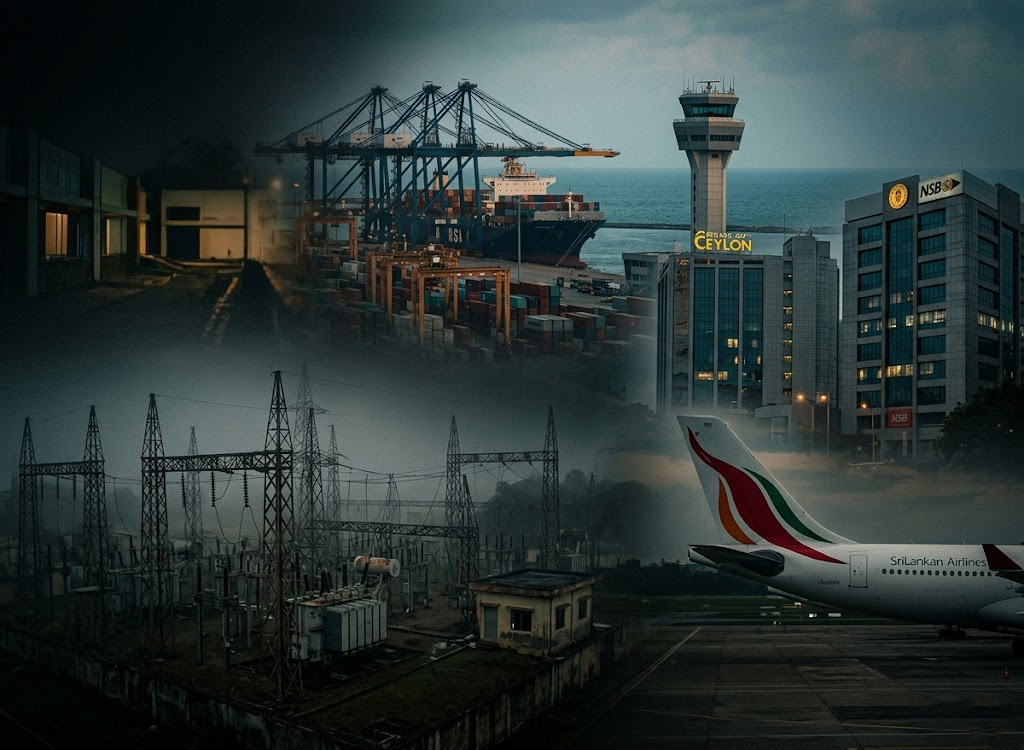
The strongest performers were institutions that operate with relatively clear commercial mandates. State-owned banks once again emerged as the backbone of public enterprise profitability. The Bank of Ceylon (BOC), People’s Bank, National Savings Bank (NSB) and Employees’ Trust Fund (ETF) had collectively generated hundreds of billions of rupees in earnings. The Sri Lanka Ports Authority (SLPA) had continued to benefit from strong logistics and maritime activity, while the Ceylon Petroleum Corporation (CPC) had recorded healthy profits despite lower global oil prices and declining revenue.
These results suggest that when governance structures are relatively stable and pricing mechanisms are allowed to function, state enterprises can generate significant value for the economy and for the Treasury.
The increase in Government revenue from dividends and levies – from Rs. 41.1 billion to Rs. 56.5 billion – is evidence of this contribution. At a time when Sri Lanka remains under pressure to strengthen public finances and reduce debt vulnerabilities, profitable SOEs are no longer merely administrative entities. They are becoming important contributors to fiscal stability.
CEB’s reversal
Yet the CEB’s reversal demonstrates how quickly those gains can be undermined.
The utility moved from a profit of Rs. 141.6 billion in 2024 to a loss of Rs. 38.7 billion in 2025. Significantly, this occurred despite higher electricity consumption and lower average generation costs. The principal cause was not operational collapse but a series of substantial tariff reductions that reduced revenue faster than costs could adjust.
This raises a fundamental policy question: can a utility operate sustainably under a cost-reflective pricing framework if political and regulatory interventions repeatedly alter tariffs?
Affordable electricity is a legitimate public policy objective. However, if tariffs are reduced without adequate consideration of financial sustainability, the burden ultimately falls elsewhere – either through future tariff increases, delayed investments, mounting debt, or taxpayer support.
The irony is that the CEB’s operational indicators actually contained encouraging signs. Increased renewable energy capacity, greater reliance on hydropower, and lower average generation costs indicate progress toward a more efficient energy system. Yet these gains were overwhelmed by the revenue impact of tariff reductions.
The lesson is not that reform has failed. Rather, it is that reform remains incomplete.
The Government’s decision to establish successor companies under the CEB’s unbundling programme and reduce legacy debt is a positive step. Similarly, the broader reform agenda – including the liquidation of dormant entities, consolidation of non-commercial enterprises, and the introduction of stronger governance frameworks – signals a commitment to modernising the SOE sector.
More reforms
The banking sector reforms deserve particular attention. The appointment of independent directors and the move toward stronger corporate governance standards represent important institutional changes. While such reforms rarely generate headlines, they are often the foundation upon which long-term performance improvements are built.
At the same time, the continuing losses at SriLankan Airlines serve as a reminder that some challenges remain deeply entrenched. The airline’s improved operational performance demonstrates that management efforts are yielding results. However, foreign exchange exposure and a massive debt burden continue to erode profitability. The improvement in liabilities and negative equity is encouraging, but the path to financial sustainability remains long and uncertain.
SOE sector in transition
What emerges from the 2025 figures is a picture of an SOE sector in transition. The traditional narrative that all state enterprises are financial burdens is increasingly difficult to sustain. Many are generating substantial profits, paying dividends, and supporting Government revenue.
However, success remains uneven. A handful of large institutions continue to carry significant structural risks, while policy decisions can quickly reverse financial gains even in enterprises that are improving operationally.
The challenge for policymakers is therefore not simply to make SOEs profitable. It is to create governance structures that allow commercially viable enterprises to operate with discipline, transparency, and predictability while ensuring that social and political objectives are pursued without undermining financial sustainability.
The 2025 results suggest that Sri Lanka is moving in that direction. But they also demonstrate how fragile progress can be when a single enterprise is capable of transforming an otherwise strong year for the entire SOE sector into a story of declining profits.
One utility should not define the SOE story. The real story is that reform is beginning to deliver results – but only if the Government has the resolve to see it through.
Disclaimer: The views and opinions expressed in this article are those of the writer and do not necessarily reflect the official position of this publication.











Leave a comment