
By Chanakya
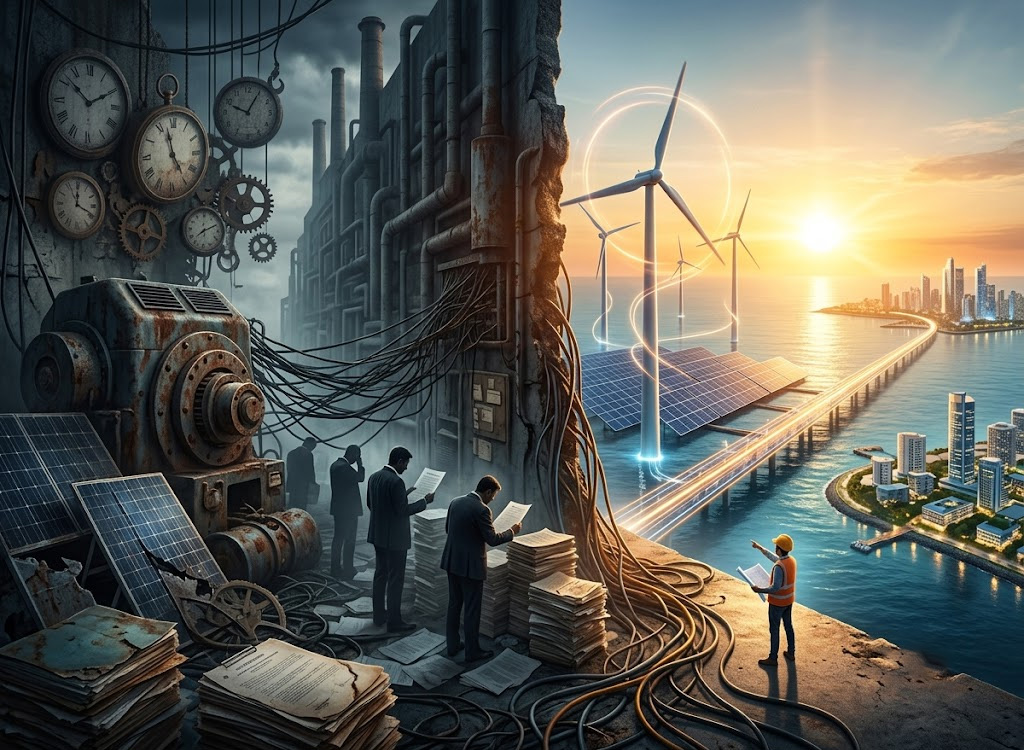
Sri Lanka has become remarkably good at announcing transformative infrastructure projects. Unfortunately, it has become equally adept at delaying them.
Nowhere is this contradiction more apparent than in the country’s growing portfolio of Indian-backed energy projects. From renewable energy parks and offshore wind farms to electricity grid interconnections and the long-envisioned Trincomalee energy hub, successive governments have signed agreements, issued optimistic statements and reaffirmed their commitment to deeper energy cooperation with India. Yet progress on the ground has been painfully slow.
The question is no longer whether these projects are beneficial. The real question is why Sri Lanka continues to hesitate when its own economic recovery depends on moving faster.
The irony is difficult to ignore. It was India that stepped forward during Sri Lanka’s darkest economic hour in 2022, extending billions of dollars in credit lines, currency support and humanitarian assistance when few others could respond with the same urgency. That emergency assistance gradually evolved into a broader economic partnership centred on connectivity, trade and energy security.
Today, India is not merely offering financial assistance; it is offering investments that could fundamentally reshape Sri Lanka’s energy landscape.
Yet instead of building momentum, many projects remain entangled in bureaucratic procedures, shifting political priorities and endless rounds of reviews.
This pattern reflects a deeper structural problem that extends far beyond India.
Competitive disadvantages
Sri Lanka has developed a reputation for treating investment approvals as political events rather than economic necessities. Every change in government often results in a fresh examination of agreements negotiated by its predecessor. Ministries work in silos. Regulatory agencies duplicate responsibilities. Environmental clearances, legal reviews and procurement approvals proceed one after another instead of simultaneously.
The result is predictable: years pass before a single foundation stone is laid.
No serious investor – whether from India, Japan, Europe or the Middle East – expects decisions to be made overnight. But investors do expect consistency.
Sri Lanka’s inability to provide predictable timelines has quietly become one of its greatest competitive disadvantages.
The delays are particularly troubling because they involve the energy sector, which is a sector that sits at the heart of the country’s economic future.
Focus on energy sector
Sri Lanka remains heavily dependent on imported petroleum and coal for electricity generation. Every spike in global fuel prices translates into higher electricity costs, greater pressure on foreign exchange reserves and renewed strain on public finances. The economic crisis demonstrated just how vulnerable the country becomes when fuel imports are disrupted.
Renewable energy is no longer simply an environmental objective. It has become an economic imperative.
Indian-backed wind and solar projects have the potential to reduce fuel imports, stabilise electricity costs and diversify the country’s energy mix. Equally important is the proposed electricity grid interconnection between Sri Lanka and India.
Discussing energy dependency
Critics often frame the project as one that could make Sri Lanka dependent on Indian electricity. That concern deserves discussion, but it should not dominate the conversation.
Across Europe, regional electricity grids improve resilience by allowing countries to share surplus power during shortages and integrate renewable energy more efficiently. Interconnection does not automatically diminish sovereignty; it can strengthen energy security when governed by transparent regulations and mutually agreed safeguards.
Sri Lanka should negotiate firmly to protect its national interests. But negotiating firmly is very different from delaying indefinitely.
Perpetual suspicion
Political hesitation has become another obstacle.
Indian investments have long attracted greater public scrutiny than projects financed by many other countries. Concerns over sovereignty, strategic influence and national security are legitimate issues for public debate. However, they should be addressed through transparent agreements, parliamentary oversight and strong regulatory mechanisms, not by allowing projects to languish in administrative limbo.
Economic policy cannot be held hostage to perpetual suspicion.
The cost of delay is rarely visible, but it is substantial.
Every postponed renewable energy project means another year of importing expensive fossil fuels. Every delayed transmission upgrade limits the integration of cleaner energy into the national grid. Every stalled investment weakens confidence among foreign investors who increasingly view Sri Lanka as a country where announcements often outpace implementation.
That perception is dangerous.
The country is actively seeking foreign direct investment (FDIs) to sustain its post-crisis recovery. Investors compare destinations not only on tax incentives or labour costs but also on institutional reliability. If Sri Lanka earns a reputation for endless reviews and policy reversals, capital will simply flow elsewhere.
Practicing good governance
This is not an argument for approving every Indian proposal without scrutiny. Good governance requires transparency, environmental safeguards and competitive pricing. Public assets must be protected, and agreements must serve the national interest.
But scrutiny should not become an excuse for paralysis.
The larger issue is whether Sri Lanka is prepared to make difficult but necessary decisions.
The government’s economic strategy depends on attracting investment, modernising infrastructure and expanding exports. None of those goals can be achieved without reliable and affordable energy. Nor can they be realised if every major project becomes entangled in years of procedural uncertainty.
India has demonstrated both its willingness and capacity to invest in Sri Lanka’s long-term development. Whether those investments ultimately materialise depends less on New Delhi than on Colombo.
The country’s energy future will not be determined by the number of memoranda of understanding signed during diplomatic visits. It will be determined by whether Sri Lanka can build institutions capable of turning agreements into functioning power plants, transmission lines and energy hubs.
Sri Lanka has already paid a heavy price for policy indecision during its economic crisis. It should not allow hesitation to become a permanent feature of its development strategy.
The time has come to move beyond ceremonial signings and political rhetoric. If Sri Lanka genuinely believes that foreign investment is central to its recovery, then it must prove it – not with more announcements, but with implementation.
Because in infrastructure, as in economics, delay carries a cost. And increasingly, it is a cost Sri Lanka cannot afford.
Disclaimer: The views and opinions expressed in this article are those of the writer and do not necessarily reflect the official position of this publication.











Leave a comment