
By The Pulseline News Desk
Sri Lanka’s merchandise export recovery is showing signs of strain, with exports declining in July as weaker demand for two of the country’s key foreign exchange earners — apparel and tea — offset gains recorded in the first seven months of the year.
Merchandise exports fell 1.3% year-on-year to US$1.285 billion in July 2026, according to data from the Export Development Board (EDB), with apparel, tea, coconut-based products and seafood all recording declines.
The July performance highlights the vulnerability of Sri Lanka’s export sector to disruptions in major overseas markets, particularly amid continuing geopolitical tensions and weaker demand in the Middle East.
EDB Chairman Mangala Wijesinghe has said the impact was particularly significant because of the concentration of Sri Lanka’s exports in markets affected by the ongoing conflict.
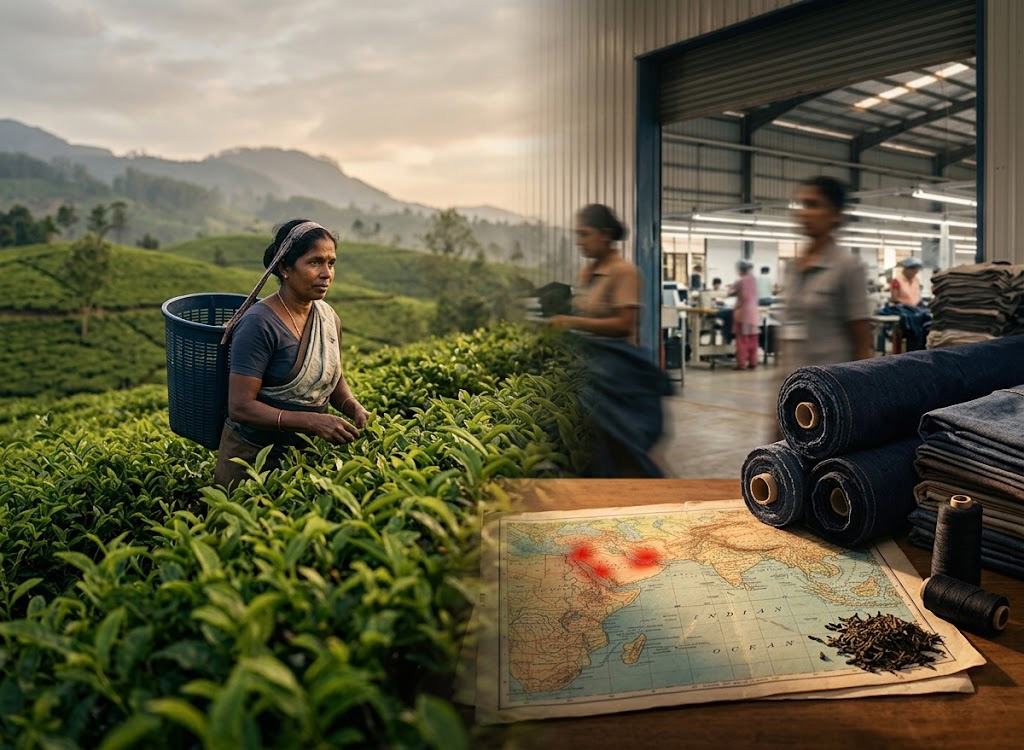
“40% of our apparel exports go to the US. 35% of our tea goes to the Middle East. The war situation has seen a drop in demand,” Wijesinghe has said.
However, he has expressed optimism that the disruption would be temporary, saying the EDB expects conditions to improve over the next three to four months.
Apparel takes a hit
Apparel and textiles, Sri Lanka’s largest merchandise export category, were among the biggest contributors to the July decline.
Export earnings from the sector fell 8.82% year-on-year to US$437.59 million.
The contraction was broad-based across Sri Lanka’s major apparel markets. Shipments to the United States (US) declined 6.28%, while exports to the United Kingdom (UK) fell 5.73% and those to the European Union (EU) dropped 8.61% compared to July 2025.
Exports to the US, Sri Lanka’s largest single export destination, fell 0.58% to US$250.87 million in July.
The weakness in apparel demand is particularly significant for Sri Lanka given the sector’s importance to employment, manufacturing activity and foreign exchange earnings.
Tea exports hit by Middle East weakness
The tea sector faced an even sharper setback.
Tea export earnings declined 17.22% year-on-year to US$116.73 million in July, with the Middle East emerging as a major source of weakness.
Tea exports to the region plunged 47.93% compared to July 2025. Exports to several key markets recorded particularly steep declines, with shipments to the United Arab Emirates falling 57.49%, Iran by 73.09%, and Iraq by 78.54%. Exports to Saudi Arabia declined 3.44%.
The figures underline the extent to which geopolitical tensions and disruptions in the region can quickly spill over into Sri Lanka’s traditional export markets.
For an economy seeking to strengthen its external position and build foreign exchange reserves, weakness in tea exports is an added concern given the sector’s long-standing contribution to export earnings.
Other sectors also weaken
The deterioration was not confined to apparel and tea.
Coconut-based product exports declined 9.89% year-on-year to US$111.71 million in July.
Seafood exports suffered an even sharper contraction, plunging 60.31% to US$15.58 million.
The declines suggest that the July slowdown was relatively broad-based, although the magnitude of the impact varied considerably between sectors.
Seven-month picture remains positive
Despite the setback in July, Sri Lanka’s overall merchandise export performance for the year remains in positive territory.
Total merchandise export earnings from January to July 2026 reached US$8.188 billion, an increase of 5.05% compared with the corresponding period of 2025.
This provides some buffer against the weaker July numbers, but sustaining the growth momentum will depend heavily on whether demand in major markets recovers as expected.
India continued to strengthen its position as Sri Lanka’s second-largest export destination. Exports to India rose 9.12% year-on-year to US$129.5 million in July.
The performance contrasts with weaker shipments to several Western markets.
Exports to the UK fell 11.34% to US$72.14 million, despite Sri Lanka benefiting from preferential market access under the UK’s Developing Countries Trading Scheme (DCTS), which provides duty-free entry for around 92% of product lines.
A warning for Sri Lanka’s export strategy
The July figures highlight a broader challenge facing Sri Lanka: the country’s export recovery remains heavily dependent on a relatively small number of sectors and markets.
Apparel and tea together account for a substantial share of merchandise export earnings, while the US, UK, EU and Middle Eastern markets remain critical destinations. Consequently, disruptions in any of these markets can have an immediate impact on national export performance.
The EDB’s expectation that conditions could improve within three to four months offers some reassurance. But the July contraction also reinforces the need for Sri Lanka to diversify its export basket, expand into new markets and move towards higher-value products.
With the Government targeting stronger export earnings as part of its broader economic recovery strategy, the ability to withstand external shocks will be just as important as achieving short-term growth.
For now, the seven-month numbers remain encouraging. But July’s decline is a reminder that Sri Lanka’s export recovery is still exposed to global demand shocks — and that the next few months will be crucial in determining whether the country can maintain its momentum.













Leave a comment