
By Chanakya
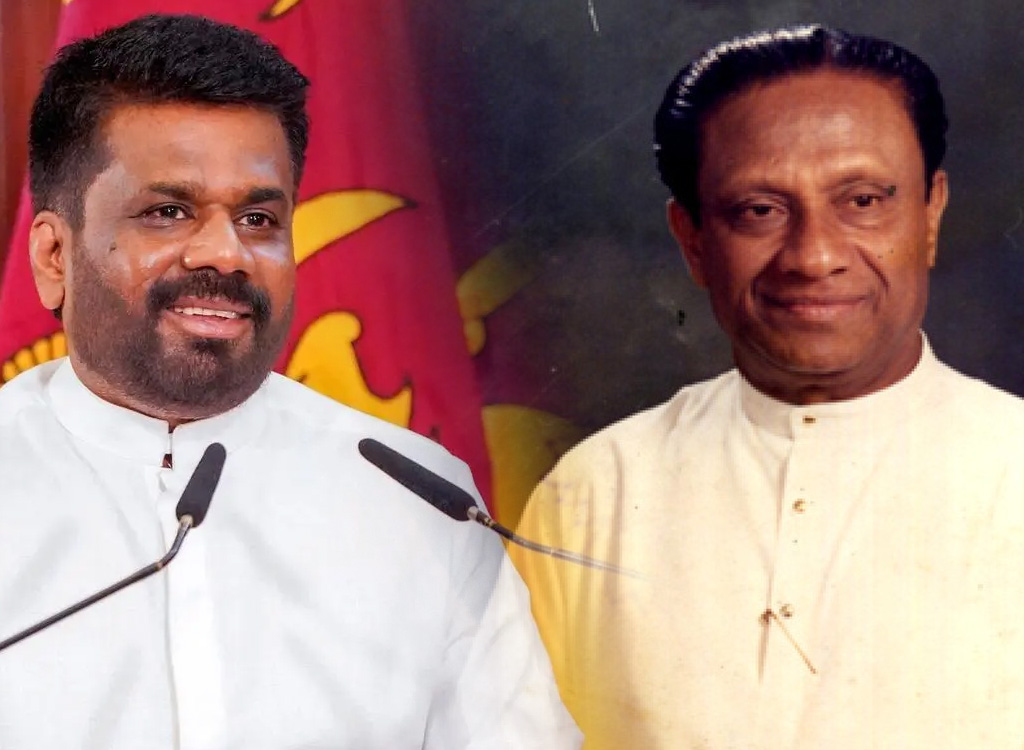
The role of English proficiency in governance and diplomacy has long been a significant factor in Sri Lanka’s political landscape. The late President Ranasinghe Premadasa is often cited in discussions about leadership, social mobility, and communication in post-independence Sri Lanka. His career offers a nuanced example of how English proficiency can shape governance and diplomacy.
A comparison between Premadasa and the contemporary Janatha Vimukthi Peramuna (JVP)-led National People’s Power (NPP) leadership, particularly Anura Kumara Dissanayake (AKD), illustrates how language ability intersects with political legitimacy, administrative effectiveness, and international engagement.
Ranasinghe Premadasa emerged from a modest, non-elite background during a period when English proficiency was closely associated with political power and social status. Unlike many of his predecessors, who were educated in elite English-medium institutions, Premadasa’s command of English was functional rather than sophisticated. However, this did not prevent him from becoming a highly effective domestic leader. He communicated powerfully in Sinhala, which enabled him to connect with the broader population and implement large-scale development initiatives, particularly in housing and poverty alleviation. His leadership demonstrated that strong local language communication can enhance democratic legitimacy and foster public trust.
Nevertheless, Premadasa’s limited fluency in English posed challenges in areas of governance that required engagement beyond the national context. In dealing with international organizations, foreign governments, and complex policy frameworks, English functioned as a critical medium. As a result, Premadasa decided to learn English when he first entered parliament. Within a span of around two years, Premadasa learnt to converse in English.
Premadasa also relied on advisors and bureaucrats to articulate policy and conduct negotiations in English. The late understood the structural limitation in governance due to language issues: dependence on intermediaries can reduce a leader’s direct control over nuanced communication, especially in diplomacy and technical policy discussions.
A similar dynamic can be observed in the case of the JVP/NPP and its leader, current President AKD.
Like Premadasa, AKD’s political appeal is rooted in a non-elite, people-oriented platform. He communicates primarily in Sinhala and emphasizes accessibility and anti-elitism in his rhetoric. His English proficiency is moderate, and while he can engage in English-language interviews and discussions, it is not the central strength of his political persona. This mirrors Premadasa’s approach in prioritizing domestic connection over linguistic alignment with global elites.
However, the context in which the JVP/NPP operates is markedly different from that of Premadasa’s era. In today’s highly globalised world, governance is deeply intertwined with international economic systems, multilateral institutions, and foreign investment networks. Sri Lanka’s recent economic challenges, including debt restructuring and negotiations with institutions such as the International Monetary Fund (IMF), underscore the necessity of direct and effective communication in English. For the JVP/NPP, this represents a critical test: while maintaining grassroots credibility, it must also demonstrate the capacity to engage confidently and competently on the global stage.
During Premadasa’s presidency, English proficiency was advantageous but not indispensable for political success. In contrast, contemporary governance demands a higher level of linguistic competence due to increased global interdependence. Leaders today are expected not only to represent their interests domestically but also to articulate and defend those interests in international forums without excessive reliance on intermediaries.
In conclusion, both Ranasinghe Premadasa and Anura Kumara Dissanayake exemplify the political strength that comes from strong local language communication and connection with the general public. However, their experiences also highlight the enduring and growing importance of English proficiency in governance and diplomacy. While it is not the sole determinant of effective leadership, it remains a crucial tool for navigating the complexities of modern statecraft. The challenge for contemporary leaders, particularly those outside traditional elites, is to strike a balance between maintaining authentic domestic engagement and acquiring the linguistic skills necessary for effective global interaction.
Disclaimer: The views and opinions expressed in this article are those of the writer and do not necessarily reflect the official position of this publication.







Leave a comment