
By Dr. Nadee Dissanayake
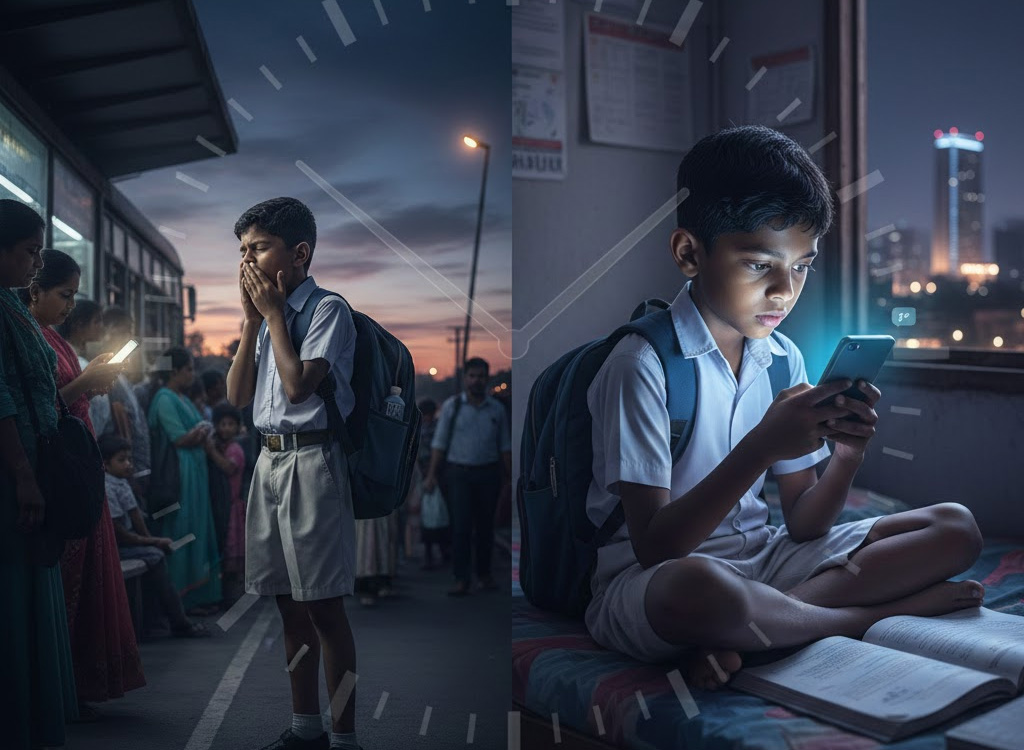
Many Sri Lankans begin their day before the sun rises. Schoolchildren wake up while it is still dark, uniforms prepared the night before, bags packed in haste. Office workers leave home early to secure a place on overcrowded buses or trains, often spending hours commuting before the workday even begins.
At night, despite physical exhaustion, mobile phones, televisions, and digital notifications keep minds alert long past bedtime. Sleep comes late, rest is shallow, and mornings arrive too soon. This silent but widespread condition has a name: social jetlag.
Social jetlag does not involve aeroplanes or crossing time zones. It occurs when a person’s biological clock, the internal rhythm that regulates sleep, alertness, mood, and energy, clashes with the social clock imposed by schools, workplaces, transport systems, and modern digital life. When these two clocks remain misaligned for long periods, the body experiences a state similar to flying across time zones several times a week, without ever leaving home.
In Sri Lanka, social jetlag has quietly become a national condition rather than an individual problem. Early school start times, long travel distances, rigid office hours, traffic congestion, and late-night screen habits together create a population that is disciplined and resilient but chronically tired.
Children carry the heaviest burden
Perhaps the most concerning impact of social jetlag is on children. Many Sri Lankan students wake up before 5 a.m. to attend school, tuition classes, or religious activities. In urban areas, some parents drop children at school gates well before opening time, simply to reach their offices on schedule. For young bodies and developing brains, this routine places continuous strain on natural sleep cycles.
Adolescents are particularly vulnerable. Scientific research shows that teenagers are biologically programmed to feel alert later at night and sleepy in the early morning. When school schedules clash with this natural rhythm, students may appear inattentive, restless, or unmotivated in class. These behaviours are often misinterpreted as laziness or lack of discipline. In reality, many students are struggling against their own biology.
Over time, this mismatch affects learning, memory retention, emotional regulation, and even self-esteem. Children are asked to perform cognitively demanding tasks at times when their brains are not fully awake. The result is frustration, declining engagement, and an unhealthy reliance on stimulants such as excessive tea, coffee, sugary snacks, or chewing gum just to stay alert.
Adults function, but at a cost
For working adults, social jetlag manifests as persistent fatigue, difficulty concentrating, irritability, and reduced motivation. Many people feel as though they are constantly ‘catching up’ on sleep, especially on weekends. Sleeping longer on Saturdays and Sundays provides temporary relief, but it further disrupts the body clock, making Monday mornings even harder.
In Sri Lanka, long working hours are often treated as a sign of dedication and discipline. But presence does not equal productivity. A tired employee may sit at a desk for extended hours but produce far less than someone who works fewer, well-timed hours with proper rest. Chronic fatigue reduces creativity, slows decision-making, and increases the likelihood of errors and workplace accidents.
The health consequences are equally serious. Long-term social jetlag is linked to increased risk of obesity, diabetes, heart disease, anxiety, and depression. These conditions place additional strain on families, employers, and the public healthcare system, costs that are rarely associated with sleep deprivation in policy discussions.
Hidden impact on family and society
Beyond individual health, social jetlag quietly reshapes family life and social relationships. When parents and children operate on different schedules, shared meals and meaningful conversations become rare. Evenings are fragmented by exhaustion and screen use. Weekends, instead of being times for connection and recreation, are often spent recovering from accumulated fatigue.
At a community level, participation declines. People feel too drained to engage in social, religious, or civic activities. Volunteerism weakens, patience shortens, and small frustrations escalate more easily. A society that is constantly tired becomes less tolerant, less connected, and less resilient.
These changes do not happen overnight. They accumulate slowly, making social jetlag difficult to notice, yet deeply influential in shaping collective behaviour.
An economic issue, not just a lifestyle choice
Social jetlag is often framed as a personal lifestyle problem – sleep earlier, wake earlier, reduce screen time. While individual habits matter, this framing misses the larger picture. Social jetlag is a systemic issue, created by how society organises time.
From an economic perspective, the costs are substantial. Fatigued workers are less efficient, innovation slows, and error rates rise. In sectors that rely on precision such as transport, healthcare, and manufacturing, fatigue can have serious consequences. Increased sick leave, burnout, and staff turnover reduce organisational stability and productivity.
At the national level, a tired workforce undermines competitiveness. Human capital is Sri Lanka’s most valuable resource. If that resource operates under constant exhaustion, national performance suffers quietly, persistently, and cumulatively.
Why systems must change, not just individuals
While individuals can adopt healthier sleep habits, their efforts will remain limited if systems continue to work against biological reality. Schools, workplaces, and transport systems shape daily rhythms far more powerfully than personal intentions.
Schools could reconsider start times, particularly for older students. Even modest delays can significantly improve attention, learning outcomes, and emotional well-being. Such changes do not reduce discipline; they enhance effectiveness.
Workplaces can explore flexible or staggered hours, remote work options where possible, and performance measures focused on outcomes rather than time spent at desks. Flexibility does not weaken accountability; it aligns productivity with human capacity.
Transport planning also plays a role. Long, unpredictable commutes force people to wake earlier than necessary and return home exhausted. Improving reliability and reducing congestion directly supports national well-being.
Digital life and the new time trap
Another powerful driver of social jetlag is digital culture. Smartphones blur the boundary between day and night, work and rest. Late-night scrolling, messaging, and streaming delay sleep even when physical tiredness is high.
Digital well-being is no longer a luxury topic. It is a public concern. Encouraging healthy digital habits especially among children and adolescents requires education, parental guidance, and responsible platform design. Awareness alone is not enough; social norms around availability and responsiveness must also evolve.
Seeing rest as a national asset
Perhaps the most important shift Sri Lanka needs is conceptual. Rest must be recognised not as the opposite of productivity but as its foundation. Clear thinking, emotional balance, creativity, and patience all depend on adequate, well-timed sleep.
Countries that align social schedules more closely with biological rhythms often see improvements in education outcomes, workforce performance, and social stability. These are not radical experiments, but evidence-based adjustments grounded in human biology.
A quiet reform with powerful results
Sri Lanka has endured economic hardship, social tension, and rapid change in recent years. In such conditions, collective calm and clarity are essential. A society suffering from chronic social jetlag struggles to provide either.
Addressing social jetlag does not require dramatic reforms or heavy investment. It requires awareness, coordination, and willingness to design systems that respect human limits. Sometimes, the most meaningful progress comes not from doing more, but from doing things at the right time.
Aligning social time with human time is not about slowing development. It is about making development sustainable. A country that allows its people to rest properly will think more clearly, work more effectively, and live more peacefully.
Social jetlag may be quiet, but its impact is profound. Recognising it may be one of the most practical steps Sri Lanka can take towards a healthier, more productive future.
(The writer is an independent researcher)
Disclaimer: The views and opinions expressed in this article are those of the writer and do not necessarily reflect the official position of this publication.









Leave a comment