
By Kusum Wijetilleke
Without a set of guiding principles related to sovereignty, alliances, security, and national interest, a country will struggle to determine how to act in crises or where to position itself within a changing global order. This pattern is evident in Sri Lanka.
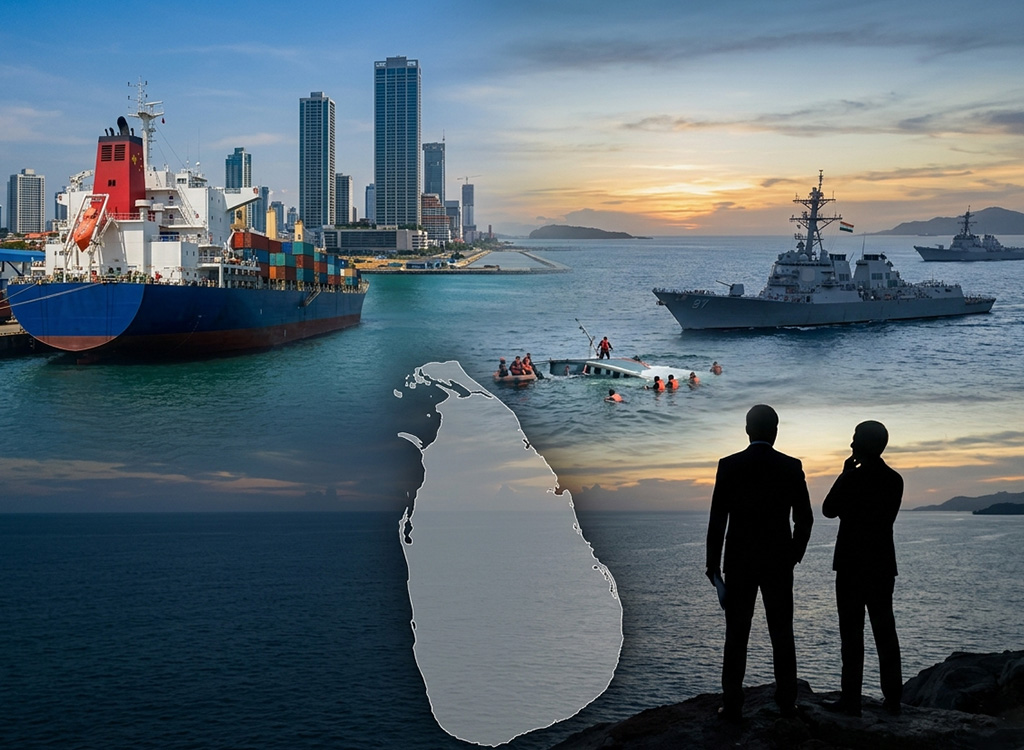
For analysts of grand geopolitical strategy, Sri Lanka now harbours a major Chinese economic footprint on India’s southern maritime flank: Chinese-financed infrastructure such as the Hambantota Port (leased for 99 years) and Port City Colombo, an artificial land reclamation project adjacent to Colombo’s main commercial district.
Chinese research vessels have also sought access to waters near Sri Lanka, occasionally generating diplomatic friction with India. At the same time, both Chinese and US naval vessels have docked at Sri Lankan ports, highlighting the island’s exposure to competing great-power interests.
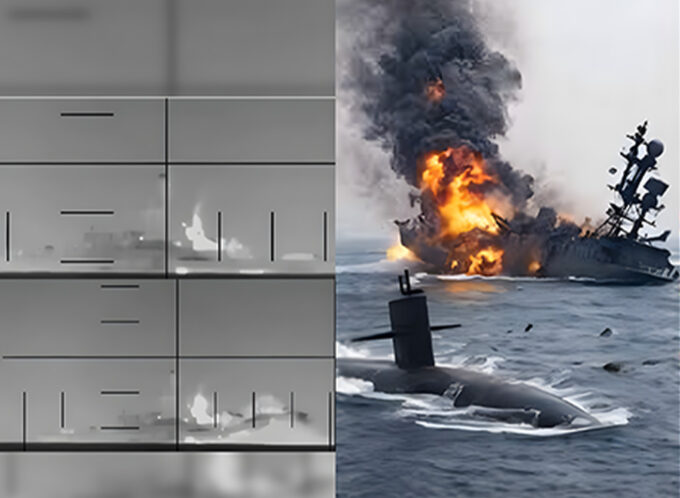
More recently, the regional security environment has become even more volatile with the Iranian vessel IRIS Dena, in the region for naval exercises at the invitation of India, being struck and sunk by a US submarine approximately 40 nautical miles off Sri Lanka’s coast.
While this lies beyond Sri Lanka’s 12-nautical-mile territorial sea, it remains well within the country’s Exclusive Economic Zone (EEZ) and is roughly comparable to the distance between Colombo and Bentota. The incident illustrates how rapidly external conflicts can spill into Sri Lanka’s immediate maritime environment.
Posture with neither principle nor policy
The lack of an overarching strategy for its foreign policy is also evident in its diplomatic performance.
Successive Sri Lankan governments have sent mixed signals in multilateral diplomacy, at times reneging on commitments made to institutions such as the United Nations Human Rights Council (UNHRC) and rejecting aspects of international accountability initiatives related to the civil war, including the UNHRC evidence-gathering mechanism established under Resolution 46/1, yet at other times, co-sponsoring a resolution (Resolution 30/1), which proposed an accountability mechanism that included foreign judicial participation.
In March 2022, Sri Lanka abstained, rather than voting ‘no’ on the UN General Assembly resolution condemning Russia’s invasion of Ukraine. More recently, Sri Lanka initially voted against a UN General Assembly resolution condemning Israeli settlement expansion in the West Bank before revising its position and voting in favour.
The Japanese-financed Colombo Light Rail Transit (LRT) project was approved under one administration and cancelled by the next in 2020. The proposed India-Japan partnership for the East Container Terminal at the Port of Colombo collapsed following domestic political opposition. The Adani Group’s renewable energy projects in northern Sri Lanka have also faced uncertainty following political and regulatory changes.
Sri Lanka is frequently cited in Western policy debates as a case of China’s ‘debt-trap diplomacy,’ although many economists argue that the claim is overstated. Nevertheless, China remains Sri Lanka’s largest bilateral creditor, giving Beijing considerable leverage in financial negotiations and infrastructure development.
Taken together, these developments suggest that Sri Lanka has struggled to balance competing regional and global powers while extracting long-term economic gains. Nearly 15 years of large-scale Chinese investment and billions of dollars in borrowing have not translated into meaningful technology transfer, export-sector upgrading, or sustained industrial development.
At the same time, Sri Lanka has failed to build a deep economic partnership with India despite geographic proximity to some of the fastest-growing regions in South Asia. South Indian states such as Tamil Nadu (a major manufacturing hub), Karnataka (India’s technology centre around Bengaluru), Telangana (rapidly growing in pharmaceuticals and IT), and Kerala (with strong human-development indicators and a large global diaspora) could have been natural partners in trade, technology exchange, and investment integration. Yet no coherent regional economic strategy has emerged.
Foreign policy therefore cannot simply be improvised in response to events; it requires a coherent philosophy that defines how a state understands its interests and its place in the international system.
The field of International Relations (IR), like economics or finance, is a distinct discipline grounded in theory, doctrine, and accumulated statecraft. Alongside subfields such as Strategic Studies and Security Studies, it provides the analytical tools through which states interpret power and define national interests in order to navigate the international system.
Yet many governments, in both the developing and developed world, behave as if foreign policy is merely an extension of domestic politics, something that can be administered by elected officials who have seldom engaged with the discipline itself. The result is improvisation rather than strategy, and Sri Lanka is a textbook example.
President Anura Kumara Dissanayake and Foreign Minister Vijitha Herath are not personally equipped to manage the complexities of foreign policy; this is not unusual, as few elected leaders are. The problem is not the absence of expertise at the political level but the failure to utilise the expertise that already exists within Sri Lanka’s foreign policy apparatus.
The Ministry of Foreign Affairs contains experienced diplomats and career professionals who understand the mechanics of international diplomacy. Their role should be to help articulate and implement a coherent strategy. However, this requires political leadership willing to acknowledge that foreign policy is a specialised field.
Countries that understand the gravity of the current geopolitical moment have already made this adjustment. India did so most clearly with the appointment of S. Jaishankar as External Affairs Minister in 2019.
A former Foreign Secretary and career diplomat, Jaishankar brought decades of experience in strategic affairs, negotiations, and great-power diplomacy. His appointment signalled that India recognised the complexity of the emerging global order and the value of placing professional expertise at the highest level of foreign policy leadership.
Historically, many major powers have placed similarly capable individuals at the helm of foreign policy. The United States relied on figures such as Henry Kissinger and George Shultz, Britain on Lord Palmerston and later Robin Cook, and France on Hubert Védrine.
These individuals were not merely politicians; they were influential strategists who shaped how their states understood and navigated the international system. Sri Lanka once had such a figure in Lakshman Kadirgamar.
The Kadirgamar doctrine: Strategic autonomy
Kadirgamar consistently emphasised strategic autonomy as the first principle of Sri Lanka’s foreign policy. Strategic autonomy does not mean neutrality in the simplistic sense often used in public discourse. Rather, it means preserving the ability to make sovereign decisions without becoming a subordinate instrument of any external power. This distinction is critical.
Much of Sri Lanka’s contemporary foreign policy commentary remains trapped in the language of the Cold War-era Non-Aligned Movement, often invoking ‘neutrality’ as if it were itself a doctrine. In reality, neutrality is not a foreign policy strategy; it is merely a posture useful in specific circumstances. Non-alignment itself was historically more complex than the term suggests. It did not imply passivity but was an attempt by newly independent states to preserve room for manoeuvre between competing blocs.
Today’s geopolitical environment is different. The emerging global order is characterised less by ideological blocs and more by spheres of influence and regional power structures. Within such a system, vague references to neutrality are meaningless unless supported by actual strategic capacity.
Sri Lanka’s Foreign Ministry should therefore rely more heavily on professional strategic analysis, whether from within its own foreign service or from leading scholars of international relations and ‘realist’ strategy such as John Mearsheimer of the University of Chicago or Barry Buzan of the London School of Economics, whose Regional Security Complex Theory emphasises the centrality of regional power dynamics. There is nothing wrong in importing expertise when it is required.
Recent maritime incidents illustrate the problem clearly. When the Iranian vessel Dena was struck by a torpedo from a US submarine in waters off Sri Lanka, the Sri Lanka Navy conducted search-and-rescue operations for distressed personnel. When another vessel, the IRIS Bushehr, suffered damage, Sri Lanka permitted it to dock in Trincomalee and ensured safe passage for its crew.
These were reasonable operational decisions. However, the Government framed them as evidence of Sri Lanka’s role as a “humanitarian nation,” while also emphasising that the Navy had acted in accordance with United Nations Convention on the Law of the Sea (UNCLOS) maritime law.
The framing is revealing. The decision to allow the IRIS Bushehr to dock reportedly required several hours of deliberation within the Government. Deliberation in a sensitive geopolitical situation is understandable and desirable. Yet presenting the outcome purely as a humanitarian gesture obscures the underlying strategic implications.
The real issue was not humanitarian assistance or maritime law but the expansion of a military conflict into the Indian Ocean region, a point that has largely been ignored by the Government of Sri Lanka.
When Foreign Minister Herath was asked about these incidents, the question was not really about the ships themselves. The subtext, perhaps even delivered half-jokingly, was far more fundamental. In the event of a major global conflict, on which side would Sri Lanka stand? The question was posed in India, with an audience and a panel that included Minister of External Affairs Dr. Jaishankar.
This question is not as hypothetical as it might sound. Sri Lanka lies within India’s traditional sphere of influence while simultaneously hosting a significant Chinese economic and infrastructural footprint.
Navigating between these realities cannot be achieved simply by declaring that the country will ‘not take sides’. Refusing to take sides itself requires strategy, doctrine, and an actual foreign policy. From the standpoint of classical international relations theory, the answer begins with geography.
States can change many things: their constitutions, economic systems, leaders, and laws. What they cannot change is geography. Sri Lanka sits just off the southern coast of India, placing the island squarely within the strategic environment of the region’s dominant power.
The art of neutrality
President Dissanayake has used the language of neutrality and non-alignment in recent statements. Yet these terms do not constitute a foreign policy framework. Foreign policy involves decisions about alliances, security arrangements, economic dependencies, and strategic partnerships. Neutrality alone does not answer those questions.
Even historically neutral states such as Switzerland developed elaborate security doctrines, defence capabilities, and diplomatic strategies to sustain their neutrality. It was not a passive stance but a carefully managed system of deterrence and diplomacy. Sri Lanka, by contrast, invokes neutrality without possessing the institutional, military, or diplomatic architecture necessary to sustain it.
Geography imposes constraints on all states, particularly smaller ones. Similarly, Sri Lanka cannot escape the gravitational pull of India as the regional hegemon. At the same time, the island’s location along major shipping routes gives it economic and strategic relevance to global powers such as China and the US. Managing this reality requires careful balancing, not rhetorical neutrality.
Sri Lanka must therefore rediscover the principle articulated by Lakshman Kadirgamar: strategic autonomy that avoids subordination to any external power while maintaining constructive relationships with all of them. Achieving this requires sustained investment in both hard power and soft power.
On the hard-power side, Sri Lanka must develop credible maritime awareness, naval capability, intelligence capacity, and security infrastructure. On the soft-power side, it must cultivate diplomatic influence, economic partnerships, and a coherent national narrative that enhances the country’s credibility in international forums.
Small states are often described as price-takers in the international system. That reality cannot be entirely avoided. Sri Lanka’s challenge today is simple: it must begin to act like a state that recognises its own agency. Even price-takers possess limited sovereignty, and that space must be maximised to ensure that room for strategic manoeuvre is preserved at all times, guided by the principle of sovereignty not as an abstract idea but as a practical foundation for policy.
(The writer is a political commentator, media presenter, and foreign affairs analyst. He serves as Adviser on Political Economy to the Leader of the Opposition and is a member of the Working Committee of the Samagi Jana Balawegaya [SJB]. A former banker, he spent 11 years in the industry in Colombo and Dubai, including nine years in corporate finance, working with some of Sri Lanka’s largest corporates on project finance, trade facilities, and working capital. He holds a Master’s in International Relations from the University of Colombo and a Bachelor’s in Accounting and Finance from the University of Kent [UK]. He can be contacted via email: [email protected] and X: @kusumw)
Disclaimer: The views and opinions expressed in this article are those of the writer and do not necessarily reflect the official position of this publication.











Leave a comment