
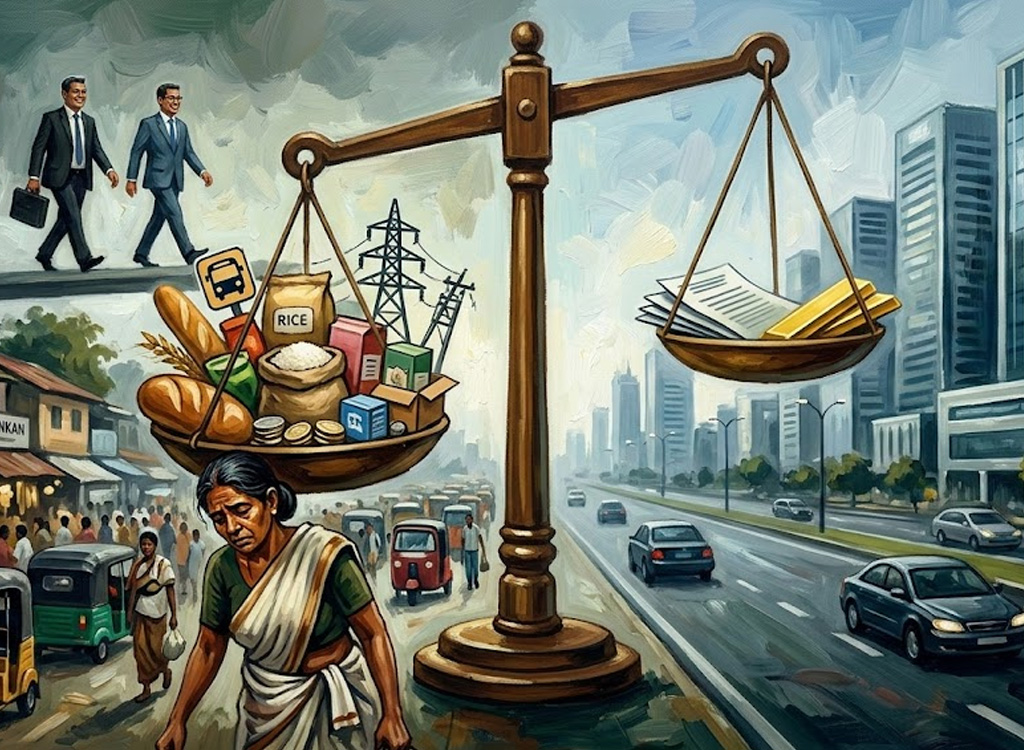
Sri Lanka has restored a degree of fiscal order, yet the structure of taxation reveals an imbalance that cannot be ignored if economic recovery is meant to be durable. Revenue numbers have improved since the crisis, but improvement in collection does not automatically imply fairness in distribution, and distribution is where the real pressure now lies.
The country’s tax framework remains heavily weighted toward indirect taxation, particularly value added tax (VAT) and duties that sit invisibly inside the price of goods and services purchased every day. These levies are calculated at uniform rates at the point of transaction, which means income levels do not influence the percentage charged on taxable consumption. A corporate executive buying household supplies pays the same VAT rate as a street vendor purchasing basic necessities from a registered retailer.
That uniformity produces consequences that are entirely predictable. Lower-income households spend a higher share of their earnings on essential consumption, including food, transport, utilities and school-related expenses, which results in transaction-based taxation absorbing a larger portion of their disposable income. For households with limited financial buffers, even incremental price increases compound across the month and restrict savings, investment in education, or emergency preparedness.
Indirect taxation offers administrative efficiency in an economy where informal earnings complicate direct assessment, and that efficiency partly explains why recent revenue growth has relied on this channel. However, reliance on consumption as the primary revenue engine shifts the burden toward those who spend most of what they earn, and that group includes large sections of the middle and lower income population.
Direct taxation is designed to address that imbalance through progressive income bands that align liability with earning strength. Certain high net worth cases and certain professional segments have historically structured income and assets in ways that reduce declared liability, while salaried employees encounter automatic deductions that guarantee contribution without negotiation.
This enforcement gap has implications. When visible compliance is concentrated within predictable segments of the workforce, public perception tilts toward viewing the system as uneven. Confidence in taxation depends on the belief that earning capacity translates into proportional contribution and that evasion carries credible consequences regardless of status.
Improving direct tax collection does not require punitive rate escalation, which could discourage investment and formalisation. The country needs systematic data integration across banking systems, property registries, corporate disclosures and professional billing records, combined with consistent auditing that extends beyond routine salary earners. Expanding the effective base through credible enforcement would reduce pressure to widen consumption coverage further.
The surge in vehicle excise revenue during 2025 illustrates the fragility of relying on episodic inflows for fiscal comfort. Pent-up demand following prolonged import restrictions generated elevated vehicle purchases and temporarily strengthened public finances. Such revenue depends heavily on exchange rate stability, consumer credit conditions and household confidence, which makes it cyclical by nature.
As deferred demand clears and purchasing behavior stabilises, excise collections will adjust accordingly, and any expenditure planning anchored to temporary peaks will confront pressure. Sustainable fiscal planning requires revenue streams that reflect structural income generation rather than consumption bursts driven by policy shifts.
Public comparisons with higher-tax jurisdictions often overlook a critical distinction. Many countries that attract Sri Lankan migrants impose heavier overall tax burdens, yet citizens in those systems experience visible public return through efficient transport networks, reliable municipal services, modern digital administration and consistent infrastructure maintenance. Contribution in those environments corresponds with tangible improvements in daily life, whereas in Sri Lanka, at times, certain important roads go without lights at night, putting the drivers and pedestrians in greater difficulty.
Sri Lanka maintains long-standing strengths in education and public healthcare that have supported social mobility across generations. Outside those pillars, infrastructure performance and service delivery remain uneven, with congestion, limited rail modernisation and administrative inefficiencies constraining productivity and quality of life. Rising tax pressure combined with stagnant service quality intensifies scrutiny of fiscal design.
A recalibrated tax structure would strengthen direct enforcement, expand the effective income tax base and protect essential goods within the VAT framework to ease pressure on vulnerable households. Such adjustment would align contribution with earning strength while preserving revenue adequacy required for debt servicing and public investment.
Fiscal stabilisation cannot rest solely on collection totals reported at budget briefings. Long-term legitimacy depends on distribution that citizens perceive as proportionate and enforcement that applies consistently across income levels. As the tax system leans excessively on consumption while allowing structural gaps in direct compliance, it might erode trust even as revenue improves.
Source: The Morning Money
Disclaimer: The views and opinions expressed in this article are those of the writer and do not necessarily reflect the official position of this publication.










Leave a comment