
From revolutionary to journalist: Political enigma
By Lionel Bopage
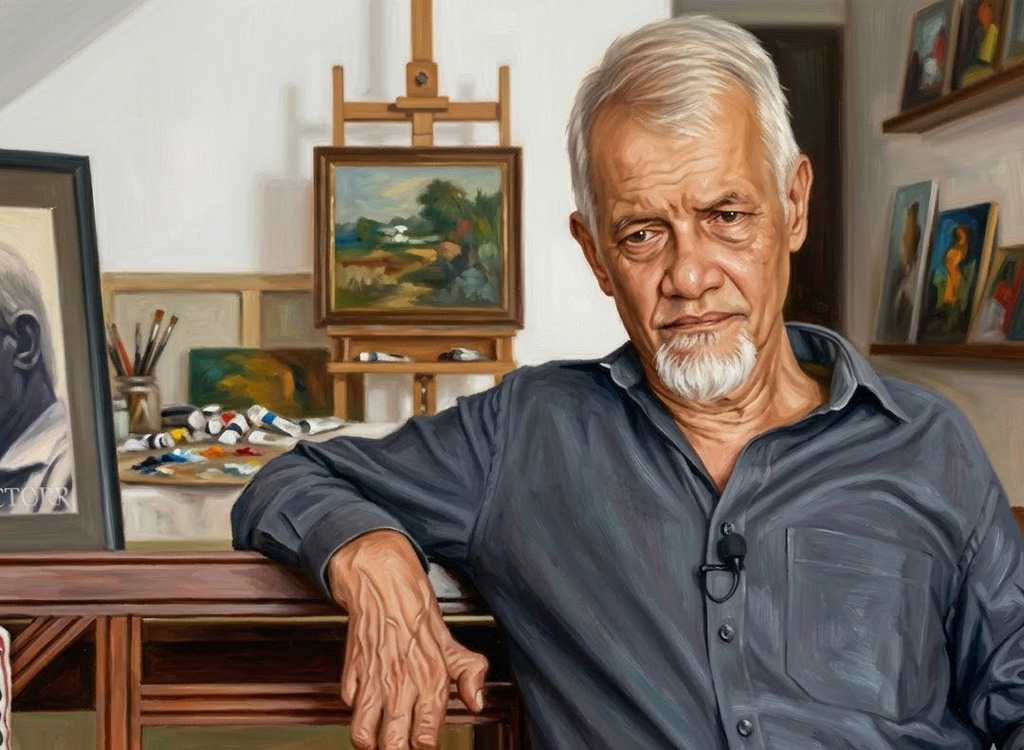
A year after Victor Ivan’s passing, the contradictions that defined him still feel alive. He was, perhaps, one of the prominent individuals, who braved all odds — including a lifelong partial disability — to leave an indelible mark on Sri Lankan media. An activist, political analyst, and author shaped by the works of Bertrand Russell and Mahatma Gandhi, he was never politically neutral. His loyalties were often volatile and shifted in unexpected ways. He accommodated opposing views; but he did so only on his own terms.
Victor Ivan, also known as Podi Athula, embodied the contradictions of Sri Lankan political activism and journalism. His journey from revolutionary insurrectionist to pioneering investigative journalist reveals the complex moral terrain navigated by those who challenge power in turbulent societies. His legacy remains contested. Some celebrated him as a fearless truth-teller, while others criticised him as an opportunistic political figure who navigated between principles and survival, with unsettling ease.
From revolutionary to reformer
Victor Ivan’s political awakening came through his involvement with the ‘Movement’ that later became Janatha Vimukthi Peramuna (JVP). As a member of the ‘Committee of Twenty-two’[i] before the April 1971 uprising, he held significant responsibility for the organisation’s military readiness. Aligned with the faction led by comrade Rohana Wijeweera, he was specifically entrusted with developing weapons for the movement – overseeing the production of hand grenades when it was discovered that the initial process was very slow.
He took a characteristically radical approach, introducing a wick that can be set alight with a matchstick, to initiate detonation. His enthusiasm, however, exceeded his caution. At a session of the ‘Committee of Twenty-two’ in Elpitiya, he attempted to demonstrate a prototype by setting it alight inside the house before throwing it outside. It exploded prematurely, piercing the clay wall. This adventurist behaviour eventually resulted in a more serious accident that left him with a mutilated left arm, requiring constant care until his death.
Trial and ideological shift
The failed April 1971 insurrection marked a decisive turning point. Victor Ivan was the seventh accused in the main Criminal Justice Commission trial, held at the Queen’s Club before a panel of five justices, including Chief Justice H.N.G. Fernando. He stood trial alongside forty-two other accused — all considered the main architects of the April uprising. Convicted of charges of conspiring to overthrow the Queen’s government and of waging war against the Queen’s government and the state, he was sentenced to five years’ imprisonment.
Nonetheless, even before the trial began, he had abandoned both the JVP and Marxism. During or prior to his detention in Ward A at Magazine Prison, he had undergone a profound ideological transformation. Detention centres set up across Sri Lanka had become informal universities where detainees critically examined the uprising and debated political positions.
There were debates about the nature of the armed struggle, and in particular, about the class the JVP conducted under the topic “Indian Expansionism”.[ii] The nature of Victor Ivan’s drift, however, was unmistakable. He began denigrating the politics the movement had collectively undertaken, placing blame entirely on other JVP leaders while absolving himself — despite his own leadership role.
He collaborated in a controversially close manner with the principal investigators of the Criminal Investigation Department, who were guided by the British intelligence Unit, MI5. He became a witness, directly or indirectly supporting the prosecution and the coalition government’s political stance against the JVP. This early shift, that is his willingness to break with previous allegiances when his stance demanded it, as his supporters saw it, or when opportunity presented itself, as his critics believed, set a pattern that would define his entire career.
The birth of investigative journalism
Upon his release in 1977, when the Criminal Justice Commissions Act (CJC) was repealed and those convicted under it were pardoned, Victor Ivan briefly joined the LSSP. He even contested the Galle by-election in 1981, conducting a strong election campaign targeting his former colleagues of the JVP, though his electoral performance proved disappointing.
It was journalism that ultimately absorbed his revolutionary energy. The newspaper Ravaya he founded became his primary vehicle of influence. For twenty-five years, he edited this publication, transforming it into one of Sri Lanka’s most forceful voices. Ravaya introduced genuine investigative journalism into Sinhala media, tackling subjects previously considered untouchable: corruption, human rights abuses, judicial misconduct, and the mass disappearances that plagued the country.
His approach to journalism drew directly from his political formation within the JVP. The qualities the movement had instilled — commitment, determination, and willingness to sacrifice — translated seamlessly into his journalistic work. He became part of a generation of successful journalists who had begun their political lives with the JVP in their younger days.
Political influences and its limits
His exposés on disappearances had become a major political issue. Such exposés contributed significantly to the election of President Chandrika Kumaratunga in 1994, which ended seventeen years of right-wing UNP rule. Victor Ivan played a crucial role in this political shift, demonstrating an influence that extended far beyond mere reportage. He was among many who worked tirelessly to bring the former president’s regime to power, believing in the promise of change. It is to Victor Ivan’s credit that he had never sought positions of authority within any political forces he helped to bring to power.
However, that relationship soured quickly. After helping Ms Kumaratunga get elected, he turned against her with characteristic ferocity, authoring ‘Chaura Regina’ (The Queen of Deceit) — a venomous critique of the president. When she later appropriated state land upon retirement with cabinet approval, Victor Ivan successfully sued to have it returned to the state. It demonstrated that his criticism could translate into concrete legal action.
Challenging the untouchable
Victor Ivan’s most significant contribution was his fearless critique of Sri Lanka’s judiciary. He exposed corruption involving Chief Justice Sarath Nanda Silva[iii] and Magistrate Lenin Ratnayake[iv], filing cases and demanding accountability from institutions that had long operated with impunity. His activism forced the establishment of investigative committees, demonstrating that even the highest judicial offices could be questioned.
The caste thesis
His intellectual contribution extended beyond journalism. While imprisoned, he wrote extensively. In doing so he advanced a controversial thesis that the discriminatory caste system was crucial to both the JVP insurrections in the south and Tamil militant movements in the north.
At a time when discussions on caste was considered taboo, his persistent analysis eventually influenced academics to acknowledge its role in Sri Lanka’s recurring social crises. In his later works, he made in-depth analyses of how caste discrimination impacted Buddhist political trends and how the caste system has shaped Sri Lankan politics since independence.
Yet his analytical methodology sometimes led to subjective conclusions. When analysing the growth and expansion of the JVP in the late 1960s and 1970s, he attributed it primarily to caste factors, concluding that the leadership had focused on and worked among specific caste groups. However, a more rigorous analysis would have reached a different conclusion. That is, the JVP expanded among certain caste-based communities precisely because those communities were at the receiving end of socio-economic and political oppression.
The politics of contradiction
Victor Ivan’s political alignments remained his most controversial aspect. He maintained connections with various political leaders, sometimes supporting those he had previously criticised. His relationship with the Rajapaksa family exemplified this complexity in its starkest form.
At Ravaya’s twenty-fifth anniversary in 2012, with President Mahinda Rajapaksa as chief guest, Victor Ivan delivered a speech, what critics called ‘sycophantic adulation,’ praising the president for militarily defeating the LTTE and calling for all political forces to unite behind the regime.
This shocked many who expected his characteristic critical tone. He appeared to become an upholder of Sinhala Buddhist hegemony and military conquest. He called for democratic governance from a regime that had failed to implement the recommendations of its own Lessons Learnt and Reconciliation Commission (LLRC). Critics saw this as political capitulation — reminiscent of his 1971 collaboration with authorities against his former comrades.
Yet the narrative remained a more complex one than simple opportunism. Victor Ivan later became one of the sharpest critics of Gotabaya Rajapaksa, accusing him of authoritarian tendencies and fascism. He was vocal about wrongdoing in the system while simultaneously coexisting with those who maintained such systems.
The enduring questions
Victor Ivan’s critics accused him of inconsistency, alleging that he compromised journalistic independence in exchange for political access by serving as a political partner and playing the kingmaker. Students of journalism found him an uncomfortable model. His courage was undeniable, but his shifting allegiances raised questions about his integrity.
Those who defended him countered that he operated in an extraordinarily dangerous environment, using proximity to power to influence policy. They pointed to his continued exposés of corruption, his critique of the system, and his willingness to challenge the judiciary as evidence of his genuine commitment to reform.
Both perspectives contain more than a grain of truth. Victor Ivan embodied what Marx described as the tension between the “poor” individual limited to a single role and the “rich” individual capable of multiple expressions. During different phases of life, he played the role of a revolutionary and a reformer, a critic and a collaborator, a principled investigator, and a political pragmatist.
Legacy and lessons
Victor Ivan passed away as a person who profoundly shaped Sri Lankan public discourse. He introduced investigative journalism to Sinhala media, challenged untouchable institutions, and forced conversations about caste, corruption, and governance that society had long avoided.
Yet his legacy raises uncomfortable questions about moral complexities faced by activists and journalists in authoritarian contexts. When does strategic collaboration become an unconditional surrender? When does pragmatism become opportunism?
The 2022 Aragalaya protest movement, which he witnessed in his final days, vindicated the belief that Sri Lanka’s system was comprehensively rotten. The protesters’ loss of faith in all state institutions echoed critiques he had made throughout his career. Yet he could not — or would not — return to his revolutionary roots to actively demand system change.
Victor Ivan’s life serves as a case study in the compromises and contradictions that define political activism in challenging times. Whether viewed as a hero or an opportunist, his impact on Sri Lankan media and politics is undeniable. He exposed corruption, challenged power, and gave voice to those who were deliberately not heard.
Perhaps the most honest assessment is that Victor Ivan was profoundly human — flawed in his politics but unwavering in his belief that speaking truth remained essential. He embodied the tempestuous expedition of Sri Lankan political consciousness itself: revolutionary idealism tempered by brutal reality, courage compromised by the need for survival, and principles tested by relentless demands.
His mutilated left arm — a permanent reminder of youthful revolutionary zeal — symbolised his entire life: scarred by early idealism, shaped by painful lessons, and marked forever by contradictions he could never fully reconcile.
That he continued fighting, writing, and challenging despite these contradictions is his truthful legacy.
[i] The informal central committee of the ‘movement’.
[ii] The “Indian Expansionism” theory is a narrative formulated and utilized by the Chinese Communist Party (CCP) and Chinese state media to frame India’s actions on the border as aggressive, expansionist, and colonial, often serving to justify China’s own aggressive military posture. The 1962 Sino-Indian War was largely triggered by these competing claims. This theory was re-emphasized under Xi Jinping.
[iii] As editor of Ravaya, Victor Ivan led an intense and prolonged battle against Sarath Nanda Silva. This was one of the great contributions to the development of independent journalism in Sri Lanka. He documented these cases and reports and published them later.
[iv] The case of former Sri Lankan Magistrate Lenin Ratnayake involved allegations of severe abuse of power, sexual misconduct, and the subsequent cover-up of those actions. It became the subject of a documentary film and significant public debate, later.
Disclaimer: The views and opinions expressed in this article are those of the writer and do not necessarily reflect the official position of this publication.





Leave a comment