
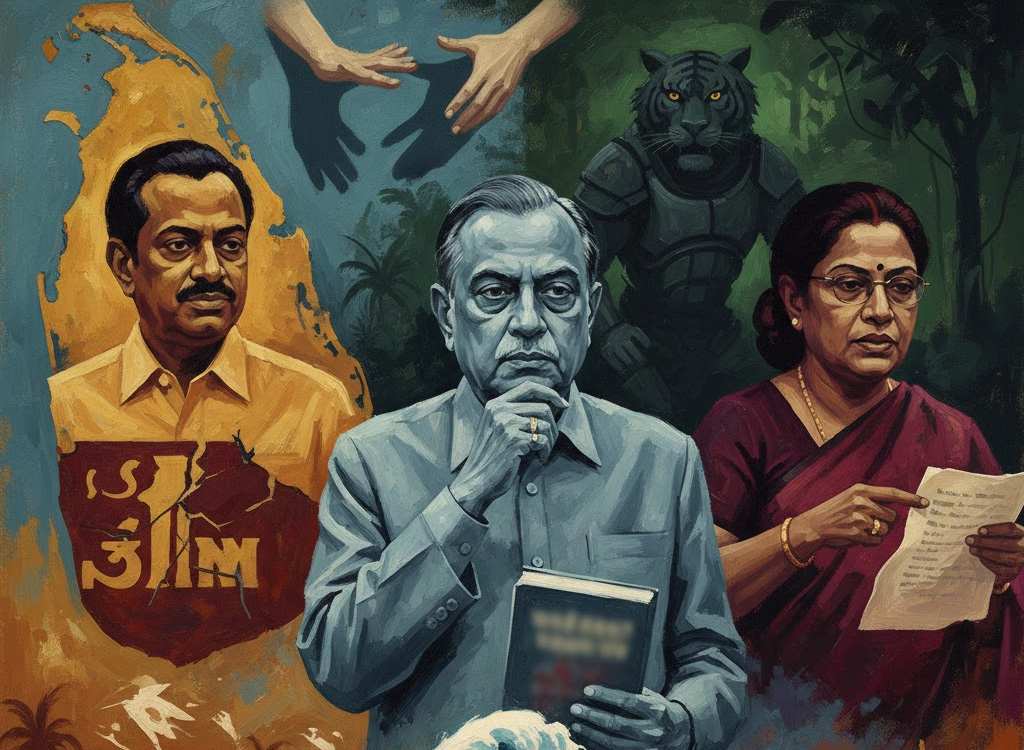
A review of the book by G.L. Peiris
By Dr. Venkat Iyer
The brutal and prolonged ethnic conflict in Sri Lanka, which nearly tore apart this otherwise peaceful South Asian island state before it was brought to a bloody but decisive end in 2009, has been the subject of much commentary over the years. The past decade and a half have seen a particular focus on the so-called Peace Process which preceded the defeat of the Liberation Tigers of Tamil Eelam (LTTE); experts from academia, the foreign policy establishment, and independent think tanks, both within and outside Sri Lanka, have sought to explain, assess, praise or excoriate the process and the actors involved in it. Against that backdrop comes a seminal book, which has the distinctive merit of being authored by someone who played a central role in piloting the process from the Sri Lankan government’s side as its chief negotiator.
It could be argued that any insider’s account of an enterprise as complex, controversial and fraught as bringing uncompromising enemies to the negotiating table, let alone persuading them to make the concessions necessary for a durable peace, cannot ever be truly objective. Even with that caveat, this book should be welcomed for at least two reasons: firstly, it is written with a degree of clarity and precision that is not only rare for politicians (especially from the Indian subcontinent) but also unsusceptible to prevarication if challenged on the facts; and, secondly, there is an overall fairness to the narration which adds credibility to the work. Among other things, Peiris does not flinch from offering critical, but measured, evaluations of some of the leading personalities involved in the peace process, including those with whom he worked closely.
He is particularly acute in his diagnosis of the weaknesses of the foundations on which the peace process rested. These were, in his view, compounded by human errors, including grave errors of judgement on the part of some of the actors involved, notably the Norwegian mediators whose had a looming presence over the entire process and who were perhaps allowed a greater measure of latitude in determining the course of events than was justified by the realities on the ground (the Norwegians were also not, as Peiris convincingly demonstrates, even-handed in their dealings with the two main parties to the conflict, showing a marked indulgence towards the LTTE). Peiris’s overall verdict on the peace process is that, despite the formidable impediments that lay in the way of everyone involved, the process was by no means “predestined to failure”. It could, he says, have “yielded a positive outcome” if some of the underlying issues were “handled differently”. He backs up this conclusion with examples of errors made or opportunities missed at various stages of the tortured negotiations.
There is much in the book which will be of interest to students of constitutional law. One crucial factor which scuppered the government’s ability to deal robustly and effectively with the LTTE’s machinations was what Peiris calls “the deep schism between rival centres of power within the government of Sri Lanka” and which Peiris explains at some length. This has to do with the ever-present scope for competition between the Executive President and the Prime Minister in the exercise of power – a state of affairs which has beset Sri Lanka ever since the constitutional arrangements there were radically restructured by President Junius Jayewardene in 1978. In the context of the peace process, those tensions ballooned into a veritable crisis when, as Peiris ruefully notes, there was a concerted attempt on the part of Prime Minister Ranil Wickremesinghe to keep President Chandrika Kumaratunga “in the dark” about the even the most essential aspects of the deal that had been worked out by the former with the LTTE. This included denying the President sight of the Cease Fire Agreement (CFA) which the Prime Minister had signed with the leader of the LTTE on 22 February 2002 – a pivotal document which guided the destiny of the peace process.
This had serious consequences, including the marginalisation of the defence forces and the exclusion of meaningful contributions from them to the decision-making process on military matters concerning the implementation of the CFA. As Peiris points out:
The paradox was that, crucial though their input undoubtedly was, consultation with the military was precluded by the cold shouldering of the President under whose sole authority the Armed Forces functioned.
Intriguingly, Peiris also avers that “in terms of conviction and values, there was little difference between the attitudes of the President and those of the Prime Minister”. Both, he says, were “committed to a balanced and equitable constitutional system of devolution as the abiding solution to a problem which had long bedevilled Sri Lanka’s national life.” In which case, the only rational explanation for their failure to work collaboratively with each other seems to be a clash of personalities, perhaps egos.
Another constitutional issue which attracts considerable attention from Peiris is federalism, whose implications for the peace process cannot, of course, be overstated. Unsurprisingly, this superficially anodyne term can – and does – mean different things to different people, as was the case with the actors on the Sri Lankan stage. Peiris goes into a fascinating – and highly illuminating (but from the point of view of lay readers perhaps too technical) – discussion of federalism and related concepts such as self-determination, autonomy, self-government, secession etc., and makes the point at the end of that chapter that, contrary to popular perceptions, the “Oslo Declaration”, a by-product of the peace process which was, at one time, heralded as a ‘breakthrough’ in the matter of power-sharing across Sri Lanka, “simply did not possess the transformational potential which was unrealistically claimed for it”.
There are two chapters in the book – dealing, respectively, with the “internationalisation” of the ethnic conflict, and the post-conflict pressure that the Sri Lankan government faced over alleged human rights violations – which repay study. On internationalisation, few will disagree with Peiris about the complexity of the concept, involving as it does the management of multiple expectations. But one valuable lesson which should open the eyes of many is Peiris’s acknowledgment that there is a clear need for “a reassessment of the role of Norway as facilitator”. The significance of this observation will be better appreciated upon a close and careful reading of Peiris’s comments – interspersed throughout the book – on Norway’s conduct during the entire period of its involvement in the peace process. Peiris is also, of course, right in making a broader observation about internationalisation:
The “international community”, in relation to the Sri Lankan peace process, is a misnomer, in so far as the countries involved had varying agendas and divergent priorities, so that they were not capable of a collective contribution having a homogenous character, even at the basic level.
On the human rights issue, which occupied much of Peiris’s time as Minister of Foreign Affairs under the administration of President Mahinda Rajapaksa in 2010 and thereafter, he makes a cogent and reasonable case but one which, given the tetchy state of the global conversation on human rights, is unlikely to persuade everyone. His interactions with many of the international institutions and mechanisms in this ever-expanding area seems to have convinced him that even-handedness and objectivity are, generally speaking, in short supply, although he does relate some refreshing examples of principled behaviour. Specifically in relation to the Human Rights Council of the United Nations, his assessment is scathing:
Objectively viewed, the criticism that the Human Rights Council was unacceptably subjected to political manipulation, with serious erosion of credibility, was unanswerable. Sri Lanka was by no means alone in complaining about irrefutable evidence regarding the application of double standards, which irreparably damaged the statute and prestige of the Council.
The book also contains a wealth of information about how the human rights dimension was weaved into the peace process “without subjecting to avoidable strain the sequence of the process”. One singularly vexing issue which had to be negotiated in this context was the forced recruitment by the LTTE of children as combatants in the murderous war raging in the North and East of the country – which had to be dealt with sensitively but firmly.
There is much else besides in the book spanning matters of high principle as well as practical utility which cannot, for reasons of space, be covered in the present review. These include, in no particular order of importance: the treatment of the sizeable Muslim community in relation to the peace process; the gender dimension of the war; the challenges of enforcing agreed commitments; the humanitarian issues of resettlement and rehabilitation of war-affected people; management of public expectations of a “peace dividend”; the link between economic incentives and progress on political issues for those present at the negotiating table, and so on. Peiris also helpfully sets out, in an opening chapter, the historical context of the peace process going back to pre-independence Ceylon and a penultimate chapter which explains how expectations that the 2004 tsunami which devastated large sections of the Sri Lankan coastline may assist in reviving the failing peace process were cruelly dashed.
Can the experience of the Sri Lanka be replicated in other situations of ethnic conflict? The answer has to be a resounding ‘no’ because conditions on the ground, coupled with local political traditions and cultural attitudes, vary markedly from society to society. Even so, books such as these are invaluable because of the broad pointers they supply, not least for the avoidance of common mistakes. Peiris notes, with a candour that many will find refreshing, that when a peace process assumes a “quality of sustained prevarication”, coupled with complacency (“a Micawber-like expectation that the more challenging issues could be sorted out with relative ease”), the end is surely nigh.
(Dr Iyer is a Barrister in Northern Ireland)
Disclaimer: The views and opinions expressed in this article are those of the writer and do not necessarily reflect the official position of this publication.










Leave a comment