
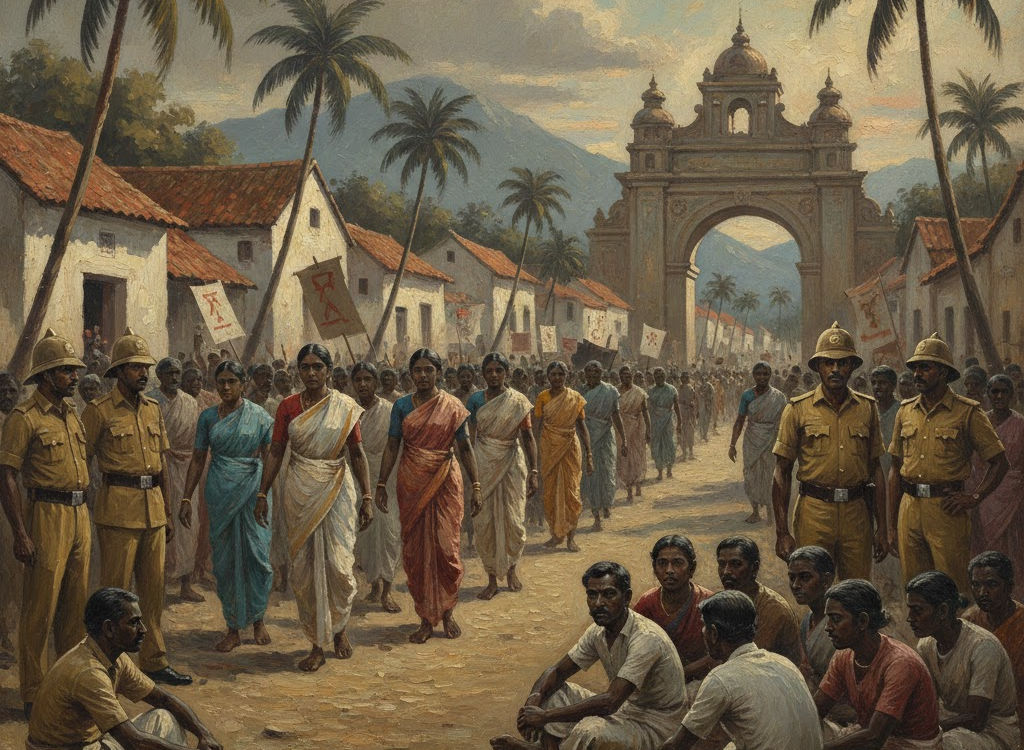
The Freedom Movement of Tamils in Ceylon
By S. Ponniah (Revised Edition, 2024)
By Lionel Bopage
Introduction
The question of nationalism in Sri Lanka remains one of the most consequential yet least understood issues in modern South Asian history. Satyagraha: The Freedom Movement of Tamils in Ceylon by Mr S. Ponniah offers an invaluable window into this complex landscape. It has documented the 1961 Tamil civil rights movement, a pivotal moment when non-violent resistance met state-sponsored violence. That movement ultimately shaped the subsequent trajectory of ethnic relations on the island.
First published in 1963 by Mr A. Kandiah and expanded in this revised 2024 edition by Messrs S. Ratneswaran and M. Vijayapalan, this work stands as both historical record and urgent political testament. It chronicles the Federal Party’s disciplined campaign of civil disobedience[i] against the government’s Sinhala Only[ii] language policy. This campaign paralysed civil administration in the Northern and Eastern provinces for nearly two months. More significantly, Mr Ponniah’s work captures a critical juncture when the Tamil community’s aspirations for equality and inclusion were met not with accommodation but with batons, tear gas, and martial law.
The architecture of exclusion
Mr Ponniah’s central achievement lies in demonstrating in layman’s terms, that Sri Lanka’s ethnic conflict was never an inevitable collision of pre-existing identities. Rather, that conflict was engineered, painstakingly and repeatedly, by successive political leaderships who manipulated language rights, Buddhist religious sentiment, and majoritarian psyche to consolidate their own power.
That conflict traces this trajectory from the British colonial period, when capitalism was superimposed upon a feudal order, through the emergence of an indigenous bourgeoisie. This indigenous bourgeoisie absorbed European liberal ideals while remaining bound to deeply hierarchical social structures.
Their work necessitates examining how the concept of “Ceylonese” nationalism, a genuinely trans-ethnic vision drawing on civilizational achievements Sinhalese and Tamils shared alike, was systematically dismantled from the 1930s onward. Political actors exploited the asymmetry between majority and minority to entrench divisions serving electoral ambitions rather than addressing authentic communal grievances.
The 1948 Ceylon Citizenship Act of the D S Senanayake regime, which disenfranchised over 700,000 Malaiyaha Tamils, and the 1956 Sinhala Only Act of the S W R D Bandaranaike regime, marked legislative milestones in this process of exclusion. The violence that followed, for example, the widespread attacks on Tamil communities by state-sponsored Sinhala mobs in 1958, was not incidental to those policies but their predictable consequence. This was the episode in which figures such as Colonel Richard Udugama played a pivotal role revealing the degree to which legislative exclusion had already become entangled with organised physical violence.
The 1961 Satyagraha: Dignity meets violence
The heart of Mr Ponniah’s narrative focuses on the 1961 Satyagraha campaign itself. Led by Mr S.J.V. Chelvanayakam, thousands of Tamil citizens engaged in peaceful sit-ins to protest discriminatory language policy. The book provides meticulous documentation of grassroots mobilisation and the discipline of protesters who, without retaliation, faced brutal state repression. When police launched baton charges against demonstrators, including prominent leaders like MP Dr. E.M.V. Naganathan, the satyagrahis maintained their commitment to non-violence even as they endured physical abuse.
Mr Ponniah captures telling contrasts such as the restrained police response in Batticaloa, where satyagrahis refused even water as a spiritual commitment, versus the police violence in Jaffna; the unity of legal professionals across political lines protesting police brutality; the participation of six Sinhalese protesters who condemned government attempts to sow discord. These details illuminate both the movement’s moral power and the state’s determination to crush it.
The brutality directed at unarmed protesters drew sharp rebukes from across the political spectrum. Mr J.R. Jayewardene of the United National Party publicly acknowledged the excessive force used by police and indicated that parliamentary action would be pursued, particularly regarding the way five Members of Parliament were treated. Comrade Pieter Keuneman of the Communist Party called for a formal inquiry into police conduct. Comrade Bernard Soysa of the Lanka Sama Samaja Party, following an on-site investigation, condemned the police behaviour as stupid and cruel. The Times of Ceylon drew an unflattering comparison between the disciplined handling of protests by London police and the conduct of their Ceylon counterparts.
A conference convened in Jaffna sought to unite political parties around the cause, producing a resolution that demanded governmental recognition of Tamil language. The resolution condemned the police response and called for an independent inquiry into police brutality. However, later on such expressions of solidarity had no bearing to their behaviour afterwards. Many of the same parties, following the 1972 constitutional changes that further entrenched Sinhala and Buddhist primacy, shifted their stances to align with nationalist sentiments. This behaviour illustrated how fragile cross-ethnic political goodwill had been.
The government’s response, deploying military forces and declaring martial law rather than addressing legitimate grievances, proved catastrophic. As Mr W. Dahanayake, an opposition MP warned at the time, unrest was escalating beyond government control. Yet Prime Minister Sirima Bandaranaike chose suppression over dialogue[iii]. This harsh repression discouraged a generation of Tamil youth, contributing directly to the rise of armed militant groups in the subsequent decades.
From non-violence to armed struggle
One of the book’s most sobering contributions is its analysis of how the failure of non-violent resistance created conditions for militancy. The roots of this trajectory run even deeper. The failure of the Bandaranaike–Chelvanayakam Pact in 1957, an agreement that might have offered meaningful accommodation, triggered the first island-wide ethnic riots in 1958. The riots resulted in significant casualties and set a precedent for the cycle of provocation and repression that defined subsequent decades.
Post-satyagraha, the Dudley-Chelvanayakam (DC) Pact of 1965 similarly attempted constitutional resolution through several key measures. Those key measures were to make Tamil an administrative language in the Northern and Eastern provinces, establish District Councils with devolved powers, and implement land policies prioritising landless residents in the provinces to protect Tamil-majority areas from demographic changes.
However, relentless opposition from Sinhalese nationalist groups rendered the pact ineffective through inaction. It was never formally repealed but practically abandoned. This betrayal marked a turning point, leading many Tamils to view peaceful attempts as futile and prompting the rise of Tamil militancy. The unfulfilled promises of 1965, combined with the exclusionary 1972 constitution, spurred well organised anti-Tamil riots in 1977 and 1981. Those riots culminated in the catastrophic violence of July 1983 anti-Tamil pogrom. The pogrom, in turn, devastated Tamil communities and eliminated prospects for peaceful reconciliation.
The 1961 Satyagraha, itself a response to the unresolved grievances of that earlier period, ended in martial law rather than dialogue. The transition from calls for linguistic equality to demands for separation, culminated in the 1976 Vaddukoddai Resolution. Its call for an independent Tamil Eelam, reflected not extremism but the breakdown of trust between communities and the exhaustion of democratic processes.
Instructive parallels can be drawn with the 2022 Aragalaya protest movement. That movement also employed non-violent methods and crossed ethnic lines, only to face authoritarian suppression. This comparison underscores the continuity of state responses to dissent and the persistent challenges facing minority communities seeking recognition and equality. In a similar vein, one needs to acknowledge with necessary candour the destructive legacy of the LTTE.
Nevertheless, that does not mean the contextualisation of the Tamil militancy as a whole should be ruled out. Political violence cannot be excused yet must be understood within a framework of cultural humiliation, socio-economic deprivation, and repeated betrayals of democratically reached agreements. The examples of Ho Chi Minh and Nelson Mandela demonstrate that armed struggle does not need to preclude eventual negotiated settlement. That is a lesson the state and the militant movements in Sri Lanka failed to heed.
Buddhism, capitalism, and politics of identity
A sophisticated analysis of Buddhism’s evolving relationship with political power will indicate the manner the Buddhist Nikayas have been historically proximate to centres of power. Buddhism realigned with the capitalist state in the post-independence era, deepening social hierarchies rather than dissolving them. Religious identity became a crude instrument of political mobilisation, complicating simplistic narratives of religious extremism that have dominated certain commentaries on the ethnic conflict.
The ideology of the Mahavamsa, portraying the Sinhalese as a chosen nation, created hierarchical worldviews that marginalised non-Sinhala and non-Buddhist communities. Yet we also need to recognise the legitimate cultural anxieties of the Sinhalese people. Their vibrant oral traditions and collective memory shaped aspirations for self-determination not inherently incompatible with pluralism.
Persistence of discrimination
The book’s contemporary relevance emerges in its documentation of what occurred in 1961 and the opportunity to relate those eventualities to the subsequent events. Despite rhetorical commitments to equality, we can observe that new political administrations also continue to fail in fully grasping the alienation felt by minority communities due to decades of discriminatory policies. The electoral system has compounded these tensions by limiting incentives for political concessions to Tamils. Many Sinhala nationalists view any devolution of power as threatening, failing to recognise that once, existing divisions historically pushed Tamils toward separatism.
Mutual solutions need to consider perspectives of both Sinhala and Tamil-speaking communities. The displacement of Ceylonese nationalism by competing ethnic nationalisms after 1956 was not spontaneous but the predictable outcome of deliberate political, social, and cultural manipulation. It had been a cycle in which refusals to accommodate Tamil aspirations generated ever greater demands for separation.
Conclusion: An urgent argument for pluralism
Satyagraha: The Freedom Movement of Tamils in Ceylon is not merely a chronicle of suffering during the 1960s. It also points towards an urgent argument for pluralism, for a conception of Lankan identity capacious enough to encompass every ethnic and religious community on the island. Through meticulous documentation of the 1961 satyagraha campaign, Mr Ponniah illuminates the moral courage of those who pursued justice through non-violent means and the tragic consequences when states choose repression of peaceful protests over recognition of rights.
The book serves multiple purposes: as historical record preserving testimonies of grassroots mobilisation; as political analysis tracing the genealogies of Sinhala and Tamil nationalist consciousness; and as moral reminder that the path not taken, genuine accommodation of minority rights within a pluralistic framework, might have spared the island decades of violence and suffering.
Professor Jayadeva Uyangoda’s observation about similarities between the 1961 Satyagraha and the 2022 Aragalaya underscores the book’s enduring relevance. The patterns of peaceful protest met with violent suppression, of democratic demands dismissed as threatening, of minority aspirations characterised as separatism, these cycles appear to continue to shape Sri Lankan politics.
This revised 24-chapter edition, expanded with contemporary analysis, should be compulsory reading for every Sri Lankan who wishes to understand not only what happened, but why, and what, still, might be done. It offers no easy answers but provides the historical foundation necessary for any honest reckoning with the past and any viable path toward a genuinely inclusive future.
This work of Mr Ponniah, which demands the most serious attention of scholars of South Asian history, students of nonviolent protest movements, and anyone committed to understanding how ethnic conflicts are created and how they can be resolved, will also richly reward them. In documenting the dignity of those who resisted oppression without violence, it preserves a tradition that remains vital to Sri Lanka’s unfinished struggle for justice and equality.
This work is highly recommended as a resource.
[i] A campaign of public, nonviolent, and conscientious breach of law aimed at bringing about changes in laws or government policies
[ii] The Official Language Act No. 33 of 1956, whichmade Sinhalese the sole official language of Ceylon (now Sri Lanka), replacing English and excluding Tamil.
[iii] Similarly, Prime Minister Sirima Bandaranaike refused a JVP request for dialogue made in the late 1970s. The JVP sought to end the escalating vicious cycle by clarifying that the traditional Left parties within the coalition government were driving a campaign for violently repressing the JVP.
Disclaimer: The views and opinions expressed in this article are those of the writer and do not necessarily reflect the official position of this publication.










Leave a comment