
By Rohan Samarajiva
It appears that the latest procurement by Lanka Coal caused a direct loss of LKR 7,668.1 million to CEB. This is a floor, not a ceiling. The direct loss calculation excludes the additional costs that must be incurred to make up for the shortfall in generation caused by sub-standard coal and the remedial measures that may have to be taken to manage increased fly ash volumes.
Lanka Coal is a 100 percent state-owned enterprise that will shortly be a part of Electricity Generation Lanka (EGL), one of CEB’s successor entities that will also be 100 percent state owned.
Statements by the authorities indicate that the coal supplier failed to perform as stipulated in the contract and that some penalty clauses may be activated. A net loss is likely, even after the penalties are recovered subject to conditions being satisfied.
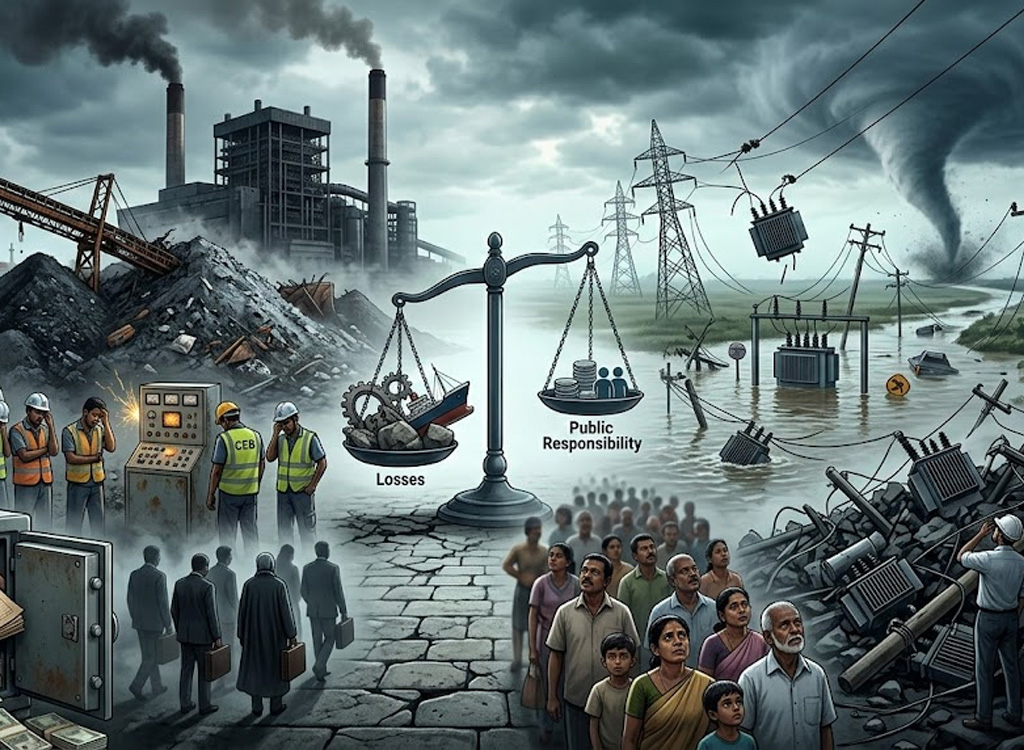
Was the cause incompetence or corruption? The latter must be proved beyond reasonable doubt and should be left to CIABOC where a complaint has already been lodged. Irrespective of the cause, someone will have to bear the loss. That is the question explored below. The more generic question is the efficacy of cost-recovery regulation and cost-pass-through formulae in dealing with costs caused by mismanagement or malpractice in state-owned enterprises (SOEs). The government is grappling with the following issues at this moment that may be dealt with together:
- Who will pay for the losses accumulated by CEB because governments since 2014 prevented tariffs from being filed?
- Who will pay for the damages from Cyclone Ditwah?
Who pays for accumulated losses?
The losses were accumulated because governments in power got the CEB to desist from submitting tariff-revision requests. Customers of those periods benefitted from below-cost tariffs. Is this something that current customers should be held responsible for? Or should the taxpayers of this country who kept rewarding politicians who caused the losses pay? If the latter, Treasury should eat the losses in the same way it is absorbing the losses of SriLankan Airlines: LKR 20 billion in one budget, LKR 25 billion in the next, and more to come with no end in sight.
In the first draft of the 2026 National Electricity Policy, the accumulated losses were to be assigned to CEB successor entities. Following criticism, this policy statement has been removed from the current draft of the policy.
The key point is that someone must pay. Until the economic crisis and the IMF enforced recovery program, politicians used to direct Treasury to absorb these losses quietly. Only a few informed citizens knew that the taxpayers were footing the bill. Most people preferred to not know who was paying for the SOE losses and the interest on the debt that was taken to cover the losses.
Who pays for Ditwah losses?
Politicians were the culpable party in the above instance. The next example is one where culpability lies with the engineers responsible for the operation of the system.
Around four million out of approximately seven million electricity customers were affected by Cyclone Ditwah in late November 2025.
- About 40 percent of CEB’s infrastructure was damaged.
- 2,994 high voltage breakdowns and 32,341 domestic level low voltage breakdowns were reported.
- The distribution network suffered the most damage with 17,143 transformers out of 39,537 affected.
- The Rantambe-Mahiyangana transmission line suffered severe damage but has been temporarily restored.
Ditwah was admittedly an unprecedented disaster. Most of the rivers flooded, and landslides were experienced in multiple districts. However, the extent of network failure suggests that some degree of responsibility lies with those who designed and operated a network that exhibited this level of fragility.
Having the government routinely step in (directly with Treasury funds or by allowing recovery costs to be passed on through tariffs) to absorb the additional costs caused at least partially by improper design and operation of networks creates a moral hazard. The CEB successor companies will continue to engage in risky operations.
The latest draft of the National Electricity Policy seems to like moral hazards: “Licensees may claim to be compensated for cash outflows caused by extraordinary events outside their control and not covered by any other provision in the tariff policy, such as arbitration awards, arbitration costs, judicial awards and legal costs related to licensed business, and additional costs to procure generating plant or energy due to force majeure events, provided such are not covered by insurance.”
Who pays for procurement malpractices?
Around 90 percent of the costs considered in relation to a tariff proposal are costs of imported coal and oil. Because the facts of the current procurement are still emerging, data from a few years back will be used to illustrate.
The Lanka Coal Company paid the highest-ever price of USD 272 for a metric ton (MT) with freight in 2022, following discomfort among sellers about its financial status. This was for a spot tender of 480,000 MT, floated after the original procurement failed. In 2019-20, the average price per MT had been USD 89; in 2020-21 it was USD 84.49; by 2021-22 the average price had jumped to USD 167. The difference in overall cost from 2020-21 to 2021-22 (for 2.25 million MT) was USD 173 million or around LKR 65 billion.
For purposes of illustration, it may be assumed that there could have been a 10 percent unreasonableness in coal purchases. That would be LKR 6.5 billion. This would, of course, have to be proved with forensic evidence or by comparison with benchmark prices.
Can the regulator disallow LKR 6.5 billion in costs (1.25 percent of the total costs relevant to the 2022 tariff)? In the context of utilities with private shareholders that are subject to Rate Base Rate of Return regulation (RBROR, the technical term for regulation that looks at the reasonable of costs incurred), this would be normal. The disallowed costs would be deducted from the rate base (the total costs) and the tariffs would be computed based on the lower number. Depending on the extent of disallowance, the tariffs could be noticeably lower.
The disallowed costs must be borne by someone. In the case of a private utility, that would be the shareholder. In a 100 percent state-owned utility, the state will have to bear the costs. If any costs are disallowed, the utility is likely to claim that it has been deprived of funds to provide continuous electricity. Treasury, as the owner, will have to take the hit. The former would be politically unfeasible; the latter would likely violate the Public Financial Management Act, No. 44 of 2024.
Assume that it could be proved that the loss of LKR 7,688.1 million plus was caused by a corrupt individual or individuals. It will take around 2-3 years for a final judgment, including appeals. In parallel action may be initiated under the still untested Proceeds of Crime Act No. 5 of 2025 to seize the proceeds of the crime. This may take a few years (or longer if the assets are located abroad). None of this will make the immediate problem of setting tariffs to cover the losses in 2026 go away.
We will pay
In all the instances discussed, we will pay. The only question is whether we pay through the tariff as electricity consumers, or as taxpayers. This is the reality of 100 percent state-owned enterprises. As long as we do not press our rulers to reform the ways in which SOEs are owned and governed, no incentives will exist for the avoidance of the dysfunctions described above. And we will pay, over and over again.
Disclaimer: The views and opinions expressed in this column are those of the author, and do not necessarily reflect those of this publication.







Leave a comment