
By J. Abeywickrema
Who rules when rules disappear?
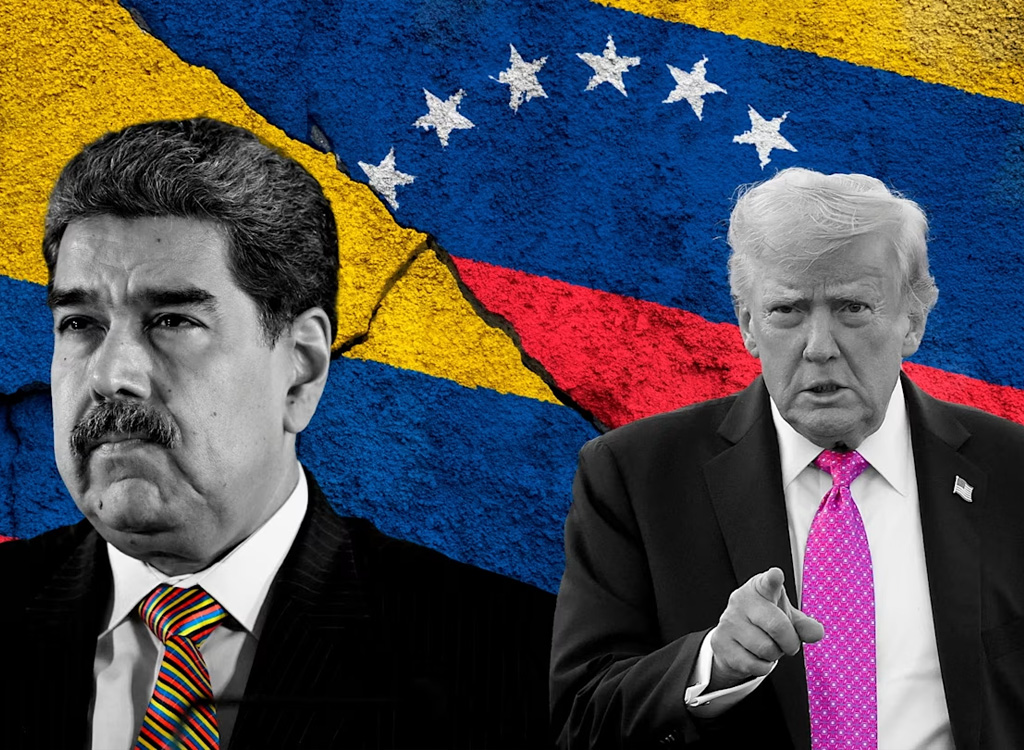
A single man and a small circle of his closest aides, unknown even to the House of Congress, took it upon themselves to attack a sovereign nation, seize its Head of State and assume control over its administration; and the world is apparently expected to accept this as normal.
At a carefully choreographed post event media appearance, US President Donald Trump flanked by those who planned and executed Operation Venezuela, openly celebrated its “precision” and “success,” boasting of targets hit and objectives achieved. Yet one fundamental question went conspicuously unanswered: by what authority did they act? Who or what conferred upon them the right to decide the fate of another country?
That silence was made more ominous when the American President went on to announce that the very same officials standing beside him would be the ones overseeing the governance of Venezuela. There was no mention of democratic transition, no reference to elections, and no acknowledgement that the Venezuelan people might have a say in who governs them. Democracy, so often invoked as justification for intervention, was not merely sidelined here; it was erased by the very same entity which for the longest time has been pontificating its merits.
Profound assumption
The implication could not be starker. Venezuelans are now to be deprived of self-determination while foreign actors move in to “manage” the country and extract its extensive oil resources, ostensibly to settle what Trump described as long-standing dues. This presumes, with breathtaking arrogance, that the people of Venezuela will greet foreign control with gratitude rather than resistance – an assumption profoundly detached from the country’s political realities and historical memory.
Such unilateral action does not occur in a vacuum. It creates a dangerous precedent, effectively granting other major powers a licence to pursue their own interventions, whether in Asia or elsewhere, justified by selective readings of history or security. It is a logic that invites China and other powerful states, to do exactly what it pleases and explain it away after the fact.
The irony is unavoidable: this is the same President who, until recently, publicly denounced American involvement in regime-change operations and foreign occupation. That denunciation now rings hollow, exposed as rhetoric rather than principle, as the world watches the doctrine of ‘might is right’ reassert itself in its most unapologetic form.
What unfolded in Venezuela in the early hours of January 3, 2026, was not merely another episode in the long history of great-power interventionism; it was a moment of global reckoning. The United States’ unprecedented military strikes on Venezuelan soil, followed by the capture of President Nicolás Maduro, did more than shock international opinion. They stripped bare the fragile architecture of the post-war international order and exposed a reality many in the Global South have long suspected but rarely seen so openly confirmed: that in today’s world, law survives only at the pleasure of power.
A return to darker times
From Colombo, the events in Caracas were watched with a mixture of disbelief and grim recognition. Disbelief, because the sheer audacity of the act – executing a naval blockade, launching strikes and physically removing the leader of a sovereign state without so much as a UN nod, felt like a return to a darker century. Recognition, because for countries like Sri Lanka, this was not a rupture with the past but its continuation. It was the old grammar of empire spoken in the modern language of “law enforcement,” “narcotics control,” and “democracy restoration.”
Washington’s initial justification was carefully calibrated. The operation, it said, was not an act of war but a targeted effort to execute long-standing criminal indictments against Maduro on charges of narco-terrorism and human rights abuses. The implication was that sovereignty itself could be suspended when a powerful state chose to internationalise its domestic legal processes. Yet any remaining ambiguity evaporated within hours.
In his special address, President Trump declared that the United States would effectively “run” Venezuela until a “safe, proper and judicious transition” could be arranged. He confirmed that American oil companies would take over Venezuela’s energy sector: the real objective – control over the world’s largest proven oil reserves – was no longer even disguised.
For much of the Global South, this admission was the most damning aspect of the episode. It confirmed what critics had been arguing all along: that the legal pretext was a thin camouflage for a geopolitical and economic project. The capture of a Head of State was not about justice but about leverage; not about democracy but about resources. In that sense, Venezuela was not an aberration but a textbook case of ‘might is right’ politics in its purest form.
Collapse of collective rules
The doctrine itself is ancient. Long before modern international law, the Greek sophist Thrasymachus famously argued in Plato’s Republic that ‘justice is nothing more than the interest of the stronger.’ Those in power, he said, make laws to suit themselves, and obedience to those laws is then described as ‘justice.’ For centuries, philosophers and statesmen have attempted to refute this bleak view of politics. The United Nations Charter was among the most ambitious of those efforts, built on the radical promise that all states – large and small – are sovereign equals, and that the use of force would be constrained by collective rules rather than unilateral will.
What the world witnessed in Venezuela suggests that this promise is now close to collapse.
Russia’s invasion of Ukraine in 2022 was widely recognised as a violation of Article 2(4) of the UN Charter, which prohibits the use of force against the territorial integrity or political independence of any state. Moscow’s justifications of pre-emptive self-defence, historical unity, and “denazification” were rejected by the majority of the international community, yet proved irrelevant in practice because Russia possessed the military capability and Security Council veto to withstand condemnation.
In Gaza, the ongoing devastation since 2023 has reinforced the perception that international humanitarian law is applied selectively. Despite UN resolutions and provisional rulings from the International Court of Justice, Israeli military operations have continued, shielded by strategic alliances and geopolitical calculations.
The United States’ actions in Venezuela now complete this grim trilogy. By imposing a naval blockade, launching strikes, and capturing a Head of State without Security Council authorisation, Washington has demonstrated that it too is prepared to bypass the very rules it has long championed. From the perspective of Asia, Africa, and Latin America, the lesson is devastatingly clear: the so-called “rules-based international order” functions only when it aligns with the interests of the powerful.
Corrosive hypocrisy
This hypocrisy is perhaps the most corrosive element of the current moment. When the United States condemns Russia’s violation of Ukrainian sovereignty while itself violating Venezuelan sovereignty, the moral authority of Western rhetoric becomes hollow. What emerges instead is a dangerous ‘permission structure.’ If permanent members of the Security Council can act unilaterally with impunity, other regional powers are inevitably emboldened to do the same. The Venezuelan precedent, many fear, effectively hands China a rhetorical licence to pursue Taiwan under the language of internal jurisdiction, just as Russia framed Ukraine as part of its “near abroad” and the United States has revived a modernised Monroe Doctrine in its hemisphere.
For Sri Lanka, this is not merely a philosophical debate about global norms: it is a matter of survival. Small states have always relied on international law as their primary defence against coercion by larger powers. If that law is reduced to what many in South Asia now describe as a “paper shield,” then the international system begins to resemble a jungle rather than a community. In such a world, neutrality becomes precarious, and sovereignty conditional.
The consequences are already reshaping regional behaviour. Across South Asia, governments are drawing the same conclusion from Ukraine, Gaza, and now Venezuela: diplomacy without deterrence is insufficient. India’s defence posture illustrates this shift most clearly. For the 2026-27 budget, New Delhi is seeking a dramatic increase in defence spending, prioritising self-reliance under its “Atmanirbharta” doctrine. The lesson it has drawn is stark: a nation must be able to fight a high-intensity, prolonged conflict without depending on foreign supply chains that can be cut off by sanctions or political pressure.
Pakistan, despite crippling economic constraints, has followed a similar path, increasing its defence budget by around 20 per cent for 2025-26. For Islamabad, the message from Venezuela is that ‘credible minimum deterrence’ remains the only reliable shield against regime-change ambitions. Bangladesh, more quietly but no less deliberately, is diversifying its arms suppliers, turning toward countries like Turkey to avoid over-dependence on any single major power.
Sri Lanka’s plight
Sri Lanka, by contrast, stands on far more fragile ground. Emerging from bankruptcy, it cannot afford this arms race. Its defence budget is largely consumed by personnel costs, leaving little room for modernisation. As a result, Colombo relies heavily on “donations” of military hardware – ships from China, vehicles from India, training from a range of partners. In a world governed by the ‘might is right’ doctrine, such generosity is rarely unconditional. Every gift carries an expectation, every favour a future claim. The fear in Colombo is that military dependence could translate into political vulnerability, particularly when strategic assets such as ports and sea lanes are involved.
It is this anxiety that explains Sri Lanka’s renewed interest in multilateral groupings such as BRICS. Far from being an ideological rejection of the West, Colombo’s calculus is pragmatic. Membership in a large bloc offers economic insulation against sanctions, diplomatic cover against isolation, and a measure of collective leverage that no small state can muster alone. Safety, once again, is sought in numbers.
The reaction within BRICS to the Venezuela strikes has been revealing. More assertive members such as Russia and Iran have pushed for outright condemnation, framing the U.S. action as ‘imperial overreach.’ Democratic leaders like Brazil and South Africa have denounced the militarisation of the Caribbean and warned against regime change under false pretences.
India, as the 2026 BRICS chair, has adopted a more cautious tone, emphasising respect for sovereignty and the UN Charter without directly naming the United States as an aggressor. Critics may call this equivocation, but it reflects a deeper dilemma: how to defend international law without reducing BRICS into a purely anti-Western alliance.
Salvaging the old order
From a Sri Lankan perspective, India’s restraint is significant. New Delhi understands that the precedent set in Venezuela is dangerous not only for Latin America but for Asia itself. If “law enforcement” can be redefined to justify cross-border military action, then the sanctity of borders everywhere is at risk. India’s insistence on separating domestic criminal law from sovereign rights is, in effect, an attempt to salvage at least a fragment of the old order.
Meanwhile, the United Nations has been exposed once again as structurally paralysed. The emergency Security Council session convened at Venezuela’s request hours after the attack, quickly devolved into familiar patterns of veto threats and procedural deadlock. As in Ukraine and Gaza, the Council proved incapable of acting precisely because those accused of violating the Charter possess the power to block accountability. The move to invoke the “Uniting for Peace” mechanism in the General Assembly may yield a moral statement, but it cannot undo the precedent that has been set: a head of state has been removed by force while the world debated wording.
For Sri Lanka, the implications are immediate as well as strategic. The economic shockwaves of the crisis are already being felt. Venezuela’s turmoil has injected volatility into global energy markets, with Brent crude expected to rise into the $62-$65 range in the short term. For an import-dependent economy, even modest increases strain foreign exchange reserves, raise transport and electricity costs, and threaten social stability. While analysts suggest that a rapid political transition in Caracas could eventually flood the market with Venezuelan oil and push prices down later in 2026, the interim volatility poses real risks to Sri Lanka’s fragile recovery.
Beyond economics lies a deeper psychological shift. Neutrality itself is beginning to look fragile in a world where power increasingly determines legitimacy. Sri Lanka’s official response has been cautious and principled, emphasising adherence to the UN Charter and calling for de-escalation. Civil society groups, less constrained by diplomatic calculation, have been far more direct, condemning the strikes as illegal aggression and warning that the erosion of sovereignty anywhere endangers sovereignty everywhere. Both responses stem from the same unease: that the rules which once offered at least minimal protection to small states are being systematically hollowed out.
Gradual descent to ‘might is right’
The tragedy is that this outcome was not inevitable. The descent into ‘might is right’ politics has been gradual, enabled by selective outrage and strategic silence. Each violation tolerated because it was inconvenient to oppose has paved the way for the next. Ukraine, Gaza, and now Venezuela are not isolated failures but cumulative ones. Together, they have transformed Thrasymachus’ ancient provocation from a philosophical challenge into a working description of global affairs.
For Sri Lanka and other small nations, the task ahead is daunting but unavoidable. It must continue to defend multilateralism not because it is perfect, but because its collapse will leave the nation defenceless. Sri Lanka must oppose violations of sovereignty consistently, regardless of who commits them, even when doing so carries diplomatic costs. And it must deepen cooperation with other small and middle powers to ensure that even the smallest voices, though individually weak, are not entirely drowned out.
The capture of a president in Caracas may seem geographically distant from Colombo, but in reality, has brought the logic of the jungle closer to home. The world that promised rule by law is giving way to rule by force. Whether that transition becomes permanent will depend, in part, on whether small states refuse to accept it as inevitable – or resign themselves, silently, to Thrasymachus’ verdict.
(The writer is a senior journalist who was attached to several leading media institutions in Colombo)
Source: Factum
Disclaimer: The views and opinions expressed in this column are those of the author, and do not necessarily reflect those of this publication.







Leave a comment