
By Vox Civis
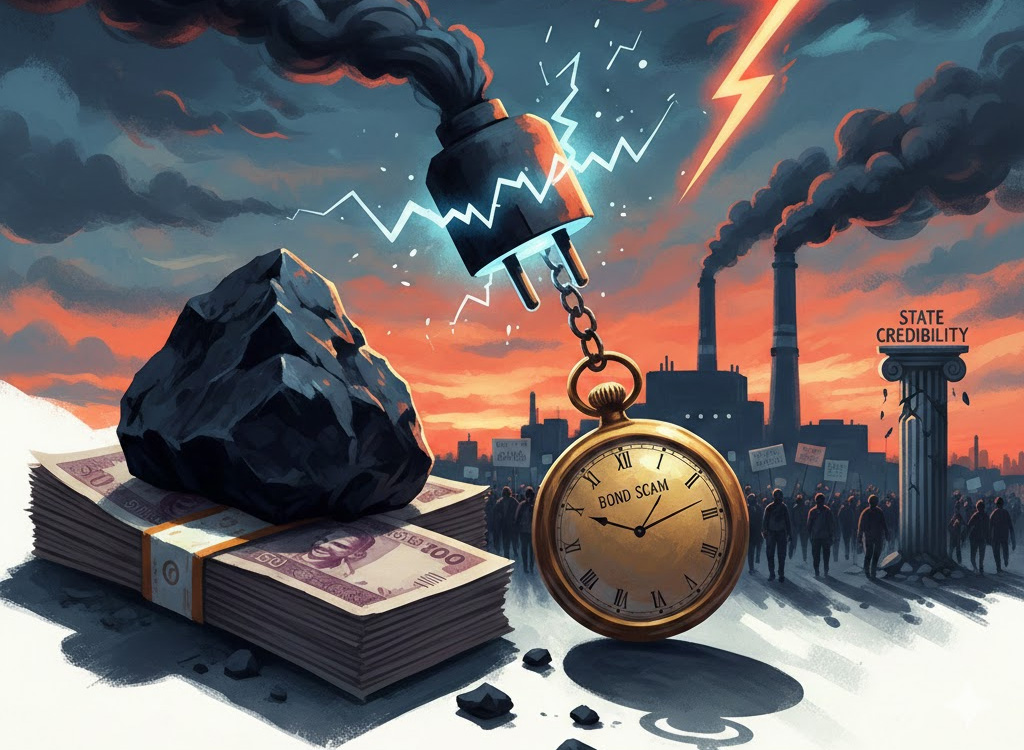
In the past few weeks, Sri Lanka’s simmering concerns over coal procurement have erupted into a full-blown political firestorm. What began as technical murmurs about the quality of imported coal has now evolved into a defining test of the credibility of the National People’s Power (NPP) led government, the integrity of public procurement, and the resilience of the country’s fragile energy security. The controversy has sharpened into a moment of reckoning not merely about coal, but about corruption, accountability, and the promises that swept this administration into power.
The immediate flashpoint is the Ceylon Electricity Board’s (CEB’s) request to the Public Utilities Commission of Sri Lanka (PUCSL) to approve a 13.6 percent increase in electricity tariffs from the next quarter. Opposition members of the Samagi Jana Balawegaya (SJB) have warned that further price hikes will drive them to the streets. The charge is politically potent because at a time when global crude oil and gas prices have softened, why must Sri Lankan consumers pay more? And more troubling still, are they being asked to foot the bill for a procurement disaster that could have been prevented?
At the center of the controversy stands the Minister of Power and Energy. The Opposition has revived allegations from his tenure at the State Fertiliser Corporation, where he was removed over a tender-related fraud and later found guilty in court, prompting a complaint to the Commission to Investigate Allegations of Bribery or Corruption (CIABOC). That inquiry, it is said, remains ongoing.
Energy security
The question being asked is, why appoint a minister with a dubious record to oversee one of the most sensitive portfolios in the country? Energy security is not merely an administrative domain; it is the backbone of economic stability. In the aftermath of the 2022 bankruptcy crisis that contributed to the collapse of the Gotabaya Rajapaksa administration, Sri Lankans understand the catastrophic chain reaction that begins with fuel shortages and power cuts.
Internal CEB documentation reportedly estimates generation losses from inferior coal at Rs. 2.7 billion. Additional repair and maintenance costs at the Norochcholai Coal Power Plant are projected at around Rs. 300 million. Even under conservative assumptions, the direct financial hit is expected to approach Rs. 3 billion. Yet the maximum compensation claimable from the supplier is capped at Rs. 1 billion, leaving at least Rs. 2 billion unrecovered. What is to be kept in mind is that these figures apply only to the first few shipments that have already arrived. With a further 20 shipments pending, the potential losses could double or triple in scale.
But the real danger lies not merely in arithmetic. If boiler tube systems are damaged by high-ash coal, the plant could be forced to shut down for weeks or perhaps even months. A three-week shutdown for such a repair alone would trigger cascading financial losses and likely power cuts. The spectre of load shedding is not exactly an abstraction in Sri Lanka, but a political accelerant. The fall of the previous regime was catalysed by energy paralysis. Therefore, to gamble with that memory is to gamble with the stability of the State itself.
The most disturbing element of this saga is the allegation that technical warnings were ignored. The CEB’s Director (Technical) has reportedly cautioned against the use of substandard coal as early as September last year. Instead of heeding internal expertise, critics allege that the Ministry had sought reassurance from the supplier. In matters of public procurement, this inversion of trust – privileging the contractor over the State’s own engineers – essentially raises profound governance concerns.
Passing the buck
Former Energy Minister Patali Champika Ranawaka has lodged a formal complaint with the CIABOC last week. He argued that the losses from substandard coal will ultimately be borne by 7.5 million electricity consumers. The Chairperson of the Electricity Consumers’ Association, M.D.R. Athula, has demanded swift accountability. According to Ranawaka, the government that promised sweeping tariff reductions is now preparing to increase them by 13.5 percent, even as global energy benchmarks remain comparatively low. It is for this reason that the dissonance between promise and policy could not be sharper.
In Sri Lanka, ordinary individuals cannot directly institute legal action over alleged misuse of state funds. It is the CIABOC that must act, supported by evidence from the Auditor General’s Department. Reports suggest that 18 complaints have been lodged with the Commission and four with the police thus far on this matter. Yet, there does not appear to be a visible investigation. The new Auditor General, critics claim, has yet to meaningfully intervene and the resultant impression – fair or not – is of institutional inertia.
Meanwhile, Parliament’s Sectoral Oversight Committee on Infrastructure and Strategic Development has drawn attention to troubling irregularities. It has found that a coal procurement tender that should have been called in April has now been postponed until September. Additionally, procurement rules have been relaxed; the required supplier experience has been reduced from three years to one, and the crucial clause of having delivered one million metric tons previously has been reduced to just 100,000 metric tons.
Custom made criteria
Additionally, the tender bond has been slashed from US$ 1 million to US$ 100,000 while the bid submission window was cut from the international norm of forty-two days to 21, ostensibly due to urgency. Yet after this rush to close bids, the award itself has been delayed by two months raising not only eyebrows but also plenty of red flags.
The calorific value standard for coal to be used in Sri Lanka ranges between 6,050 and 6,200 kilocalories per kilogram. Tests at Norochcholai reportedly showed a value of 5,504 kilocalories for the disputed shipments. An international laboratory test later indicated 5,600 kilocalories, still well below standard.
Meanwhile, the supplier’s documentation claimed 6,100 kilocalories. A difference of roughly 500 kilocalories per kilogram translates into the need to burn significantly more coal to generate the same electricity – raising costs, increasing ash, and accelerating wear on machinery. Ordinarily, 0.36 kilograms of coal produce one kilowatt-hour. In practice, consumption has reportedly climbed to around 0.42 kilograms – certainly not a marginal variance.
Equally troubling is the allegation that the second shipment was not subjected to plant-level testing, even though two consecutive failures would have triggered automatic contract cancellation under special tender conditions. Instead, the supplier’s own quality report was accepted. If true, this suggests procedural manipulation to shield a contract from termination.
Environmental implications have received scant attention. Coal with ash content exceeding 16 percent may contravene standards set by the Central Environmental Authority. The environmental protection license for Norochcholai is issued by the North Western Provincial Environmental Authority. If high-ash coal damages equipment and increases emissions, affected communities deserve compensation and not merely the absorption of penalties.
Meanwhile, the PUCSL has been tasked with calculating the “pass-through” cost to consumers: in other words, how much of the alleged procurement failure is embedded in monthly electricity bills? This question goes to the heart of the matter. In a country still reeling from austerity, taxation reforms, and IMF conditionalities, the idea that citizens must shoulder the burden of alleged corruption is incendiary.
Extraordinary responsibility
The political irony is profound. The NPP rose to power on an uncompromising anti-corruption platform, leveraging decades of opposition rhetoric associated with the Janatha Vimukthi Peramuna (JVP). Many Sri Lankans believed that this was the moment for a decisive break from the patronage politics of the past. Nearly 6.8 million voters entrusted the alliance with extraordinary authority. That mandate now carries extraordinary responsibility.
Critics argue that the NPP’s media and propaganda machinery has proven adept at narrative control. Even as allegations mount, the scale of the issue has not penetrated public consciousness to the degree its financial magnitude would suggest. This is not merely about messaging; it is about democratic vigilance. If the roles were reversed, observers note, the JVP of old would have mobilised relentless campaigns, exposing every tender document and laboratory report to public debate. The infamous Central Bank ‘bond scam’ of 2015 is a case in point.
History offers many a cautionary parallel. The 2022 crisis was not solely about foreign exchange shortages; it was about corruption and mismanagement. Energy insecurity is uniquely destabilising. When factories halt, hospitals strain, households despair and finally when the lights go out, so too does political legitimacy.
The coal procurement controversy therefore transcends partisan rivalry. It is a test of whether Sri Lanka has internalised the lessons of its recent trauma. Transparent procurement standards exist for a reason: to protect the public purse, ensure technical integrity, and maintain investor confidence. When criteria are diluted, bonds reduced, and timelines compressed without compelling justification, suspicion and its attendant consequences are inevitable.
The government still has an opportunity to restore confidence. Independent, accredited international testing of all current shipments must be undertaken without delay. Supplier registration standards should revert to their pre-2023 rigor. The Bribery Commission and Auditor General must act decisively and visibly. If wrongdoing is established, accountability must reach the highest levels. If the allegations are unfounded, a comprehensive public disclosure of all documentation is essential.
Question of credibility
Energy policy cannot be held hostage to political expediency. Nor can the cost of misjudgment be socialised onto consumers already grappling with economic hardship. The coal burned at Norochcholai does more than generate electricity; it fuels the credibility of the State. Each kilogram that fails to meet standard erodes not only calorific value but public trust.
Sri Lanka stands at a delicate juncture. The IMF programme demands fiscal discipline: debt restructuring requires investor confidence; economic recovery depends on reliable power. To undermine these pillars through questionable procurement is to imperil hard-won stability. If this controversy is mishandled, it risks becoming the spark that reignites political volatility.
In the end, the coal scandal is not merely about inferior fuel. It is about whether the promise of clean governance can withstand the temptations of power. It is about whether institutions charged with oversight will perform their duties without fear or favour. It is about whether the electorate’s faith will be honoured or betrayed.
Sri Lankans have endured too much to accept a return to the old normal. If this is indeed sophisticated corruption as alleged, it must be confronted with equal sophistication in investigation and reform. The cost of silence will not be measured only in billions of rupees, but in the dimming of a nation’s aspirations.
Disclaimer: The views and opinions expressed in this article are those of the writer and do not necessarily reflect the official position of this publication.









Leave a comment