
When justice becomes selective
By Vox Civis
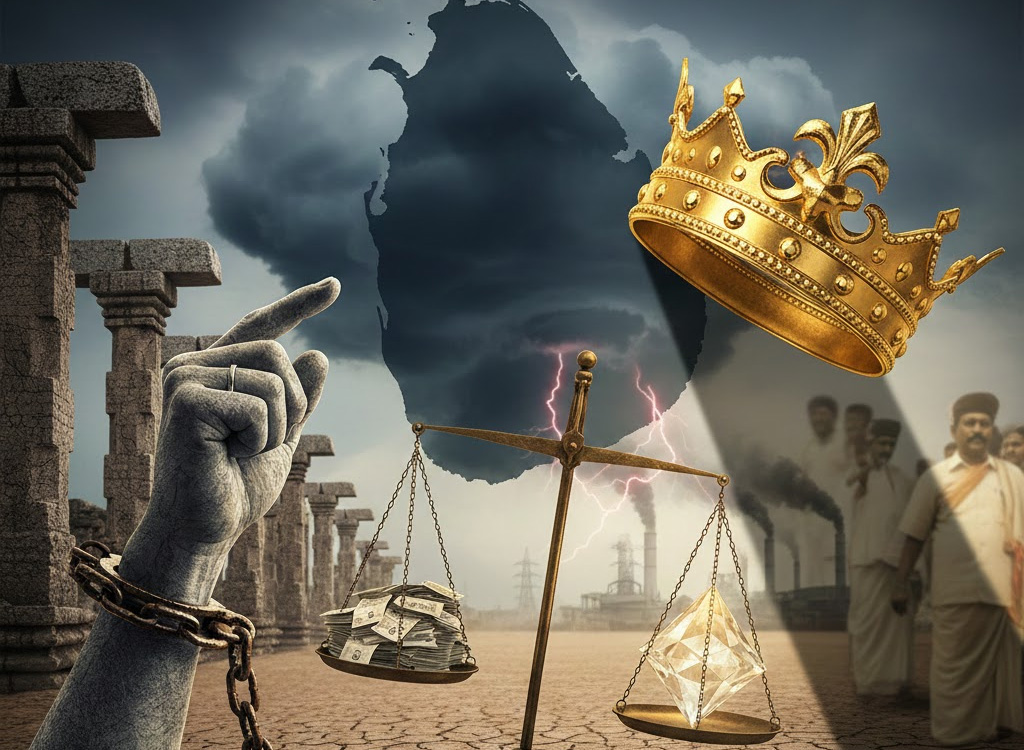
A democracy commits one of its gravest sins when it punishes integrity while rewarding deceit. When a public servant who has spent a lifetime upholding administrative discipline, ethical restraint and the rule of law is isolated, vilified, and incarcerated for a decision taken within an institutional grey zone created by political power itself, the failure is ultimately not individual. It is systemic, moral and deeply political. Sri Lanka today, under the NPP, stands at precisely such a crossroads.
In the close to five-decade long era dominated by the Executive Presidency, the distinction between personal privilege and state responsibility has never been clearly demarcated. Presidential entitlements have evolved through precedent rather than statute, custom rather than clarity and administrative officers have been forced to navigate opaque terrain where decisions have been guided not by codified rules, but by institutional practice, implied authority, and political expectation.
To retrospectively criminalise an administrative decision made in good faith under such conditions can in no way be described as ‘justice’ in the traditional sense. And certainly not when the official concerned is one who has been universally acknowledged as having maintained an impeccable character in long years of public service, up until this allegation was thrown at his doorstep. Put in another way, this is not how ‘accountability’ should work in a functional democracy for the simple reason that, it is precisely how fear works in a failing one.
An iconic figure
At the heart of the current controversy is the remanding of senior public servant and former Secretary to the President, Saman Ekanayake, over the approval of expenses connected to former President Ranil Wickremesinghe’s visit to the University of Wolverhampton in 2023. Whether state funds were misused as alleged is a matter for the courts to determine. But to suggest that this once highest-ranking public official in the country would willfully authorise wasteful or unlawful expenditure is an allegation that flies in the face of his entire career.
More troubling than the charge itself is the political context in which it has unfolded. Before assuming office, some notable figures of the present government publicly declared on multiple platforms: “Saman Ekanayake, get ready to go to jail.” These same figures once installed in office repeated those sentiments, openly boasting that they would “send him inside.” These statements are not footnotes; they are central to understanding the perception of political victimisation in its truest sense.
When arrests follow public threats, the presumption of impartial justice is irrevocably compromised, that is natural. The perception of impartiality is further eroded when far more grievous cases that carry immense weight from a social viewpoint for which ready evidence is available in wholesale quantities, are conveniently ignored and pushed to the backburner while the half-baked, politically beneficial ones are brought to the forefront.
What makes this episode particularly corrosive is the hypocrisy embedded within it. Sri Lanka’s political history is replete with far more egregious examples of state abuse. During Mahinda Rajapaksa’s presidency, SriLankan Airlines was routinely used to ferry relatives, associates, and political hangers-on across the globe. So much so that it even came to a point where the world-renowned Emirates Group was compelled to abruptly pull out of the management contract it had with Sri Lanka’s national carrier – an airline that was making healthy profits at the time.
Open selectivity
These trips were authorised, documented, and signed off by Presidential Secretaries acting as Chief Accounting Officers. Mountains of evidence exist relating to corruption, fraud, and misappropriation from that era and others. Yet many of those responsible remain untouched and free, for reasons best known to the current political dispensation.
Against that backdrop, the sudden urgency to prosecute an expense approval linked to a single overseas visit appears less like a principled stand against corruption and more like an attempt to please the gallery. The problem with that is when justice, applied selectively, ceases to be justice and becomes mere performance.
The tragedy is compounded by the fact that Saman Ekanayake is precisely the kind of public servant Sri Lanka can least afford to lose, or worse, destroy. The hundreds if not thousands who have worked under him over the years know this only too well. Many such officials have stated on social media that when he served as Secretary to the Prime Minister, his presence alone induced discipline. Not because he ruled by fear, but because he demanded accountability.
Yet, many former colleagues recall that his questions were rarely punitive. Instead of interrogating staff about errors, he asked them what they were reading, what they were learning, whether they imagined themselves remaining stagnant forever. It was an unexpected pedagogy of public service; one rooted in growth, not grovelling. Rare, indeed.
Many others have pointed out his outright intolerance for manipulation. When a petition had once surfaced objecting to the selection of staff for an official trip to China, his response had been swift and unequivocal: cancelling the entire trip. Everyone lost the opportunity because one person attempted to play the system. Although harsh, the lesson was unmistakable.
Even in personal dealings, many are the public confessions flooding social media about the man’s professionalism. One social media activist had recalled that a delayed reference letter prompted irritation not because of neglect, but because protocol had been bypassed. Once contacted directly, the matter had been resolved. The unambiguous message being, order mattered, process mattered and ego did not. The very caliber of public servants this country is badly in need of these days.
Outpouring of moral support
Dozens have taken to social media vouching for the fact that this is not a man who courted politicians, flattered power, or traded loyalty for proximity. According to them, unlike other high-profile Secretaries who seamlessly blended administrative authority with overt political allegiance, Ekanayake remained resolutely institutional. He did not campaign from stages, he did not mythologize leaders, and most importantly, did not accumulate power beyond his office. That, perhaps, is precisely why he now finds himself isolated and bereft of ‘support’ in his present predicament. What it shows is that in a system increasingly intolerant of neutrality, integrity can turn out to be a liability.
But this crisis cannot be understood solely through the lens of one man’s ordeal. It is part of a larger and far more dangerous pattern: the systematic process of insulating the political leadership and shifting of political responsibility onto the bureaucracy. As elected leaders fail to deliver on promises, they appear to be creating a precedent by seeking refuge behind officials. Based on the evolving scheme of things, when scandals erupt, it is the administrators and not the policymakers who will be sacrificed. Needless to say, this turn of events will not only demoralise the public service but also hollow out the state.
While that is certainly cause for concern, Sri Lanka’s deeper problem, however, lies elsewhere; it lies with the voters, itself. Thanks to the apathy in holding those elected to account, betrayal has been normalised. Sri Lanka’s electors have got accustomed to the practice of rewarding rhetoric and tolerating failure. As a result, leaders, in five-year cycles, rise to power on sweeping promises – system change, accountability, asset recovery and whatever else that is sweet to the ears, and when those promises evaporate, they wait patiently for the next election to ‘send those leaders home.’ That in essence, is not how things should be, in a democratic set-up.
Criminalising breach of political promises
In any other domain, such conduct; willful neglect of documented assurances – would constitute criminal breach of trust. When individuals solicit authority on the basis of explicit commitments and then willfully abandon them, the offence is not merely political, but also moral. A government that came to power pledging to expose the Easter attack masterminds, prosecute the bond scam culprits and recover assets allegedly hidden in Uganda, has quietly abandoned that agenda. There has been no reckoning, no explanation, no apology. Instead, what we see is deflection.
The brutal irony is that the regime that campaigned on the premise of ushering in ‘system change’ is now finding itself in the uncomfortable position of falling victim of the very laws it seeks to propose in furtherance of that assurance. It is becoming abundantly clear that this regime too, much like the ones before, has cornered itself to the extent that it is both unable and unwilling to enact laws holding politicians criminally accountable for broken promises, because to do so would potentially mean becoming the first casualty of that law.
In such a backdrop it is inevitable that the status quo – warts and all – will continue to prevail into the foreseeable future, ensuring further paralysis of the state and by extension, institutional and economic as well. The election of the NPP to high office was from the citizens’ point of view, literally the last straw. Therefore, if citizens fail to demand the promised accountability now, the consequences can only be catastrophic.
It is for this reason that it can be said that Sri Lanka has not yet seen the worst of its poverty or desperation. Those lie ahead. And when the damage becomes irreversible, no election will be able to save the day or repeat the kind of resurrection that took place in 2022 for which the likes of Ekanayake are now being hounded.
This is why the current status quo is alarming – not only for what it does, but for what it reveals. In just over a year in office, the NPP has pushed an agenda that has managed to combine selective justice with corruption allegations on an industrial-scale, while also actively dismantling oversight mechanisms.
The coal saga mismatch
The most egregious example is the unfolding multi-billion-rupee substandard coal scandal, supposedly the largest procurement fraud, confronting the country. Coal matters because it underpins affordability. Electricity generated at the Lakvijaya Power Plant in Norochcholai is significantly cheaper than diesel-based alternatives. The plant’s three units produce 900 megawatts, making it indispensable to national energy security. Yet in January, engineers observed that a unit expected to generate 300 megawatts was producing much less while the output pollution level was much higher. The reason: poor-quality coal.
To operate optimally, Sri Lanka requires between 1.5 and 1.7 million metric tons of coal annually; roughly 38 to 40 shipments. Alarmingly, only a fraction of these shipments have been ordered, pointing to an impending generation crisis.
The procurement process itself reeks of manipulation. The standard 42-day tender period was arbitrarily reduced to 21 days, effectively excluding reputable global suppliers. Experience requirements were slashed from 500,000 metric tons to 100,000, diluting quality safeguards. Even more disturbing, coal with calorific values below the accepted 5900 KCal/kg – previously rejected under strict enforcement – is now being accepted.
Given the extent of the deviation, in no way can it be described as accidental. It has benefited a company with no track record in coal supply: Trident Chemphar, previously known for bidding to supply rice to Sathosa. The coal supplied failed both Sri Lankan and Indian quality tests. Yet the government proceeded regardless.
The consequences are severe. Environmentally, the ash content of this coal is 22 percent, compared to the standard 16 percent, causing unquantified ecological damage. Mechanically, low-grade coal accelerates slagging and fouling in turbines designed for higher quality fuel, reducing lifespan and efficiency. Financially, inefficiencies force reliance on expensive diesel plants, costs that will inevitably be passed on to the public through higher tariffs.
The attempted cover-up is as troubling as the fraud itself. A token fine of $2.1 million has reportedly been imposed, but even that is under contestation. Additionally, an internal circular has been issued banning Norochcholai employees from sharing data with outsiders. While silence is now the name of the game, transparency is being openly criminalised.
A deaf ear
Yet, the regime continues to turn a deaf ear and a blind eye to the growing number of allegations pertaining to ongoing corruption, while actively hounding the likes of Ekanayake whose case pales into insignificance in light of the coal scandal and its economic impact. To put that in context, Ekanayake is in remand custody for approving a Rs. 16.6 million trip for his boss in 2023 while the loss from substandard coal is approximately five times that on a daily basis – Rs. 75 million – and could potentially run in to billions.
And the sad state of affairs does not end there either. It now appears even oversight is being systematically compromised. The appointment of the new Auditor General after vacillating for nine whole months, is already shrouded in controversy with the new appointee’s track record not seemingly the cleanest as the top position demands. The party that chanted “Audit first, second, and third” has, ever so quickly, hollowed out the very institution meant to enforce it. With the Constitutional Council effectively reduced to a rubber stamp, independent commissions have become decorative relics.
The opposition, too, is not without blame and must hasten to answer why the appointment was unanimous, given the allegedly scarred record of the new appointee. Did the Opposition Leader protest? Or did political expediency once again trump principle?
What emerges from this wreckage is a grim conclusion. Past regimes were flawed, often corrupt, and frequently abusive. But the current one, which masqueraded as a moral alternative, has revealed itself to be something worse: selectively punitive, structurally corrupt, and institutionally destructive. It punishes honest officers while protecting powerful interests. It prosecutes symbolic targets while enabling systemic theft. It speaks the language of reform while practicing the politics of impunity.
Where, then, does Sri Lanka go from here? The answer does not lie in waiting. It lies in questioning: at every level, in every household, in every community. It lies in refusing to accept slogans as substitutes for substance. It lies in recognising that justice delayed is not merely justice denied, but democracy being systematically dismantled right before our eyes.
Disclaimer: The views and opinions expressed in this column are those of the author, and do not necessarily reflect those of this publication.








Leave a comment