
By The Pulseline News Desk
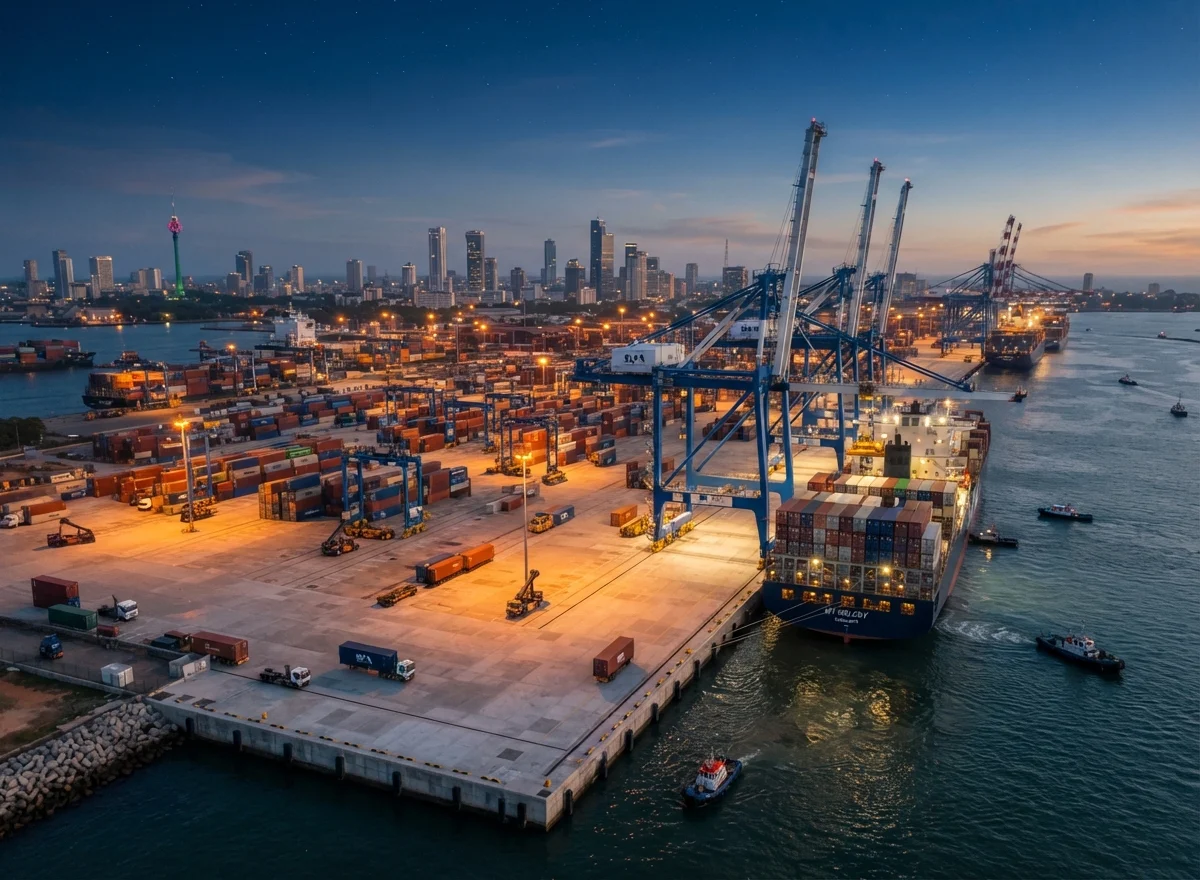
Sri Lanka is preparing to begin partial operations at the Colombo Port’s East Container Terminal (ECT) by the end of November, following the completion of initial testing, as the government moves to bring the long-delayed project into service under a state-owned operating structure.
Deputy Minister of Ports and Civil Aviation Janitha Ruwan Kodithuwakku has said the terminal would initially operate at minimum capacity while the Sri Lanka Ports Authority (SLPA) awaits the arrival of essential equipment, particularly straddle carriers required for cargo handling.
The first 15 straddle carriers are expected to arrive around September 2027, by which time the infrastructure needed to operate the terminal at 50% capacity is also expected to be completed, he has said.
Procurement of a further 15 straddle carriers is expected to be completed within the following four months. Infrastructure required to achieve full capacity is scheduled for completion by the first quarter of 2028, with the government targeting full-scale operations around mid-2028 through a parallel marketing programme.
Kodithuwakku has said during a television programme that construction of the ECT began in 2022, with completion originally scheduled for 2024. However, only around 10% of the project had been completed by that year.
Following government intervention, a further 60% of the construction work was completed, bringing overall progress to approximately 90% in 2026.
The government is also establishing a new company wholly owned by the SLPA to manage the terminal, with the intention of introducing greater operational flexibility and private-sector efficiency while retaining state ownership.
Kodithuwakku has said no decision had been taken on sharing ownership of the terminal with private investors, as the government was examining the operating model that would generate the highest returns for SLPA and enable the ECT to compete with other terminals at the Colombo Port. “There is no decision yet on sharing ownership, as we want a model that competes with other terminals and brings maximum returns to the Ports Authority,” he has said.
The SLPA has already financed the entire ECT investment, meaning the immediate challenge is not securing additional capital but attracting shipping lines and cargo volumes to the terminal.
The Deputy Minister has said approximately 85% of cargo handled at the Colombo Port was transshipment business, with around 10 major international shipping lines controlling a significant share of that market.
He has stressed that a strong marketing strategy would therefore be essential to secure business and ensure the terminal operates at its intended capacity. “Right now, we do not need an investment for the East Container Terminal because the Ports Authority has finished investing, but we need a marketing strategy,” he has said.
The government’s approach also revisits the controversy surrounding the ECT in 2020, when trade unions staged protests against plans for a private-sector partnership. The opposition included unions affiliated with the National People’s Power (NPP), which had argued against the proposed ownership arrangement.
Kodithuwakku has said the government had fulfilled its commitment to retain the terminal under the SLPA, arguing that the earlier proposals for sharing ownership were intended to compensate for inefficiencies in state-sector operations.
The SLPA will initially operate the terminal while the government assesses whether direct state management or a more advanced operating arrangement would deliver the best financial and operational results.
The ECT is strategically important to Colombo Port’s efforts to strengthen its position as a regional transshipment hub. However, its eventual success will depend not only on completing the remaining infrastructure and equipment requirements but also on securing the confidence and business of major international shipping lines.
With partial operations expected to begin this month and full-scale operations targeted for mid-2028, the government’s next challenge will be to turn the completed infrastructure into a commercially competitive terminal.









Leave a comment