

By The Pulseline News Desk
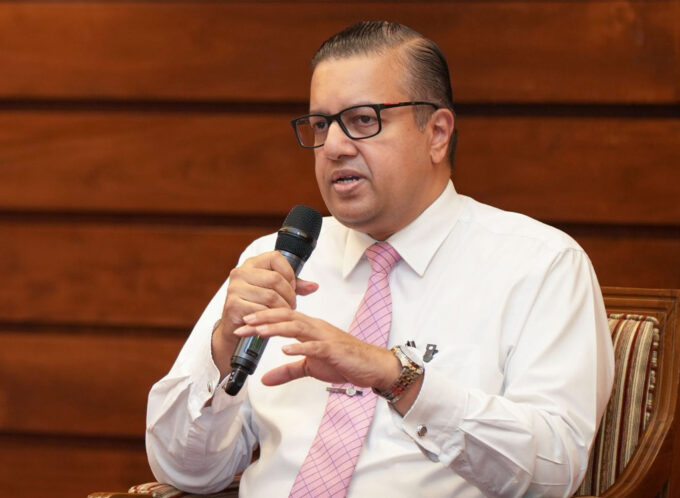
Samagi Jana Balawegaya (SJB) MP Harsha de Silva has warned that the Central Bank’s decision to raise interest rates could further slow Sri Lanka’s economic recovery, curtail household spending and delay the distribution of economic gains among the public.
He has argued that higher borrowing costs would reduce people’s spending capacity, potentially weakening economic activity at a time when the country is seeking to sustain its projected growth.
Speaking to the media following a meeting with SJB local government representatives, de Silva has questioned the sustainability of the reported 4.7% economic growth rate, claiming that 0.7 percentage points of the figure had come from tax revenue.
He has said a closer examination of the economic data was necessary to understand the extent to which the reported growth reflected an actual expansion in economic activity. “The Central Bank keeps saying that inflation is now expected to reach 9%. Therefore, it is increasing interest rates to reduce the amount of money people have available to spend, in order to control demand-driven inflation,” he has said.
However, he has cautioned that the resulting reduction in spending could have a negative impact on economic growth and development.
De Silva has argued that the country’s expected growth could weaken further as households and businesses faced higher borrowing costs and reduced spending capacity.
He has also warned that the benefits of economic recovery would take longer to reach ordinary people under these circumstances. “Although the economic growth rate has been reported at 4.7%, 0.7 percentage points of that figure comes from taxes. If someone properly analyses the figures, they will see that a significant portion of the reported economic growth has actually come through tax revenue,” he has said.
He has maintained that the combination of slower economic expansion and the limited transmission of growth benefits to households could further delay improvements in living standards.
The remarks come after the Central Bank tightened monetary conditions, citing rising inflationary pressures and rapid credit growth, while projecting that headline inflation could reach around 9% in the near term.
The monetary authority has defended the move as necessary to contain demand-driven inflation and maintain price stability, highlighting the challenge of balancing inflation control against the need to sustain economic growth.










Leave a comment