
By The Pulseline News Desk
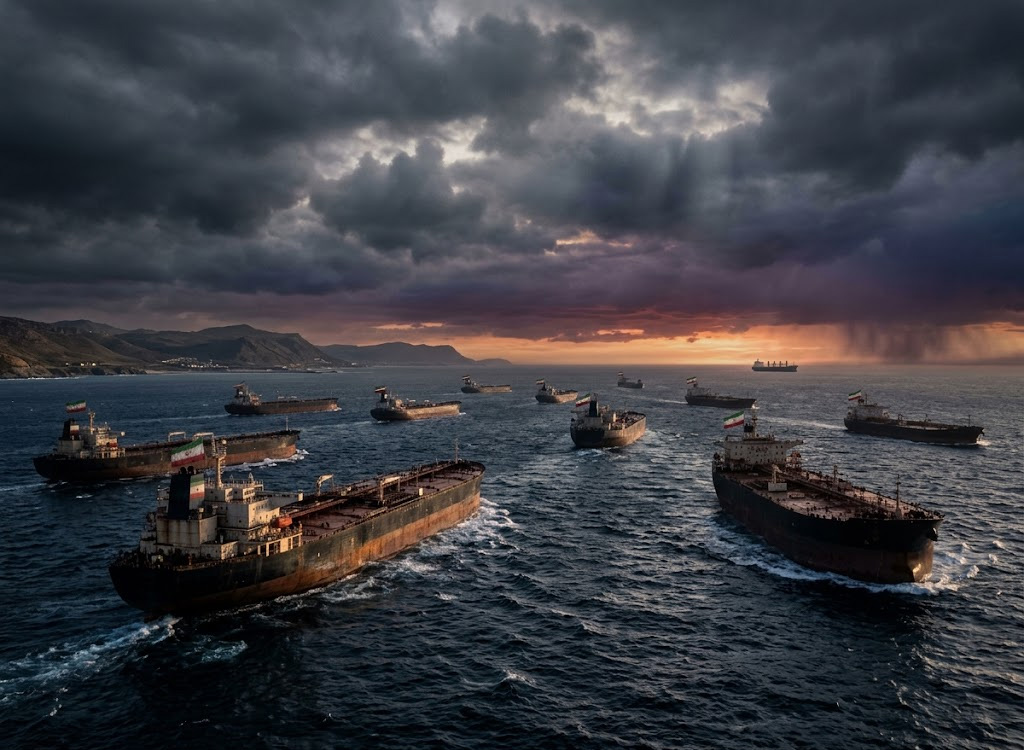
A fleet of US-sanctioned Iranian crude oil tankers that had been lingering for more than a month off Sri Lanka’s southern coast has reportedly begun dispersing, moving further into international waters amid growing scrutiny over their presence and the potential sanctions risks for local businesses.
More than a dozen of the 16 Iranian-flagged Very Large Crude Carriers (VLCCs) that had been stationed outside Sri Lanka’s territorial waters near Galle had begun moving away on 26 August, according to shipping data monitored by The Sunday Morning newspaper.
By 28 August afternoon, around 11 vessels were reported to be heading north-westwards into the Laccadive Sea, effectively breaking up the long line of tankers that had remained offshore for several weeks.
Open-source vessel-tracking platforms, including MarineTraffic, have showed the dispersal of the vessels, which form part of what is commonly described as Iran’s ‘dark fleet’ — ships used to transport Iranian oil despite international sanctions and restrictions.
The development follows growing international attention on the vessels and the risks their presence could pose to companies operating in Sri Lanka’s maritime and financial sectors.
The Sunday Morning had reported earlier that 16 Iranian-flagged VLCCs, all subject to sanctions imposed by the US Department of the Treasury, had been idling at the edge of Sri Lankan waters off the southwestern coast.
Deputy Minister of Ports and Civil Aviation Janitha Ruwan Kodithuwakku had confirmed that the vessels were outside Sri Lanka’s territorial waters. He had also acknowledged that Sri Lankan companies providing services to the sanctioned vessels, as well as banks facilitating such transactions, could potentially expose themselves to US sanctions.
However, the Government had said it had not received any official communication from Washington regarding the vessels.
The issue has nevertheless raised questions about the extent to which Sri Lankan authorities are monitoring the activities of sanctioned vessels operating close to the country’s maritime boundaries.
Authorities in Colombo have largely remained silent over the vessels and the potential exposure of local bunker suppliers, shipping agents and financial institutions dealing with them.
The tankers are reportedly believed to have been involved in ship-to-ship transfers of Iranian crude oil to buyers near the Eastern Outer Port Limits off Malaysia’s Johor before moving towards waters off Sri Lanka.
Their presence is particularly significant given the increasing attention being paid by the US to Iran’s sanctions-evasion networks and maritime oil trade.
The US Navy has reportedly moved in recent months to intercept three Iranian-flagged tankers in international waters south of Sri Lanka, highlighting the strategic sensitivity of the region.
Although the tankers have now moved away from Sri Lankan waters, their month-long presence has exposed a potentially difficult issue for Colombo.
Sri Lanka has no direct role in enforcing US sanctions outside its jurisdiction, but local companies and financial institutions could face consequences if they knowingly provide services or facilitate transactions involving sanctioned vessels.
The dispersal of the tankers may have eased the immediate visibility of the issue off Galle, but it has not removed the wider questions surrounding Sri Lanka’s exposure to sanctioned shipping activity.
For Colombo, the challenge is to protect the country’s maritime and financial interests while ensuring that Sri Lankan territory, waters, ports and commercial services are not inadvertently drawn into an increasingly aggressive US-Iran sanctions confrontation.










Leave a comment