
By The Pulseline News Desk
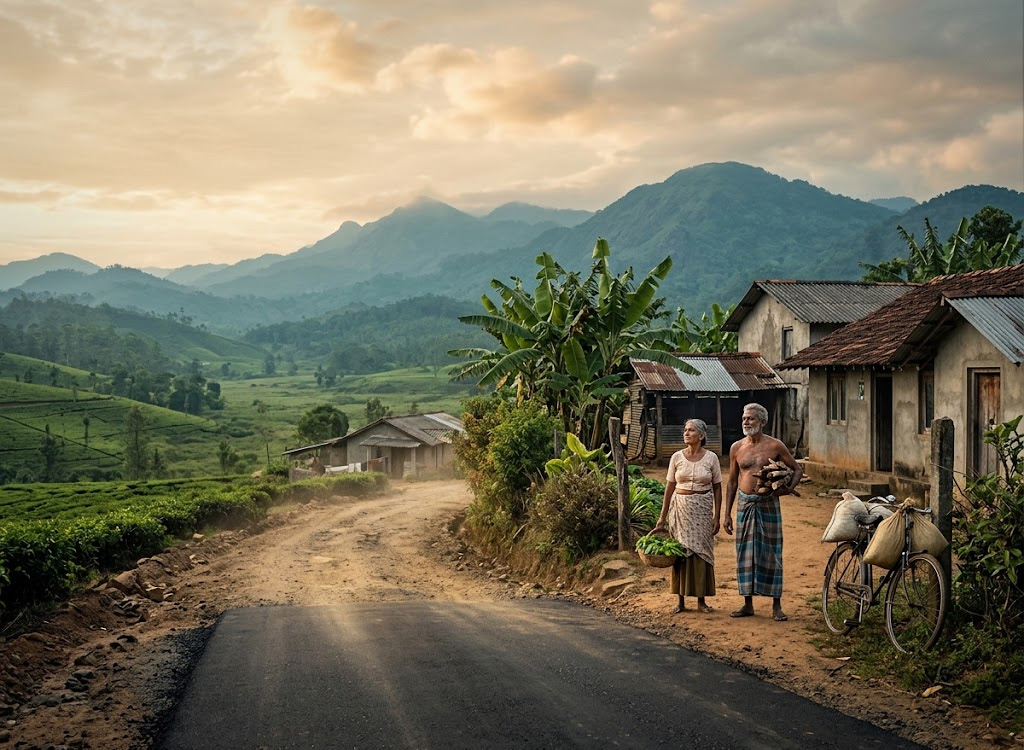
President Anura Kumara Dissanayake has identified rural poverty as a key challenge facing Sri Lanka, saying the Government’s development strategy is focused on expanding economic opportunities through improved road infrastructure, high-speed communication networks and targeted financial support for rural communities.
Speaking at the launch of the Sri Lanka Economic and Investment Summit 2026 on 12 October, Dissanayake said the Government was prioritising rural economic empowerment through its budgetary and development programmes, arguing that poverty could not be eradicated through isolated infrastructure projects or short-term welfare measures.
He said a sustained and structured approach was needed to enable rural communities to generate their own income and participate more meaningfully in the national economy.
“This is why, through the 2026 Budget, we have focused heavily on empowering rural citizens within their native regions,” he said, referring to investments in communication infrastructure and road networks connecting rural and urban centres.
He stressed that rural poverty could not be eliminated within a year or two simply by building roads and bridges but required a long-term programme that addressed the structural barriers preventing rural communities from accessing economic opportunities.
The President’s remarks come as the Government prepares its 2027 Budget, with rural development and economic empowerment emerging as key considerations in its broader strategy to sustain the country’s economic recovery.
Limited economic opportunities
Dissanayake acknowledged that the number of people requiring social safety-net assistance had increased, arguing that the situation reflected the country’s failure to create sufficient economic opportunities for rural communities.
He said rural livelihoods remained heavily concentrated in agriculture, marine and inland fisheries, and small-scale village businesses, leaving many households with limited avenues to improve their incomes.
“What economic avenues do they currently have?” he asked, pointing to the narrow range of activities available to rural populations.
The President said expanding economic opportunities was essential to reducing long-term dependence on Government welfare programmes and enabling people to support themselves through sustainable livelihoods.
He also highlighted the limitations of Sri Lanka’s smallholder agricultural sector, noting that farming had historically served primarily as a subsistence activity rather than a commercial enterprise for a significant proportion of the population.
Given the limited size of individual landholdings and available resources, he argued that poverty alleviation and food security should remain central considerations when developing policies for small-scale farmers.
Finance, technology and market access
The President identified limited access to capital, technology, management expertise and markets as major obstacles preventing rural communities from developing new businesses and expanding existing economic activities.
He said the Government had introduced a collateral-free lending scheme to address the difficulties faced by people who lacked assets to offer as security when seeking bank loans.
According to Dissanayake, the programme had already channelled nearly Rs. 18 billion in loans, providing financial support to people who would otherwise face difficulties accessing formal credit.
He said the Government was also working to introduce modern technology and direct public resources towards initiatives that could expand rural economic activity.
The approach, he explained, involved two key areas: investing Treasury revenue in rural infrastructure and strengthening community empowerment programmes to connect rural populations with new opportunities.
Infrastructure development would include the rehabilitation of minor irrigation tanks and canals, alongside improvements to road networks and communication facilities.
Connecting rural producers to markets
Dissanayake said better transport links between villages and urban centres could help rural producers reach markets more efficiently, while faster communication networks would improve access to information and economic opportunities.
Improved connectivity could also help rural entrepreneurs identify new markets, access services and diversify their income sources beyond traditional livelihoods.
However, the President emphasised that infrastructure alone would not be sufficient to eliminate poverty without complementary measures to address the financial, technological and market-related constraints faced by rural communities.
The challenge, therefore, is to translate public investment into sustainable income-generating opportunities rather than relying primarily on welfare assistance.
For the Government, the success of its rural development strategy will depend on whether improved connectivity, access to finance and community-based programmes can create viable livelihoods across the country.
Dissanayake said the State had a responsibility to address the barriers preventing rural citizens from creating their own economic opportunities, positioning rural empowerment as a long-term development priority rather than a short-term poverty-relief exercise.









Leave a comment