
By The Pulseline News Desk
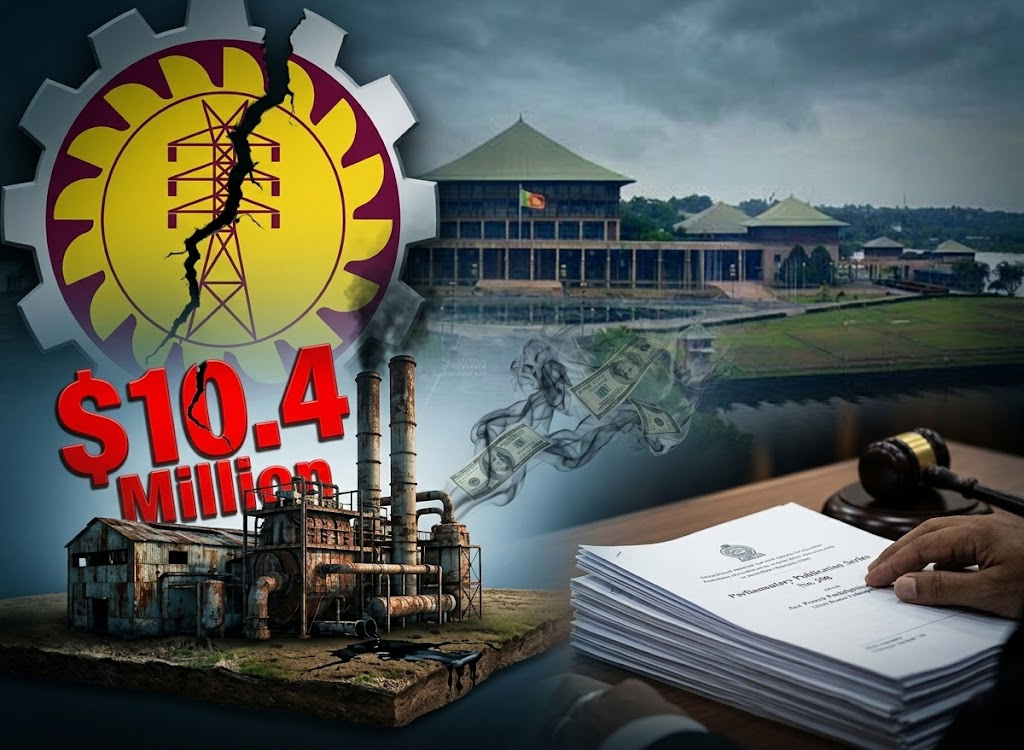
Sri Lanka’s long-running dependence on emergency power procurement has come under renewed scrutiny after parliamentary investigations had reportedly revealed that the state electricity utility had paid approximately $ 10.39 million in equity returns to private power producer Ace Power Embilipitiya between 2018 and 2024, despite the plant’s original power purchase agreement having expired in 2015.
According to reports, the payments are detailed in Parliamentary Publication Series No. 396, which contains the Energy Minister’s observations on investigations conducted by the parliamentary Committee on Public Enterprises (COPE).
The findings highlight how weaknesses in long-term generation planning, transmission constraints and recurring hydropower shortages allowed a 100MW furnace-oil power plant to remain a source of state-funded capacity payments for years after its original 10-year build-own-operate agreement ended.
Expired agreement, repeated extensions
The original agreement with Ace Power Embilipitiya had reportedly expired in April 2015. However, instead of replacing the capacity through planned least-cost generation, the state had repeatedly extended power purchases from the plant.
Between 2016 and 2023, five separate extensions and short-term agreements were entered into.
The first one-year extension, from April 2016 to April 2017, had involved $ 4.16 million in non-escalable capacity charges, including about $ 3.16 million in equity returns.
A further extension in 2017 had resulted in another $ 4.37 million in non-escalable charges, including $ 3.32 million in equity returns.
The largest arrangement was a three-year extension from 2018 to 2021, under which approximately $ 13.17 million had been paid in non-escalable charges, with around $ 10.02 million going towards equity returns.
Further short-term arrangements were made during the 2022 economic crisis and again in late 2023, when severe hydropower shortages in the Southern Province placed additional pressure on the electricity supply system.
‘Emergency’ becomes long-term solution
The repeated extensions were reportedly justified by the authorities on the grounds of emergency supply requirements.
Among the reasons cited were delays in implementing planned least-cost generation projects, transmission bottlenecks affecting the southern grid and drought conditions that reduced water levels in major reservoirs, including Samanalawewa.
However, the repeated use of emergency procurement mechanisms had effectively allowed the state to continue making capacity payments to an independent power producer whose original agreement had already expired.
The Public Utilities Commission of Sri Lanka (PUCSL) had repeatedly raised objections, informing the CEB and Ministry of Energy that extending expired independent power producer agreements was inconsistent with Section 43 of the Sri Lanka Electricity Act, which requires competitive tendering for new generation capacity.
Despite these concerns, emergency provisions under Cabinet directives were used to justify continued purchases in the interests of maintaining uninterrupted electricity supplies.
The episode has consequently raised a broader question over whether emergency procurement became a substitute for proper long-term generation planning.
Tried — and failed — to buy
Ironically, the Government had previously explored acquiring the Embilipitiya plant outright.
In March 2016, Cabinet had approved negotiations to purchase the facility, with the stated objective of strengthening long-term grid stability while reducing costs.
Ace Power had reportedly offered to sell the plant for $ 17 million. However, the Chief Government Valuer had assessed the facility at approximately Rs.2.37 billion in July 2017.
The negotiations had eventually collapsed after the company had declined to reduce its asking price, citing substantial expenditure on maintenance and major overhauls.
The Government had subsequently abandoned the acquisition and returned to short-term capacity arrangements.
What followed was years of payments to keep the facility available, raising questions over whether the State had ultimately spent more through repeated emergency arrangements than it might have incurred through a definitive long-term solution.
End of the Embilipitiya chapter
The prolonged arrangement had finally come to an end after the newly unbundled state electricity utility had formally informed Ace Power Embilipitiya on January 30, 2025, that electricity from the plant would no longer be required.
But the financial and policy questions surrounding the plant remain.
Following a COPE hearing on September 24, 2025, parliamentary oversight members had recommended a full forensic audit into emergency energy procurements and capacity payments made to the facility.
The proposed audit is expected to examine how emergency procurement decisions were made, why competitive tendering requirements were repeatedly bypassed, and whether the State received value for the substantial payments made over the years.
The Embilipitiya case thus represents more than the story of a single private power plant as it exposes a deeper structural problem in Sri Lanka’s electricity sector: when long-term generation projects are delayed, transmission weaknesses persist and hydropower becomes vulnerable to drought, emergency thermal power can become a costly permanent solution.











Leave a comment