
By The Pulseline News Desk
President Anura Kumara Dissanayake used this week’s pre-budget review of the Environment Ministry to send a pointed message on two of the country’s most persistent environmental flashpoints: unchecked development along the Northern and Eastern coastlines, and the slow-moving effort to protect rural communities from human-elephant conflict.
Growth on the coast, but not at any cost
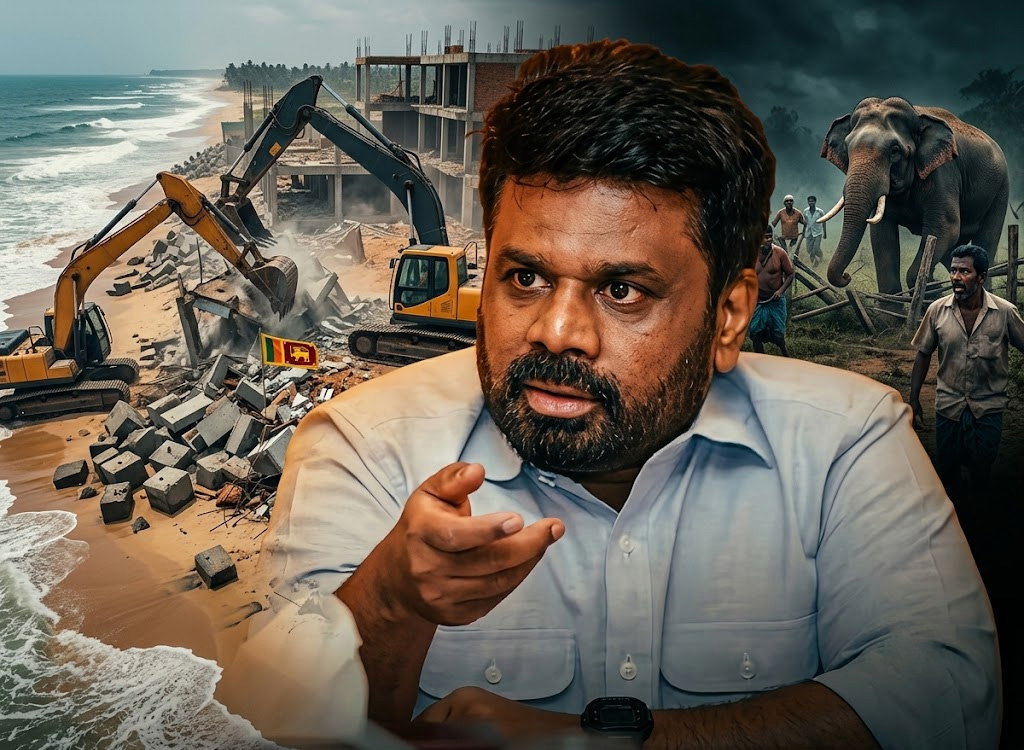
Speaking at the 2027 Pre-Budget discussion held at the Presidential Secretariat on Wednesday (22), Dissanayake directed officials to take maximum measures to safeguard Sri Lanka’s rapidly developing Northern and Eastern coastlines. His instruction was framed around a specific balance: that development projects in these areas must proceed in harmony with environmental priorities and the livelihoods of the communities who live there, rather than treating growth and conservation as separate concerns.
That balance, he made clear, comes with enforcement teeth. The President instructed that the strongest possible legal action be taken against unauthorised coastal construction, pointing to the significant damage such activity causes. To ensure the directive translates into action rather than another unmet promise, a steering committee will be appointed to oversee and monitor coastal protection efforts going forward.
Coastal erosion also drew specific attention. Dissanayake instructed that an expert committee be appointed to examine measures to prevent erosion along the Oluvil coastline and to submit its findings promptly — a sign that the issue is being treated as urgent rather than routine.
A warning on human-elephant conflict
Perhaps the sharpest note of the meeting came on the subject of human-elephant conflict. The President singled out the slow progress of mitigation projects, warning that continued delays pose a direct threat to human lives — language that leaves little room for the incremental pace such projects have often followed in the past.
Dissanayake also pushed back on how elephant fences have traditionally been planned, emphasising that their location and extent should be determined by the need to protect people, not simply by the boundaries of wildlife zones. It’s a reframing that puts human safety, rather than habitat demarcation, at the center of fence planning decisions going forward.
Reviewing environmental spending
The discussion doubled as a progress check on the 2026 budget and a preview of priorities for 2027. Projects examined fell under the theme “A Thriving Nation – A Beautiful Life, A Sustainable Biosphere – A Green Life,” which carried a total allocation of Rs. 19,719 million. The institutions under review spanned the Central Environmental Authority, the Department of Wildlife Conservation, the Forest Department, the Department of Coast Conservation, and the Marine Environment Protection Authority.
With rural livelihoods a recurring theme, the President directed officials to complete all projects within their stipulated timeframes and to fully utilise allocated budgets by carrying out construction and implementation work before year’s end — a directive aimed squarely at the kind of underspending that has dogged public projects in previous cycles.
Clean Sri Lanka and broader initiatives
The meeting also reviewed progress under the Clean Sri Lanka programme, covering water source conservation, the Clean Coastline Project, the Coastal Recreation Parks Development Project, and accessibility improvements for persons with disabilities at the Sinharaja and Kanneliya forests.
Minister of Environment Dr Dammika Patabendi told the meeting that the Ministry is formulating a high-quality carbon emissions policy, which he said is expected to open broader investment opportunities for the country.
Ministry Secretary K.R. Uduwawala raised a more structural concern, noting that inadequate planning in securing foreign-funded projects has led to overlapping allocations across different ministries. To address this, he said a permanent coordinating committee will be established to bring future project planning under tighter oversight.
Other items on the agenda included upgrading holiday bungalows managed by the Departments of Wildlife Conservation and Forest Conservation with modern technology to improve facilities for the public, along with plans to develop floriculture as an industry and to enhance the National Botanic Gardens as part of broader biodiversity conservation efforts.
The bigger picture
Taken together, the directives issued at the discussion suggest a shift in tone from planning to enforcement — coastal protection backed by legal action and monitoring committees, budget allocations tied to firm year-end deadlines, and elephant-conflict mitigation reframed explicitly around the protection of human life. Whether that tone translates into faster results on the ground will likely be the measure by which this pre-budget review is judged in the year ahead.












Leave a comment