
By The Pulseline News Desk
The Consumer Affairs Authority’s (CAA) prosecution of 23 private hospitals, laboratories and diagnostic centres this week is about far more than a list of fines. It is a rare and highly public demonstration of regulatory intervention in one of Sri Lanka’s fastest-growing industries, raising uncomfortable questions about oversight, patient safety and the standards governing private healthcare.
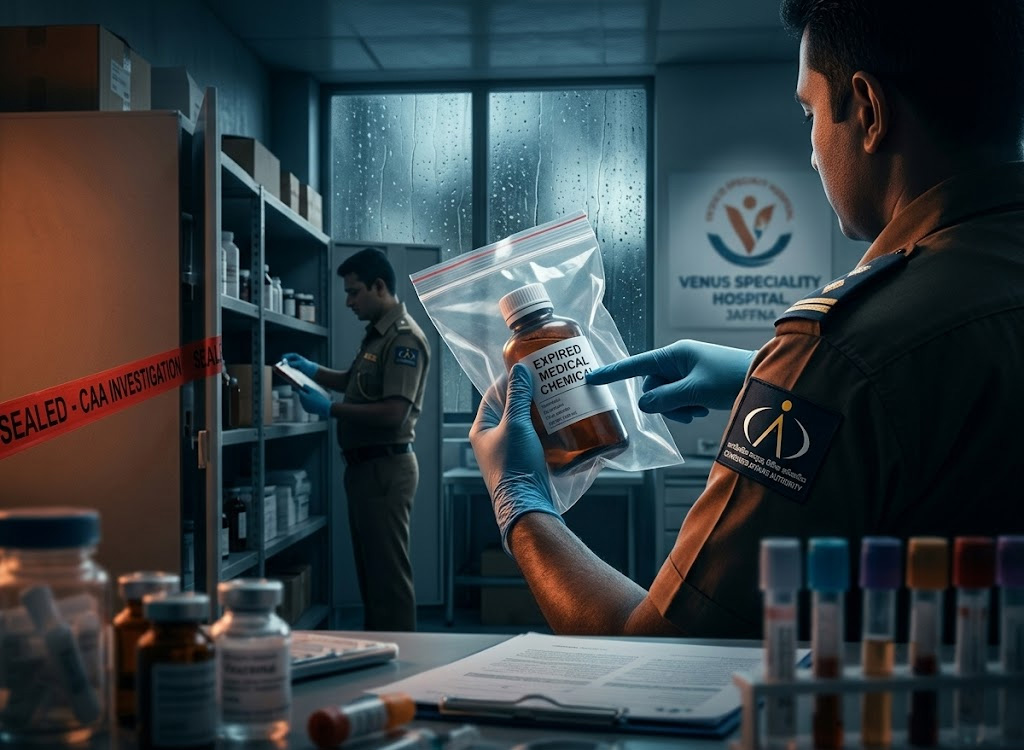
The investigations uncovered the use and storage of expired medicines and laboratory chemicals, the failure to properly separate expired stock from usable supplies, and instances where diagnostic centres charged above the maximum prices prescribed by the CAA. Collectively, the offences resulted in nearly Rs.5.8 million in court-imposed fines, with authorities indicating that further legal action is likely.
On paper, the penalties range from Rs.7,000 for smaller laboratories to Rs.3 million for Venus Speciality Hospital in Jaffna. But the monetary value is almost secondary. The more significant consequence is that several of Sri Lanka’s best-known private healthcare brands – including Asiri Hospital Holdings, Lanka Hospital Diagnostics, Nawaloka Laboratories, Durdans Hospital, Kings Hospital Colombo, Ceylon Hospital PLC and Royal Hospital – have found themselves before the courts over consumer protection violations.
That alone marks an important shift.
Sri Lanka’s private healthcare sector has expanded rapidly over the past two decades, filling gaps left by an increasingly strained public health system. The economic crisis accelerated that trend, with medicine shortages, delays and capacity constraints in the state sector pushing more patients towards private hospitals and diagnostic services despite the higher cost.
With that expansion has come an expectation that the industry operates to standards that justify the confidence, and expense, placed upon it by patients.
The CAA’s findings inevitably cast doubt on that assumption.
Of particular concern is the discovery of expired chemicals allegedly being used in diagnostic and laboratory testing. Laboratory investigations underpin a significant proportion of clinical decisions, influencing everything from routine treatment to life-altering diagnoses. If the integrity of those tests is compromised, the consequences extend well beyond consumer law into the broader question of patient safety.
The investigations also exposed weaknesses in inventory management, with expired medicines and chemicals allegedly remaining in circulation or being stored alongside usable stock without proper segregation. Such findings point less to isolated mistakes than to failures in internal quality assurance and compliance systems.
Equally notable is the pricing dimension of the investigation. The CAA says some laboratories exceeded the maximum charges prescribed under consumer protection regulations, highlighting another persistent complaint from patients – that the cost of private healthcare is often opaque and inconsistently applied.
Successive governments have grappled with balancing market freedom against consumer protection in the health sector. The latest prosecutions suggest regulators are becoming increasingly willing to intervene where pricing and patient welfare intersect.
Yet the operation also exposes a broader institutional question.
If violations of this nature were identified across multiple hospitals and laboratories within a relatively short inspection campaign, it inevitably raises questions about the effectiveness of routine regulatory oversight. Were these longstanding practices that escaped detection, or has enforcement itself become more proactive under the current administration?
The answer matters because public confidence in healthcare depends as much on effective regulation as it does on clinical expertise. Patients cannot reasonably be expected to verify the quality of laboratory chemicals or inspect pharmaceutical storage conditions. They rely on institutions – and the regulators overseeing them – to ensure minimum standards are consistently maintained.
The CAA has made clear that the campaign is continuing, with additional legal action expected against other institutions investigated during the islandwide raids. It has also appealed to the public to report violations through its 1977 hotline, signalling a greater emphasis on consumer participation in enforcement.
Whether this becomes a sustained compliance drive or a short-lived enforcement exercise will determine its long-term impact.
For the private healthcare sector, the episode serves as a reminder that reputation is built not only on clinical outcomes and modern facilities, but also on rigorous governance behind the scenes. For regulators, it is an opportunity to demonstrate that enforcement will be consistent rather than episodic.
And for patients, the prosecutions offer reassurance that regulatory action is possible, but also an uncomfortable reminder that confidence in healthcare ultimately depends on constant vigilance, not periodic crackdowns.













Leave a comment