
By The Pulseline News Desk
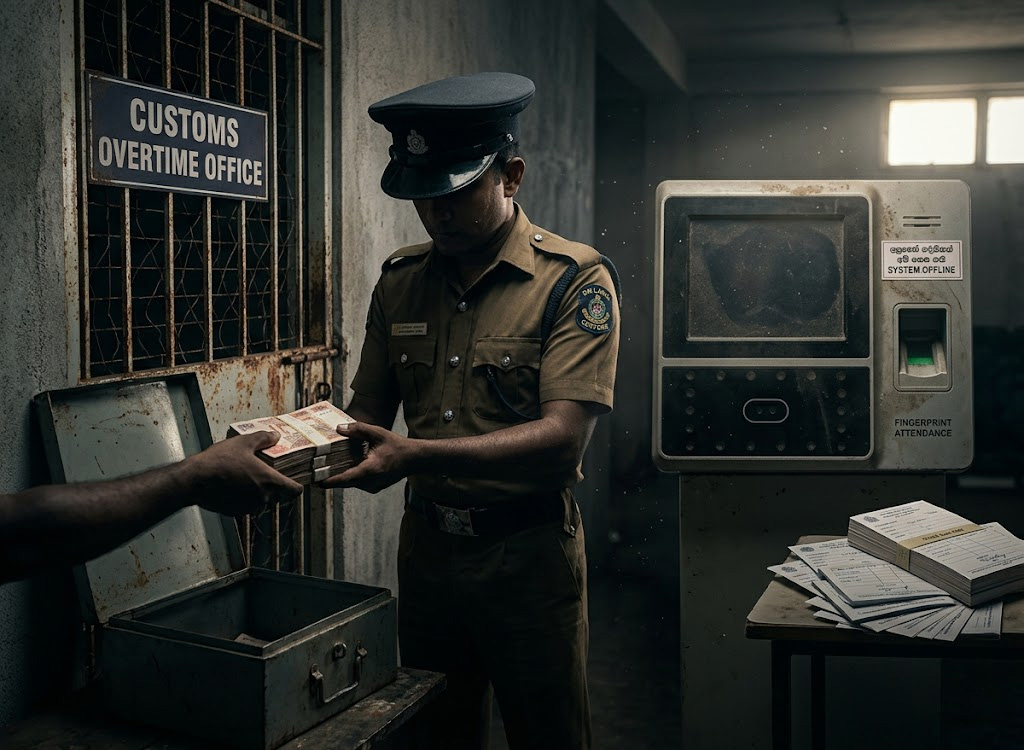
Sri Lanka Customs has reportedly paid more than Rs. 1.42 billion in overtime allowances to its officers in 2025 without properly verifying their attendance through fingerprint machines, raising fresh questions over financial controls and accountability within the institution.
According to the latest findings of the National Audit Office (NAO), Customs had paid Rs. 1,426,216,662 in overtime allowances during the year despite failing to use fingerprint-based attendance records to establish whether officers had actually reported for duty and completed their working hours.
The audit has raised concerns because attendance verification is particularly important when public funds are being used to pay overtime and other allowances.
The report has further revealed that Customs had paid an additional Rs. 92,027,074 in cargo inspection fees and Rs. 12,979,200 in information technology and communication fees to officers without properly establishing their arrival and departure from the workplace.
In other words, payments amounting to more than Rs. 1.53 billion across these three categories were made in circumstances where the required attendance verification mechanism had not been properly implemented.
Rules already in place
The issue is not one of a lack of regulations.
According to the audit findings, public administration circulars require government institutions to use fingerprint machines to formally record and verify the arrival and departure of officers.
However, Sri Lanka Customs had failed to comply with this requirement.
More significantly, the matter had already been highlighted by Parliament. The Committee on Public Accounts (COPA) had, during its examinations in 2023 and 2024, specifically recommended that all Customs officers be required to use fingerprint machines to record their attendance.
Despite those recommendations, the system had still not been effectively implemented when the payments were made in 2025.
Accountability questions
The audit finding places the spotlight on a fundamental question: how can the State establish that overtime work was actually performed when there is no reliable electronic record confirming an officer’s presence at the workplace?
The issue is particularly significant given the scale of the payments involved.
Overtime payments are intended to compensate public officers for work performed beyond their normal working hours. Similarly, cargo inspection fees and other allowances are linked to specific duties and services.
Without a reliable attendance and departure record, however, the verification process becomes dependent on administrative records and manual certification, potentially creating weaknesses in internal controls.
The latest findings therefore raise concerns not only about the money already paid but also about whether previous recommendations aimed at strengthening financial discipline have been adequately implemented.
A recurring problem?
The fact that COPA had already raised the need for mandatory fingerprint attendance systems in 2023 and 2024 makes the latest revelation particularly significant.
It suggests that recommendations made through parliamentary oversight mechanisms have not necessarily translated into effective administrative action.
For an institution such as Sri Lanka Customs, which plays a critical role in government revenue collection, weaknesses in basic attendance and payment controls carry wider implications.
The National Audit Office findings are therefore likely to place renewed pressure on Customs authorities to explain why an already identified control weakness remained unresolved and what measures will now be taken to ensure that overtime and other duty-related payments are supported by verifiable records.
The central issue is not merely the Rs. 1.42 billion overtime bill. It is whether the Government has adequate systems in place to demonstrate that every rupee paid to public officials corresponds to work actually performed.













Leave a comment