
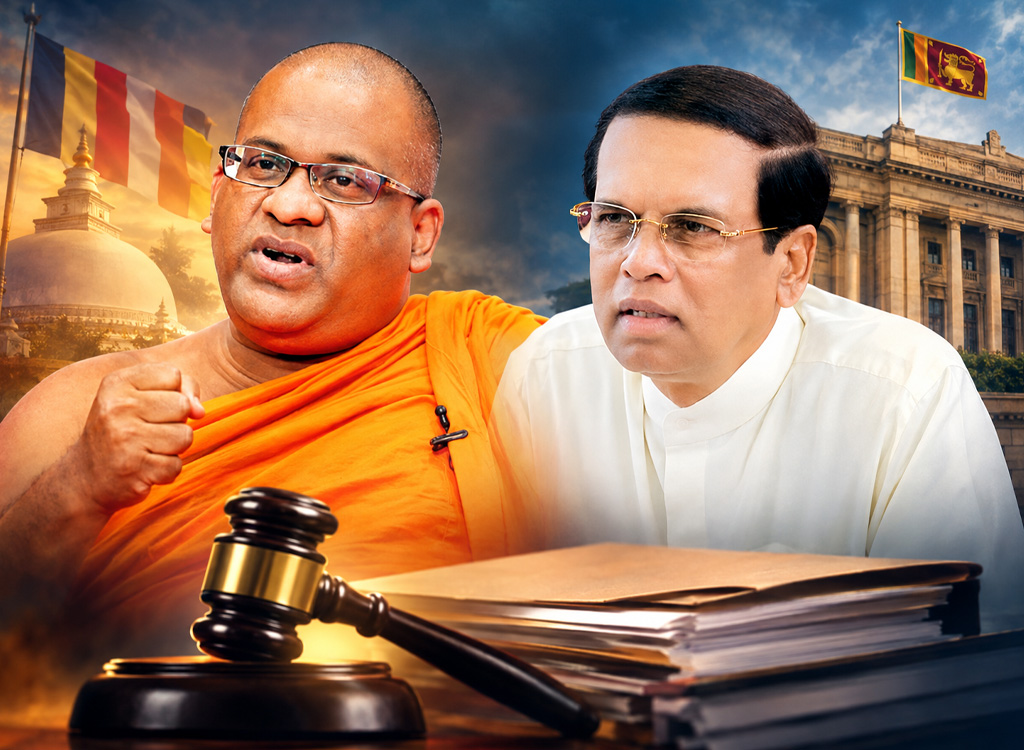
Former President apologises to Buddhist clergy, claims Justice Ministry approval was not obtained before pardon documents were signed
By The Pulseline News Desk
Former President Maithripala Sirisena has blamed officials at the Presidential Secretariat for what he has described as a technical error in the process of granting a presidential pardon to Ven. Galagoda Aththe Gnanasara Thera, saying the failure ultimately contributed to the monk’s return to prison.
Sirisena has said he had examined a copy of the relevant court judgment and concluded that a defect in the documentation submitted by the Presidential Secretariat had played a role in the court’s decision.
He has maintained that he had been misled by officials responsible for handling the legal aspects of the pardon, while acknowledging the court’s authority and accepting its judgment.
The former President has also apologised to Buddhist monks over the error, insisting that the failure had occurred within the administrative process during his tenure.
Alleged failure to obtain Ministry approval
Sirisena has said Gnanasara Thera had faced two cases before the Homagama Magistrate’s Court, identified as B 7417/10 and 40042.
According to the former President, the additional senior secretary responsible for legal affairs at the Presidential Secretariat had informed him that approval from the Ministry of Justice and Prisons was required in connection with the pardon.
However, Sirisena has alleged that the relevant documents were not forwarded to the Ministry to obtain the necessary approval before his signature was secured.
“This was misleading me,” he has said, attributing responsibility for the procedural failure to officials who handled the documentation.
Sirisena’s statement suggests that the dispute centres on whether the administrative and legal requirements associated with the pardon were properly followed before it was issued.
The former President has said the defect became apparent when he had examined the court judgment relating to the matter.
The specific legal findings concerning the documentation and the respective responsibilities of the officials involved would need to be assessed against the judgment and the relevant records.
Court decision and Gnanasara’s imprisonment
The controversy surrounding the pardon has resulted in renewed scrutiny of the process through which executive clemency was granted to the Buddhist monk.
Sirisena has said the administrative error had ultimately contributed to Gnanasara Thera being imprisoned again following legal proceedings initiated through a complaint by Sandya Ekneligoda.
The former President did not dispute the court’s decision. Instead, he has said he respected the judgment and accepted that it was correct.
His statement therefore sought to distinguish between his decision to grant the pardon and the alleged failure of officials to complete the required procedures.
Apology to Buddhist clergy
Sirisena has said he had issued the statement following inquiries from Buddhist monks, journalists and members of the public seeking clarification about the technical defect that affected the pardon.
He has also expressed regret to the Buddhist clergy, apologising for the mistake while maintaining that officials serving under his administration were responsible for the procedural failure.
The apology comes amid continued public interest in the case and questions about the handling of presidential pardons, particularly where legal requirements and judicial proceedings are involved.
Questions over presidential pardon procedures
The controversy raises broader questions about the administrative and legal checks that must be completed before a presidential pardon is granted.
Although the President exercises constitutional powers relating to pardons, the processing of such decisions involves documentation and legal procedures that must be properly handled.
Sirisena’s allegations place the conduct of officials at the Presidential Secretariat under scrutiny and raise questions about whether the necessary checks were carried out before the pardon documents were signed.
The episode also highlights the importance of clear accountability when errors occur in the exercise of executive powers.
While the former President has accepted the court’s decision and apologised for the outcome, his claim that officials had misled him raises a separate question about responsibility for the administrative failure.










Leave a comment