
By The Pulseline News Desk
Sri Lanka’s tourism recovery has entered August under renewed pressure, with tourist arrivals falling 8% during the first six days of the month, raising fresh questions over whether the country can reach its revised target of 2.5 million visitors this year.
According to Sri Lanka Tourism Development Authority (SLTDA) data, 42,810 tourists arrived between August 1 and 6, compared with 46,541 during the corresponding period last year.
That brought the average daily arrival rate down to 7,135, from 7,757 a year earlier.
The weak start also comes as cumulative arrivals for 2026 remain below last year’s level. From January 1 to August 6, Sri Lanka reportedly recorded 1.386 million arrivals, compared with 1.415 million during the same period in 2025 — a decline of around 2%.
Perahera offers August a potential boost
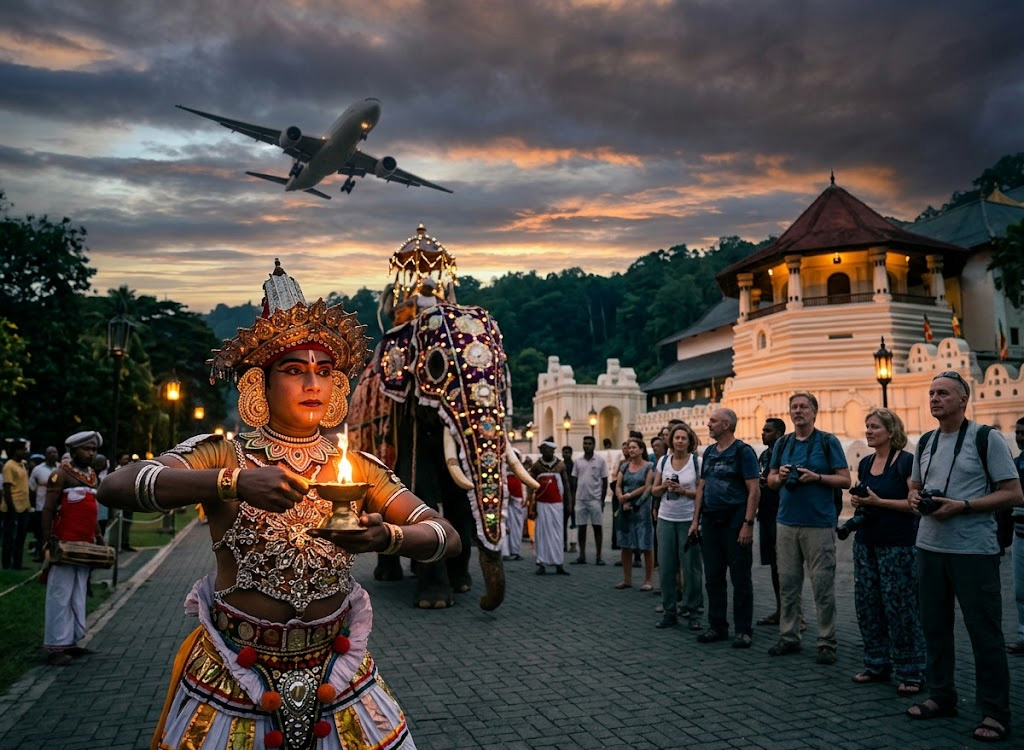
The early-August figures, however, do not capture one of the country’s biggest tourism events of the month — the Kandy Esala Perahera, scheduled for August 18 to 27.
The Kumbal Perahera will run from August 18 to 22, followed by the grand Randoli Perahera from August 23 to 27.
The festival traditionally attracts large numbers of international visitors, particularly during the final week of August, potentially providing some momentum after the subdued opening.
The bigger question is whether the Perahera-driven increase will be strong enough to compensate for the broader weakness in international arrivals.
Gulf disruption weigh on tourism
The slowdown has largely been linked to the disruption of air travel caused by the Middle East conflict, which intensified from late February.
Airspace closures across major Gulf transit routes forced airlines to reroute flights through longer corridors, increasing flying times, fuel consumption, insurance costs and ultimately airfares on several long-haul routes serving Sri Lanka.
The impact is particularly significant for Sri Lanka because a substantial share of its international visitors traditionally travel through major Gulf aviation hubs, including Dubai, Doha and Abu Dhabi.
The combined share of Sri Lanka’s arrivals passing through four major Gulf hubs fell from nearly one-third in June 2025 to 21.3% in June 2026, highlighting the scale of the disruption.
The effect has been reflected in the monthly arrival pattern. After recording 16.2% growth in February, Sri Lanka saw arrivals plunge by 19.7% in March and 22.3% in April, followed by only a partial recovery in May and renewed softness in June and July.
Tourism Deputy Minister Ruwan Ranasinghe has cited the Middle East aviation disruption as a key reason for reducing the Government’s 2026 tourism target to 2.5 million arrivals, from the original three-million target.
The tourism revenue target has also been reduced from $4 billion to $3.5 billion.
The Deputy Minister has nevertheless expressed hope that 2026 could still end as a record year for tourist arrivals.
Even 2.5 million now looks challenging
The revised target itself is beginning to look increasingly demanding.
Sri Lanka would need approximately 1.11 million additional tourists over the remaining 147 days of the year to reach 2.5 million.
That would require an average of around 7,577 arrivals per day, compared with the current year-to-date daily average of approximately 6,359.
The traditional tourism peak from September to December offers some hope. November and December are particularly strong months, with average arrivals exceeding 197,000 and 253,000 respectively over the past three years.
But even assuming last year’s monthly volumes for the remaining period, total 2026 arrivals would be around 2.33 million, leaving a gap of roughly 166,000 visitors to the revised target.
Closing that gap would require nearly 18% growth during the final five months compared with the corresponding period last year.
That would represent a substantial acceleration at a time when the recovery remains heavily dependent on the normalisation of international air connectivity.
India emerges as a key buffer
The impact of the aviation disruption is also becoming visible in Sri Lanka’s source-market composition.
India has strengthened its position as the country’s leading tourism market, with its share of arrivals increasing from around 21% during the comparable period last year to nearly 25% this year.
India has been relatively insulated from the Gulf disruption because a large proportion of Indian visitors travel to Sri Lanka on direct or shorter-haul routes.
China has also strengthened and has overtaken Russia to become Sri Lanka’s third-largest source market.
Australia, Japan, the Maldives and Israel have recorded smaller increases in their respective shares.
By contrast, several major European markets — including Germany, France, the Netherlands, Italy, Spain and Poland — have lost ground.
The shift is broadly consistent with the disruption facing long-haul European travellers who rely heavily on Gulf hubs for connections to Sri Lanka.
Russia remains a major concern
Russia’s performance is particularly notable.
Once Sri Lanka’s third-largest source market, Russia’s share of cumulative arrivals has fallen from approximately 7.6% last year to 5.75% this year.
Russian visitors have historically relied substantially on routes through Dubai and Sharjah, making the market vulnerable to the continuing disruption in Gulf aviation.
The decline has continued despite efforts to revive Russian tourism, including discussions on direct flights and simplified visa arrangements at the “Let’s Travel” forum in Moscow in June and separate assurances regarding the resumption of charter flights.
So far, the arrival figures have failed to show a meaningful recovery in Russian or wider CIS traffic.
Peak season arrives amid uncertainty
Sri Lanka is therefore approaching its most important tourism months with two opposing forces at play.
On one side are the Kandy Esala Perahera, the approaching winter travel season and stronger Indian and Chinese markets.
On the other are higher travel costs, disrupted Gulf connectivity and continuing uncertainty over the Middle East conflict.
A European aviation safety advisory covering the Gulf has been extended through August 31, while restrictions on overflights through Kuwaiti airspace and continuing security concerns around the Strait of Hormuz add to the uncertainty.
For Sri Lanka, the next few months will therefore be critical.
The country does not merely need the usual seasonal surge. It needs a significant acceleration in arrivals to reach even its revised 2.5 million target — at a time when the aviation corridors that helped power its tourism recovery remain vulnerable to events far beyond its control.










Leave a comment