
By Chanakya
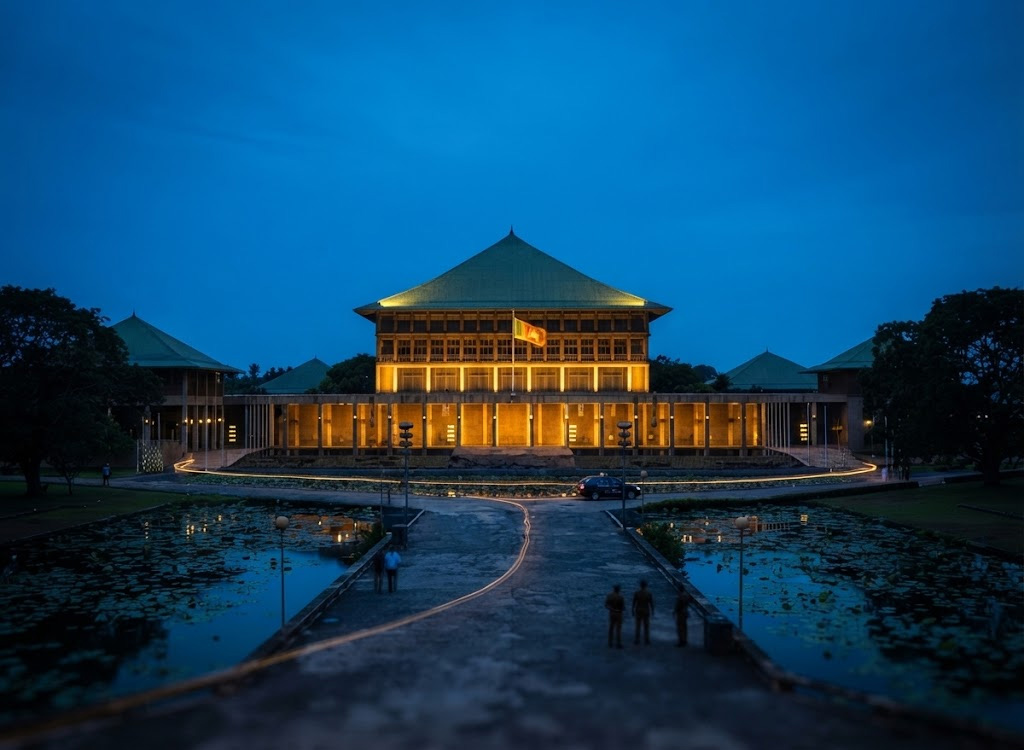
Parliament is due to hold a two-day debate on Thursday and Friday on the 22nd Amendment to the Constitution. Its central provision is modest: it would raise the retirement ages of the country’s senior judges by two years. Yet it drew 67 petitions to the Supreme Court, reported to be the highest number ever filed against a constitutional amendment in Sri Lanka, and it has placed the Bar Association of Sri Lanka, the main Opposition and a range of civil-society voices on one side of the argument, with the Government on the other.
Speaker Jagath Wickramaratne has received the Supreme Court’s determination on the Bill, which is due to be announced in the House on today (22). Its significance is procedural, but it is decisive. The Government maintains that the Bill needs only a two-thirds majority in Parliament, meaning the votes of at least 150 of the 225 members. Its critics argue that it must also be approved by the people at a referendum. If the Government is right, a vote could be held on Friday (25).
A Constitution built around the presidency
The Constitution now under repeated revision was promulgated on 7 September 1978, under President J. R. Jayewardene. It created the executive presidency, which has shaped Sri Lankan politics ever since, and most of the constitutional argument of the past five decades has been about how much power that office should hold.
The rules for changing the document are layered. Under Article 83, most provisions can be amended by a two-thirds majority of Parliament. A small set of entrenched provisions, including those on the unitary character of the State, the sovereignty of the people and the foremost place given to Buddhism, additionally require approval at a nationwide referendum. Before Parliament may vote on any amendment Bill, the Supreme Court is asked to say which route applies. That question is now at the heart of the 22nd Amendment.
The first decade: 1978 to 1988
Sixteen numbered amendments were made in the Constitution’s first 10 years, all of them during the Jayewardene presidency. The political analyst Rajan Philips, writing in the Colombo Telegraph last month, had observed that none of the 16 had a reformist purpose, and that many were ‘expedient, partisan and ad hominem’.
The Third Amendment (1982) allowed a sitting President to seek a fresh mandate after four years in office, and the Fourth (1982) extended the life of the first Parliament. The Sixth (1983), passed in the wake of the July 1983 violence, outlawed advocacy of a separate state. The 13th (1987), which grew out of the Indo-Lanka Accord, made Tamil an official language and established the Provincial Councils. It remains the most consequential, and the most contested, of the early amendments. The 14th and 15th (1988) enlarged Parliament to 225 members and lowered the threshold for representation. The 12th Amendment was never enacted, so the 21 numbered amendments correspond to 20 enacted changes.
Reform, reversal, repeat: 2001 to 2022
After a long gap, the character of the amendments changed. Each has since been, in large part, an answer to one question: how much power the President should hold, and who should be able to check it.
The 17th Amendment (October 2001), passed under President Chandrika Kumaratunga, was the first reformist measure. It curbed presidential powers without abolishing the presidency, and it created a Constitutional Council to oversee appointments to independent commissions. The 18th (September 2010), under President Mahinda Rajapaksa, undid much of that work. It removed the two-term limit on the presidency and replaced the Council with a Parliamentary Council whose role was purely advisory.
The 19th Amendment (28 April 2015) reversed the 18th. Passed by 215 votes to one, it restored the two-term limit, shortened the presidential term to five years, revived the Constitutional Council and strengthened the position of the Prime Minister. The 20th (22 October 2020), under President Gotabaya Rajapaksa, dismantled much of it again, restoring wide presidential powers, including the power to dissolve Parliament after one year. It passed by 156 votes to 65. The Supreme Court had found that some of its clauses, as drafted, would require a referendum, and the Bill went through with a two-thirds majority alone.
The 21st Amendment (21 October 2022) came in the aftermath of the economic collapse and the ousting of President Gotabaya Rajapaksa. Passed by 179 votes to one, it barred dual citizens from sitting in Parliament, restored the Constitutional Council, limited the President’s power to dismiss the Prime Minister and the Cabinet, and allowed Parliament to be dissolved only after two and a half years.
The amendments at a glance
| Amendment | Year | What it did |
| Sixth | 1983 | Outlawed advocacy of a separate state, following the violence of July 1983. |
| Thirteenth | 1987 | Made Tamil an official language and created Provincial Councils, following the Indo-Lanka Accord. |
| Seventeenth | 2001 | Curbed presidential powers and created the Constitutional Council to oversee independent commissions. |
| Eighteenth | 2010 | Removed the two-term limit on the presidency; replaced the Council with an advisory body. |
| Nineteenth | 2015 | Restored the two-term limit, cut the presidential term to five years and revived the Council (215 votes to one). |
| Twentieth | 2020 | Reversed much of the Nineteenth and restored wide presidential powers (156 votes to 65). |
| Twenty-first | 2022 | Barred dual citizens from Parliament and curbed presidential powers over the Cabinet (179 votes to one). |
| Twenty-second | Pending | Would raise the retirement ages of superior court judges; Parliamentary debate is due on 24 and 25 September 2026. |
The 22nd Amendment
The Bill was gazetted on 7 August 2026 and presented to Parliament on 18 August by the Justice Minister, Harshana Nanayakkara, together with a companion Judicature (Amendment) Bill. According to reports, the idea first appeared as a private member’s proposal by the MP Faiszer Musthapha, which reached Parliament’s Order Book in December 2025, before the Government adopted it as its own.
As summarised in the press, the Bill would raise the retirement age of Supreme Court judges from 65 to 67 and that of Court of Appeal judges from 63 to 65. The Chief Justice would retire at 67 or after six years in office, whichever comes first, and the maximum number of Court of Appeal judges would rise from 19 to 24. The Government presents the changes as a judicial-efficiency measure, aimed at clearing a heavy backlog of cases.
President Anura Kumara Dissanayake defended the proposal on 12 August. “I do not believe that meaningful change can take place without taking risks,” he said. He rejected claims that it was designed to benefit particular individuals, arguing that questions of timing arise in any judicial system, and he placed the Bill within wider judicial reforms that include new High Courts and additional prosecutors.
The objections are of two kinds. The first concerns judicial independence. The Bar Association of Sri Lanka, the Opposition Samagi Jana Balawegaya, Professor G. L. Peiris and many other petitioners have argued that changing the tenure of sitting judges leaves them beholden to the executive and the legislature. The UN Special Rapporteur on the independence of judges and lawyers, Margaret Satterthwaite, wrote to the Government on 7 August warning that applying the increase to serving judges ‘could raise concerns over executive and legislative interference’. The Leader of the Opposition, Sajith Premadasa, put it more bluntly.
The second objection is constitutional. Petitioners have argued that judicial independence is bound up with the sovereignty of the people, which Article 3 entrenches, and that the Bill therefore needs a referendum as well as a two-thirds majority. Lawyers for the Government have countered that the petitioners have failed to show how the amendment affects the people’s sovereignty.
Personalities have never been far from the debate. One analysis published by Jaffna Monitor had noted that Chief Justice Preethi Padman Surasena, who took office in July 2025, would reach 65 late this year under the present rules, and that because the Bill applies to sitting judges he could serve until the end of 2028. The Chief Justice headed the five-judge bench that heard the petitions on 1 and 2 September. Lawyers argued that he faced a conflict of interest, and a request for the petitions to be heard by all sitting judges was declined. However, there has also been warnings by some sections of the private bar that opponents risk weakening their case by attacking individual judges rather than the constitutional principle.
The larger promise
The debate also carries an uncomfortable comparison for the Government. The National People’s Power (NPP) pledged in its August 2024 manifesto to abolish the executive presidency, replacing it with a President without executive powers who would be appointed by Parliament, and to introduce a new constitution drafted through public discourse and approved at a referendum. It won a two-thirds majority in Parliament in November 2024, taking 159 of the 225 seats.
Yet in February 2026 Minister Nanayakkara noted that the Cabinet had set no timeline for those changes and had not yet discussed them. No drafting committee had been appointed. In the meantime, civil-society groups have begun their own consensus-building process, aiming to produce a draft by the end of 2027. Some have called the 22nd Amendment ‘not at all reformist’, while adding that it resembles the expedient amendments of the 20th century.
What happens next
The Supreme Court’s determination will be announced on Tuesday, and Parliament will debate the Bill on Thursday and Friday. The Opposition has said it will hold a mass demonstration at Parliament on Thursday (24) and plans nationwide protests if a referendum is ordered. The Health and Mass Media Minister, Nalinda Jayatissa, has said the Government is ready for either outcome. “If a two-thirds majority in Parliament is required, we are prepared to proceed accordingly, and if a referendum is required, we are prepared for that as well,” he has said.
A referendum would be a rare event. Sri Lanka has held only one, in December 1982, when voters approved the extension of the first Parliament’s term. Whichever route the Court has pointed to, the result will add another chapter to a Constitution that has now been revised more often than it has been rewritten.
Disclaimer: The views and opinions expressed in this article are those of the writer and do not necessarily reflect the official position of this publication.










Leave a comment