
By The Pulseline News Desk
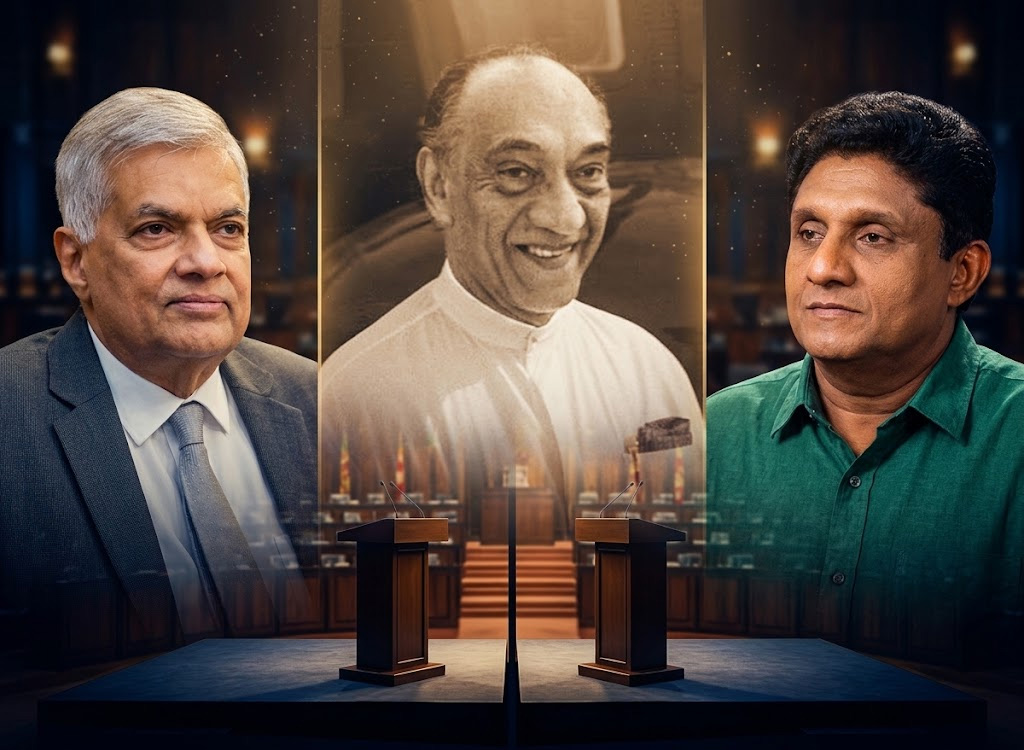
Sri Lanka’s political past and its possible lessons for the country’s future will come under the spotlight today (17), as former President Ranil Wickremesinghe and Opposition Leader Sajith Premadasa are set to share the same platform for a discussion centred on the governance philosophy of former President J.R. Jayewardene.
The event, organised by the D.S. Senanayake Political Academy Alumni Club (DSSPA Alumni Club), will be held under the theme “J.R., Governance and the Middle Path” at the National Library and Documentation Services Board auditorium in Colombo 7 at 2 p.m.
The participation of Wickremesinghe, leader of the United National Party (UNP), and Premadasa, leader of the Samagi Jana Balawegaya (SJB), gives the event an added political dimension, although the stated focus is on governance, political thought and Sri Lanka’s experience under the Jayewardene era.
Revisiting the J.R. Model
Few political transformations in post-independence Sri Lanka have had an impact as far-reaching as the changes introduced under J.R. Jayewardene.
After the UNP’s landslide victory in 1977, Jayewardene’s administration moved away from the country’s previous economic model and introduced an open economic policy. The period also saw major infrastructure and development initiatives, while the Executive Presidency became the central feature of the country’s political structure.
These changes fundamentally altered the relationship between the State, the economy and the private sector.
Decades later, however, the “J.R. model” remains a subject of competing interpretations.
Supporters have pointed to the opening of the economy, increased private-sector participation and large-scale development as major departures from the previous system. Critics, meanwhile, have questioned the social and political consequences of the economic reforms and the concentration of executive power.
It is against this historical backdrop that today’s discussion is expected to examine what, if anything, can be drawn from the Jayewardene era for Sri Lanka today.
Why the ‘Middle Path’ matters now
The reference to a “middle path” is particularly significant given the economic and geopolitical pressures confronting states today.
Sri Lanka’s recent economic crisis exposed the consequences of external vulnerabilities, fiscal pressures and policy instability. At the same time, the country remains dependent on international markets, foreign investment, trade, tourism and diplomatic relationships with competing global powers.
The organisers are therefore expected to explore whether a balanced approach to governance and economic policy can help a country navigate such pressures without becoming excessively dependent on any single economic or geopolitical model.
The discussion will also provide an opportunity to examine the relationship between economic liberalisation, state intervention and social welfare — issues that continue to shape political debates in Sri Lanka.
Ranil-Sajith presence adds political interest
The presence of Wickremesinghe and Premadasa on the same stage is likely to be closely watched beyond the historical discussion itself.
Both politicians have occupied prominent positions within the UNP tradition, although their political paths have diverged significantly in recent years. Wickremesinghe served as President during Sri Lanka’s post-2022 economic recovery period, while Premadasa currently leads the principal opposition party, the SJB.
Their participation in a discussion centred on J.R. Jayewardene — a political figure whose economic and constitutional legacy continues to influence Sri Lankan politics — provides an opportunity for the two leaders to address broader questions about governance and economic direction.
Whether the discussion remains primarily historical or develops into a debate about contemporary policy choices will be closely observed.








Leave a comment