
By The Pulseline News Desk
Chinese President Xi Jinping and U.S. President Donald Trump on Thursday unveiled what both sides described as a new vision for relations between the world’s two largest economies, signaling a cautious effort to stabilise ties after years of confrontation over trade, technology, and security.
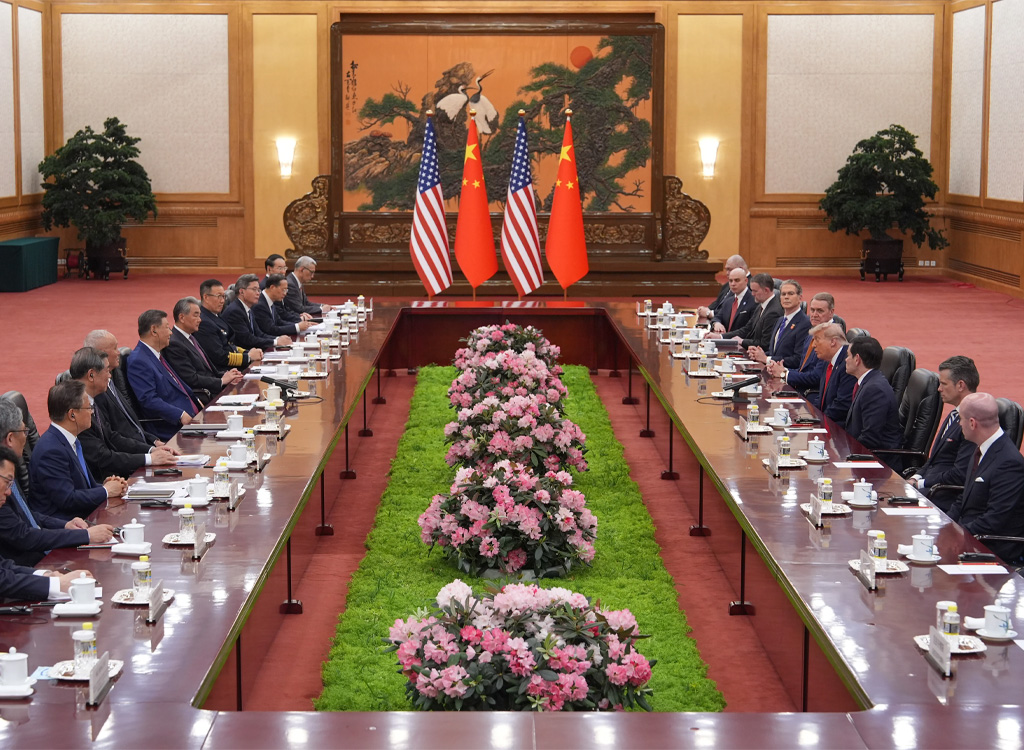
Meeting at the Great Hall of the People in Beijing, the two leaders pledged to pursue a relationship based on what Chinese officials called “constructive strategic stability,” a phrase analysts say reflects a mutual desire to prevent strategic competition from escalating into open conflict.
The summit, marked by ceremonial pageantry and unusually warm rhetoric, underscored the importance both governments now place on managing tensions amid mounting global uncertainty.
“We should be partners, not rivals,” Xi said during opening remarks, emphasising the need for cooperation between Beijing and Washington DC despite persistent differences on key geopolitical issues.
Trump echoed the conciliatory tone, describing his relationship with Xi as “strong” and expressing confidence that the two countries could expand economic cooperation while reducing friction in sensitive areas.
The meeting comes at a critical moment for bilateral relations. Over the past decade, the U.S. and China have clashed over tariffs, export controls, military activity in the Indo-Pacific, cybersecurity, and Taiwan. Those disputes have increasingly fueled concerns that strategic rivalry between the two powers could destabilise the global economy and security order.
Chinese officials portrayed Thursday’s discussions as a turning point, framing the new diplomatic language as an effort to redefine the relationship around competition that remains controlled and predictable rather than confrontational.
Despite the positive tone, significant differences remain unresolved.
Taiwan emerged as one of the summit’s most sensitive topics, with Xi warning that mishandling the issue could lead to “clashes and even conflicts,” according to Chinese state media. Beijing considers the self-governing island part of its territory and has repeatedly vowed reunification, while Washington DC continues to maintain military and political ties with Taipei.
Trade and technology were also central to the talks. Both sides indicated progress in negotiations aimed at easing some economic tensions that have disrupted global supply chains and strained commercial ties between American and Chinese companies.
Chinese officials said recent trade discussions had produced “positive outcomes,” while U.S. representatives highlighted potential cooperation in areas including energy, artificial intelligence, and counternarcotics efforts.
Business leaders from major American corporations accompanied portions of the visit, reflecting the deep economic interdependence that continues to bind the two nations despite growing geopolitical rivalry.
Analysts caution, however, that the apparent thaw may prove fragile.
Previous attempts to reset relations between Washington DC and Beijing have often collapsed under the pressure of domestic politics, military tensions, and competing strategic ambitions. Deep mistrust persists on both sides, particularly over Taiwan, semiconductor technology, and regional influence in Asia.
Still, Thursday’s summit suggested a growing recognition in both capitals that unmanaged competition carries serious risks.
For Xi, the meeting offered an opportunity to present China as a responsible global power seeking stability in an increasingly divided world. For Trump, the summit reinforced his long-standing emphasis on leader-to-leader diplomacy and economic dealmaking.
Whether the latest effort produces lasting change remains uncertain. But for now, both governments appear intent on replacing confrontation with cautious engagement, and signaling that even amid rivalry, dialogue remains possible.
(With input from news agencies)












Leave a comment