
By The Pulseline News Desk
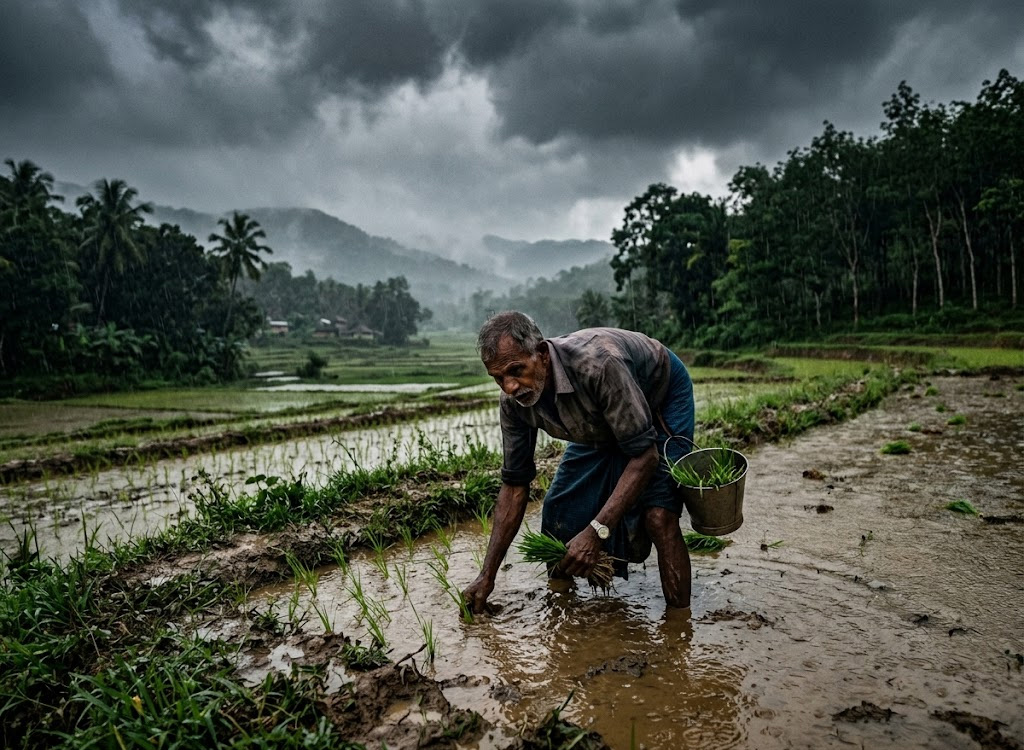
Sri Lanka’s farmers are heading into the crucial Maha cultivation season under a new layer of uncertainty, with stronger El Niño conditions, rising agricultural costs and the possibility of heavy rainfall threatening to disrupt food production and place further pressure on household budgets.
A new United Nations (UN) regional assessment has placed Sri Lanka among countries of “elevated concern”, warning that the combined impact of climate conditions and high input costs could create significant challenges for agricultural production in the months ahead.
The assessment indicates that rainfall could increase from October with the onset of the Second Inter-Monsoon. While additional rain would provide welcome relief to depleted reservoirs and improve water availability for cultivation, excessive rainfall could prove equally damaging.
Heavy downpours during the Maha planting period could result in flooding and waterlogging, disrupt field preparation and planting, and delay other agricultural activities.
For farmers already operating under tight financial conditions, the weather risk is being compounded by the continuing increase in the cost of production.
The UN report points to elevated fuel prices as one of the key concerns. Diesel prices remain above pre-Middle East crisis levels, while petrol prices are approximately 41% higher. Higher fuel costs feed directly into agricultural expenses, including land preparation, irrigation, machinery operations and transportation.
Sri Lanka’s dependence on imported agricultural inputs adds another vulnerability. Fertilizer costs remain exposed to international market conditions, while global wheat prices could also affect food costs and consumer prices.
The risks therefore extend well beyond the farm gate.
A poor Maha season, or even a season disrupted by excessive rainfall, could reduce supplies of key food commodities, increase dependence on imports and place renewed pressure on food prices at a time when the cost of living remains a major concern for households.
At the same time, insufficient rainfall would create a different set of problems, particularly for farmers dependent on irrigation reservoirs. Sri Lanka’s agricultural sector is consequently facing a narrow window in which both too little and too much rain could undermine production.
The Maha season is particularly important to the country’s food supply, making the coming months a critical test of Sri Lanka’s ability to manage climate risks while keeping agricultural production costs under control.
The UN assessment was jointly produced by the Food and Agriculture Organization (FAO), World Food Programme (WFP), UN Women, World Meteorological Organization (WMO) and other UN humanitarian agencies.
The warning comes as Sri Lanka continues its broader economic recovery, with authorities seeking to strengthen food security, rebuild agricultural production and contain inflation.
For policymakers, the challenge will be to ensure that the expected rainfall becomes an agricultural advantage rather than another economic shock.
That will require close monitoring of weather patterns, reservoir levels and crop conditions, while ensuring farmers have timely access to fertilizer, fuel and other essential inputs.
For consumers, meanwhile, the Maha harvest will matter for another reason: what happens in Sri Lanka’s fields over the next several months could eventually be reflected in the prices paid in markets and supermarkets.
With climate volatility increasingly becoming an economic issue, the success or failure of the coming Maha season could have consequences far beyond the country’s agricultural sector.












Leave a comment